Buying guide
The best filter for a 40 gallon tank
This is the size where the label and the arithmetic part company completely. Work out the number first, then read the shelf, and the shortlist gets very short.
Fin & Filter earns a commission when you buy through the links on this page. It costs you nothing and it does not decide what we rank. How we’re funded.
We have not used any of this gear. Every pick below is chosen from published manufacturer specifications and the arithmetic on how we pick, which you can re-run yourself.
A fully stocked 40 gallon community tank needs a filter rated about 343 GPH: 40 gallons times six turnovers is 240 GPH of real flow, divided by 0.7 for the throughput you lose to media and head height. The Seachem Tidal 75 at 350 GPH is the only common hang-on-back that clears that on its own. The Fluval C4 at 264 GPH is about 23% short of a full load and fine on a planted or lightly stocked tank. On a tank this size, two filters — a C4 at one end and an AquaClear 50 at the other — beat one filter for less money, and survive an impeller failure.
At 10 gallons the label and the arithmetic roughly agree. At 20 they part company. By 40 gallons they are barely acquainted: this is the size where filters are routinely sold for tanks they cannot filter to a community standard, because the number on the box assumes a few fish in a lightly stocked display rather than the stocked tank most people actually build. The whole method is on how we pick, and the short version is below.
The number, and where it comes from
Six turnovers an hour is the target for a stocked community tank. 40 gallons times six is 240 gallons an hour of real flow. Rated flow is measured with clean media and no head height, and a real filter loses roughly 30% of it to the media it is packed with and the lift back into the tank, so the rating you shop for is 240 divided by 0.7 — about 343 GPH.
| Filter | Rated GPH | Stated ceiling | vs 343 (stocked 40) | vs 286 (planted 40) |
|---|---|---|---|---|
| Seachem Tidal 75 | 350 | 75 gal | Clears it | Clears it |
| Fluval C4 | 264 | 70 gal | 23% short | 8% short |
| AquaClear 50 | 200 | 50 gal | 42% short | 30% short |
| Aqueon QuietFlow 30 | Not published | 45 gal | Unknown | Unknown |
| C4 + AquaClear 50 | 464 combined | — | Clears it | Clears it |
Flow and tank-range figures from the sources at the foot of this page. Required figures computed with the method on how we pick. A combined figure assumes two independent filters on the same tank, which is how most 40 gallon tanks over ten years old are actually running.
Note what the table does not contain: a long list of filters labeled for 40 gallons. That is not an oversight. Search the category and you will find plenty of them — what you will not find is published flow figures that support the claim, which is why how to size an aquarium filter is the page to read before you shop.
Quick picks
Filters that clear the figure, and the ones that need help
| # | Product | Best for | Price |
|---|---|---|---|
| 1 | 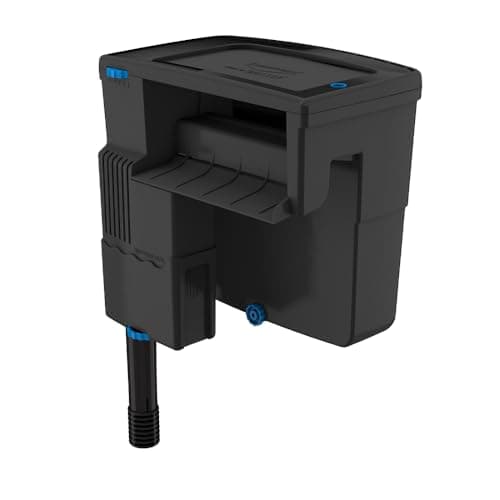 Seachem Tidal 75 Power Filter 350 rated GPH against the 343 this tank needs — the only single hang-on-back on this page that clears the figure outright. | A fully stocked 40 gallon community tank, on one filter | $69.50 on Amazon #ad How we’re funded · price as of September 25, 2026 |
| 2 | 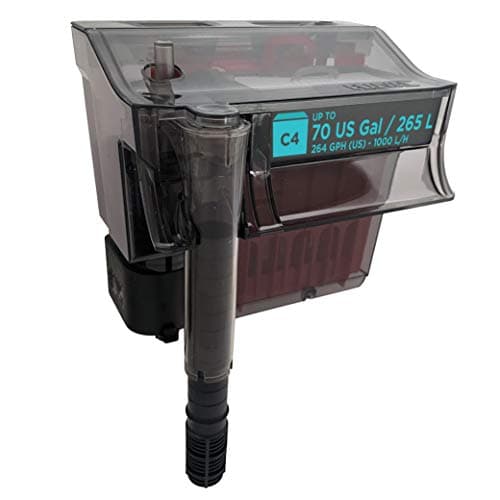 Fluval C4 Power Filter 264 GPH, five stages and a trickle chamber — short of a full community load on this tank, and fine on a light one. | A lightly stocked or planted 40, or as half of a two-filter setup | $54.37 on Amazon #ad How we’re funded · price as of September 25, 2026 |
| 3 | 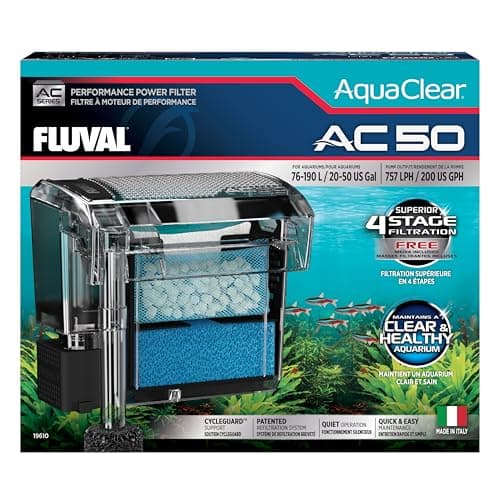 Fluval AquaClear 50 Power Filter 200 GPH of rinse-and-reuse media for a modest price — not a 40 gallon filter alone, and the cheapest way to finish one. | The second filter, at the other end of the tank | $59.25 on Amazon #ad How we’re funded · price as of September 25, 2026 |
| 4 | 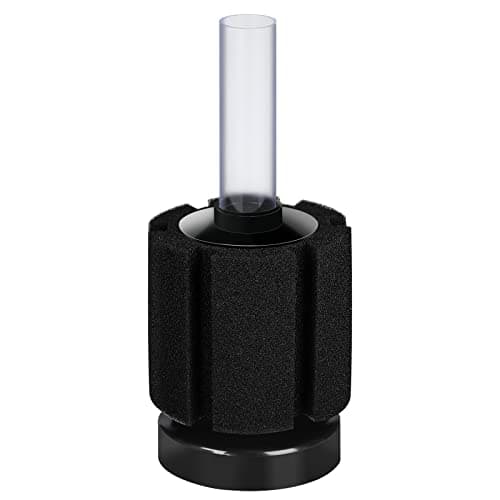 AQUANEAT Bio Sponge Filter (nano, up to 10 gallons) An air-driven sponge adds colonized surface area and redundancy for a few dollars, whatever hang-on-back you buy. | Cheap biological insurance and a gentler corner | $5.98 on Amazon #ad How we’re funded · price as of September 25, 2026 |
| ! | 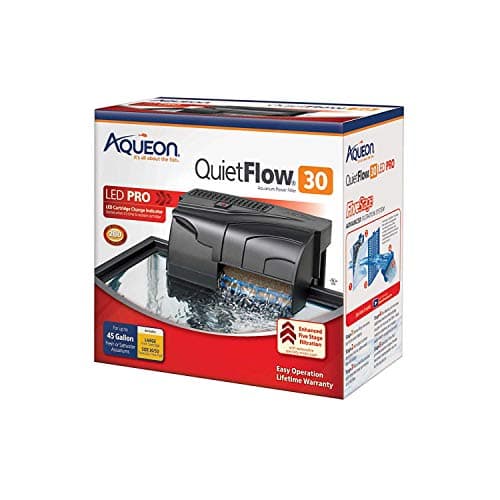 Aqueon QuietFlow 30 LED PRO Power Filter Sold for aquariums up to 45 gallons, with no published flow figure we can find to check that against. Skip this one — see why below | Not a 40 gallon tank, despite the number on the box |
Rows link to the full write-up further down this page. Prices come from the live price layer only; where there is no live figure the button reads “Check price” rather than showing a remembered number.
One big filter or two smaller ones
At 10 and 20 gallons this is an academic question. At 40 it is the actual decision, and two filters win on almost every axis except tidiness.
- Redundancy. One filter means one impeller between your fish and a stalled nitrogen cycle. Two means a failure is an inconvenience you notice at the weekend.
- Circulation. A 40 gallon tank is long. One outflow drives one end of it; two outflows at opposite ends move the whole water column and stop debris settling in the far corner.
- Maintenance that never costs you a cycle. Service one filter this month and the other next month, and there is always a fully colonized filter running.
- Cost. A Fluval C4 plus an AquaClear 50 is usually less than a single filter rated for twice the tank, and between them they clear the figure with margin.
- The downside, stated plainly. Two filters means two intakes, two power cords, more hardware hanging on the back glass and a slightly noisier tank.
What else changes at 40 gallons
Heating. Wattage follows volume and the lift over your coldest room temperature. A 40 gallon tank held at 78 °F in a room that bottoms out near 68 °F is a 10 degree lift, which at roughly 5 W per gallon means about 200 W. At this size two smaller heaters at opposite ends are worth considering, for the same redundancy reason as the filters, and because a single stuck-on heater has more water to overheat.
Water changes. A weekly 25% change on 40 gallons is 10 gallons. That is two full buckets each way, every week, forever — the point at which a faucet-driven water changer stops being a luxury and starts being the reason the routine survives the winter.
Stocking. More water is more forgiving of mistakes, which is the argument for a bigger tank in the first place — but it also invites the mistake of stocking to capacity in one trip. Add fish in groups over weeks, not in an afternoon; the reasoning is on adding fish to a new tank.
Pick 1
Seachem Tidal 75 Power Filter
A fully stocked 40 gallon community tank, on one filter
The number
Rated 350 US GPH for aquariums up to 75 US gallons, per Seachem. A 40 gallon community tank needs 343 rated GPH by our method, which this clears with about 2% to spare. A lightly stocked or planted 40 needs 286, which it clears comfortably.
Seachem publishes what most makers do not: a flow figure, a media volume, and a stated tank range you can check the flow against. 350 GPH and half a US gallon of media space is a real filter for this tank, not a label.
Two design details matter more here than on a small tank. The intake dial sets how much water comes from the surface skimmer rather than the intake, which is the cheapest way to deal with the protein film a stocked 40 gallon tank grows. And the maintenance alert on the lid rises when water is being redirected around clogged media, so you find out that flow has dropped before the fish tell you.
It is a basket filter, so the media is rinsed and reused rather than thrown away. On a tank this size that is the difference between a filter that costs nothing to run and one that costs a cartridge a month.
The honest costs. It is a big, tall unit and it is the most expensive hang-on-back here. Clearing 343 by 2% is clearing it, but it is not margin — if you stock heavily, plan on a second filter or a sponge. The surface skimmer is one more part to keep clear, and no heater, test kit or media upgrade is included.
| Rated flow | 350 US GPH (1500 L/h), per Seachem |
|---|---|
| Stated tank range | Up to 75 US gallons (300 L), per Seachem |
| Media volume | 0.50 US gallons (1.9 L) of media space |
| Flow control | A dial sets how much flow comes from the intake versus the surface skimmer |
| Maintenance | A blue alert rises on the lid when flow is being redirected around clogged media |
| What it does not do | It is a large, tall unit for a hang-on-back and it is priced accordingly. The surface skimmer is a genuine feature but it is also one more part to keep clear. No heater, no test kit, no substrate. |
Specs from Seachem, Tidal 75 product page (350 US GPH, up to 75 US gallons, 0.5 gal media volume, maintenance alert); Seachem Tidal 75 Gallon power filter, Amazon listing. We have not used this unit.
#ad How we’re funded · price as of September 25, 2026
Pick 2
Fluval C4 Power Filter
A lightly stocked or planted 40, or as half of a two-filter setup
The number
Rated 264 US GPH for 40 to 70 US gallons. A stocked 40 gallon tank needs 343, which this misses by about 23%. A lightly stocked or planted 40 needs 286, which it misses by about 8%.
The C4 is the filter our 30 gallon page recommends, and the reason it appears lower here is arithmetic rather than quality: the same 264 GPH that clears a 30 gallon tank falls short on a 40.
What it brings is filtration depth rather than flow. Two mechanical stages in series, a chemical stage, a Bio-Screen and a wet/dry trickle chamber, each serviceable on its own, plus a cleaning indicator that tells you when the pad needs rinsing. On a planted 40 gallon tank running a lower turnover target, that package is genuinely well matched.
It is also the obvious half of a two-filter setup. A C4 at one end and a second filter at the other clears the figure between them and gives you redundancy.
The honest costs. Stated for tanks up to 70 gallons, which our method says it cannot filter to a community standard — treat the top of that range as a light-stocking figure. Five stages means five things to buy again eventually, including the Bio-Screen. Noisier than a sealed filter because of the trickle chamber. No heater, no test kit.
| Rated output | 264 US GPH |
|---|---|
| Stated tank range | 40 to 70 US gallons |
| Filtration | Five stages: two mechanical, one chemical and two biological, each replaceable independently |
| Maintenance | Cleaning indicator that shows when the poly-foam needs rinsing |
| What it does not do | It is rated for 40 to 70 gallons, so on a 30 gallon tank it is deliberately oversized — which is how it clears our figure, and also why the flow needs turning down or baffling for anything long-finned. It is physically large on the back glass, and it is the most complex filter here to service, with five stages rather than one cartridge. No heater, no test kit. |
Specs from Fluval C4 Power Filter up to 70 US Gal, Fluval USA product page; Fluval C4 Power Filter, Amazon listing (264 GPH, 40-70 gal). We have not used this unit.
#ad How we’re funded · price as of September 25, 2026
Pick 3
Fluval AquaClear 50 Power Filter
The second filter, at the other end of the tank
The number
Rated 200 US GPH for 20 to 50 US gallons. Alone on a 40 gallon tank it delivers about 58% of the 343 required. Paired with the Fluval C4's 264 it puts the tank at 464 rated GPH, comfortably over the figure.
Nobody should buy this as the only filter on a 40 gallon community tank, and the listing's 50 gallon ceiling is exactly the kind of number this site exists to correct. As the second filter, it is the best value on the page.
Two filters on a tank this size is not belt and braces, it is the sensible configuration. The outflows sit at opposite ends so the whole tank circulates rather than one half of it. If an impeller seizes while you are at work, the other filter keeps the colony alive. And you can service one this week and the other next month without ever losing your biological filtration.
The media is the usual AquaClear basket: foam, BIOMAX and carbon, each replaceable on its own and none of it on a subscription.
The honest costs. On its own here it is 42% short, and we would rather say that plainly than sell it as a 50 gallon filter. It has no surface skimmer and no cleaning indicator. And two filters means two intakes to keep clear of debris.
| Rated output | 757 L/h (200 US GPH) maximum flow |
|---|---|
| Stated tank range | 20 to 50 US gallons / 76 to 190 L |
| Power draw | 5 W |
| Media | Four-stage: pre-filter mechanical capture, Bio-Foam, activated carbon and BIOMAX |
| Flow control | Adjustable |
| What it does not do | At 200 rated GPH it sits under the 257 our method asks for on a fully stocked 30 gallon community tank, and under the 214 a lightly stocked one wants. It is an open-basket filter, so it is cheaper to run than a cartridge model, but on a 30 gallon tank plan to pair it rather than rely on it alone. No heater, no test kit, no substrate. |
Specs from AquaClear 50 Power Filter, Fluval USA product page (200 GPH / 757 L/h, 20-50 US gal, 5 W, four-stage media); AC50 Power Filter 20-50 US Gal, Amazon listing. We have not used this unit.
#ad How we’re funded · price as of September 25, 2026
Pick 4
AQUANEAT Bio Sponge Filter (nano, up to 10 gallons)
Cheap biological insurance and a gentler corner
The number
Rated for tanks up to 10 gallons on its own, so on a 40 it is a supplement rather than a filter. It contributes biological surface area and water movement rather than measurable turnover.
Our 30 gallon page makes this argument and it holds at 40: the turnover figure is a proxy for two things, water movement and colonized surface area, and a sponge filter is almost pure surface area.
That is why a hang-on-back that is 20% short of the figure plus a sponge filter is a better-filtered tank than the flow numbers suggest. It is also why a quarantine or hospital tank can be started instantly by moving the sponge across.
On a 40 gallon tank it also creates a low-flow corner, which matters if you keep anything long-finned in a tank moving 350 gallons an hour.
The honest costs. It needs an air pump, airline and a check valve, none of which are in the box. It is visible inside the tank rather than hidden at the back. And it is a supplement here, not an answer: nothing about a nano sponge filters a 40 gallon tank on its own.
| Flow rating | Not published. Air-driven sponge filters carry no manufacturer GPH figure; output depends on the air pump you pair with it. |
|---|---|
| Filtration | Mechanical and biological. No chemical stage unless you add one. |
| Running cost | No cartridge. The sponge is rinsed in old tank water and reused. |
| What it does not do | No air pump, no airline and no check valve in most listings, so budget for all three. No chemical filtration, and there is no hiding it behind the hardscape. |
Specs from Fluval, AquaClear 20 product page (the hang-on-back flow comparison). We have not used this unit.
#ad How we’re funded · price as of September 25, 2026
Skip this
Aqueon QuietFlow 30 LED PRO Power Filter
Not a 40 gallon tank, despite the number on the box
The skip entry is not about build quality, it is about what you are being asked to buy on trust. The listing sells this filter for aquariums up to 45 gallons. Aqueon's own website does not respond to us, and we could not find a published GPH figure for it on any source that does, so there is no way to check that 45 against the 386 rated GPH our method asks for on a stocked 45 gallon tank.
For a 10 gallon tank a missing flow figure is survivable, because almost anything sold for a 10 clears 85 GPH. At 40 gallons the gap between a filter that clears 343 and one that does not is the difference between a stable tank and a nitrite spike, and a tank-size label is not evidence either way.
It is also a cartridge filter, so the recurring cost is a cartridge at a time when your tank needs the most media it will ever hold.
If you want an Aqueon on this tank, buy on a published flow figure or buy something that publishes one. Our review of the line is on the Aqueon QuietFlow LED PRO review.
| Stated tank size | Up to 45 gallons, per the Amazon listing |
|---|---|
| Type | Hang-on-back, cartridge-based |
| Feature | LED cartridge-change indicator, as on the smaller sizes |
| What it does not do | No published GPH figure from a source that loads for us, so none is printed. On a 40 gallon tank the stated range leaves no margin at all, and the cartridge remains a recurring purchase. No heater, no test kit. |
Specs from Aqueon QuietFlow 30 LED PRO Power Filter, Amazon listing (up to 45 gallons). We have not used this unit.
Whatever you buy, it arrives sterile. A filter converts no ammonia at all until the bacteria have grown in it, which takes weeks rather than days — start with how to cycle a fish tank, and if you are stepping up from a smaller tank, move the old filter's media across rather than starting from nothing.
Questions people actually ask
Frequently asked questions
+ What size filter do I need for a 40 gallon tank?
+ Is one filter enough for a 40 gallon tank?
+ Can I use a 30 gallon filter on a 40 gallon tank?
+ Do I need a canister filter for a 40 gallon tank?
+ How often should I clean a filter on a 40 gallon tank?
+ What filter comes with a 40 gallon starter kit?
Where the numbers came from
Sources
- Seachem, Tidal 75 product page (350 US GPH / 1500 L/h, up to 75 US gallons, 0.5 US gal media volume, intake/skimmer dial, maintenance alert)
- Seachem, Tidal filter comparison (flow rate and aquarium size for Tidal 35 / 55 / 75 / 110)
- Fluval C4 Power Filter up to 70 US Gal, Fluval USA product page (264 GPH, 40-70 gal, five-stage)
- AquaClear 50 Power Filter, Fluval USA product page (757 L/h / 200 US GPH, 20-50 US gal, 5 W)
- Aqueon QuietFlow 30 LED PRO Power Filter, Amazon listing (up to 45 gallons)
- Aquifarm, aquarium filter flow rate guidance (turnover multiples)
Read next
Related on Fin & Filter
The best filter for a 30 gallon tank
The 257 GPH figure a stocked 30 gallon needs, which filters clear it, and the tank-size label that misleads worst.
Canister vs hang-on-back filter
Hidden plumbing and more media, or a cheap box you service in five minutes. The honest comparison, at the sizes a beginner keeps.

How to size an aquarium filter
Tank gallons times turnover, divided by 0.7. The formula, worked examples, and the table for every common size.