Head to head
Canister vs hang-on-back filter
One is the upgrade everybody assumes they will eventually make. The arithmetic says most beginners should not, and the reason has nothing to do with how good canisters are.
Fin & Filter earns a commission when you buy through the links on this page. It costs you nothing and it does not decide what we rank. How we’re funded.
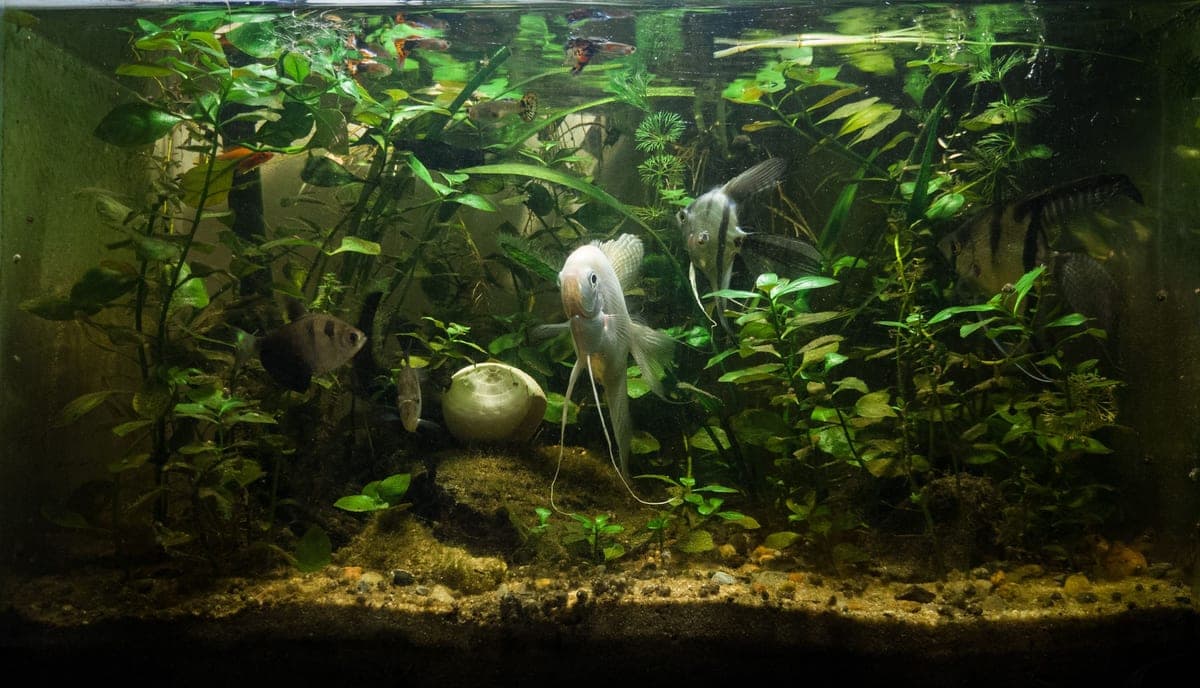
We have not used any of this gear. Every pick below is chosen from published manufacturer specifications and the arithmetic on how we pick, which you can re-run yourself.
For a first or second freshwater tank up to about 40 gallons, buy the hang-on-back. It costs a fraction of a canister, it is serviced in five minutes with a jug of tank water, and at these sizes it is not the limiting factor in whether your fish survive — your test kit and your water-change routine are. A canister earns its money when you want no equipment visible in the tank, when you are running a heavily stocked or planted tank that needs more media than a basket holds, or above roughly 55 gallons. What a canister does not do is make a small tank meaningfully more stable, and a cheap canister is worse than a mid-range hang-on-back at the same money.
This comparison gets asked in the wrong order. Most people ask which type is better, when the actual question is which type matches the tank they have and the maintenance they will realistically do. Both categories filter the same way — mechanical, then biological, with a chemical stage if you want one — and both are sold with tank-size labels that the flow figures do not support. What differs is where the box lives, how much media it holds, what it costs, and how a service session feels on a Sunday afternoon.
Quick picks
One of each, and the one to avoid
| # | Product | Best for | Price |
|---|---|---|---|
| 1 | 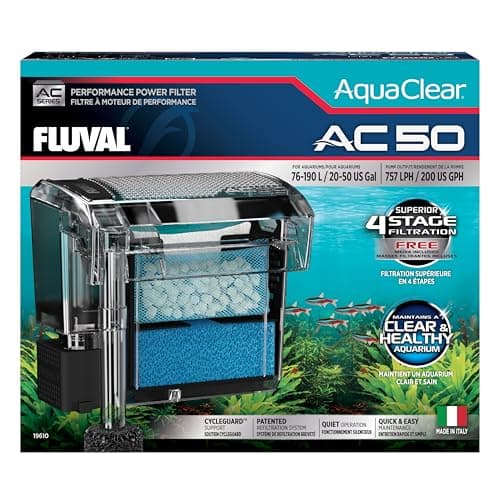 Fluval AquaClear 50 Power Filter 200 GPH of rinse-and-reuse media for a fraction of any canister's price, serviced in five minutes with a jug. | Almost every first and second tank | $59.25 on Amazon #ad How we’re funded · price as of September 25, 2026 |
| 2 | 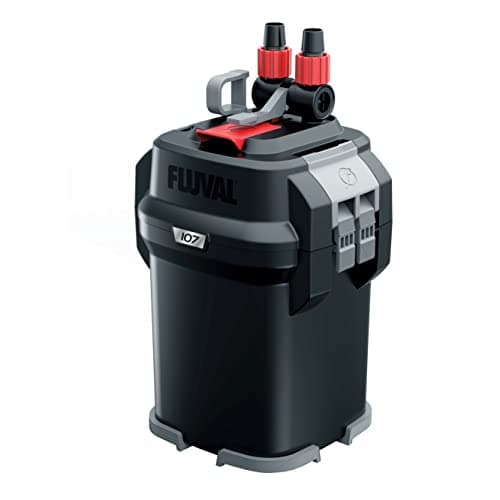 Fluval 107 Performance Canister Filter The mainstream small canister: everything but two pipes lives in the cabinet, with Fluval's media stack and a decent service design. | The canister to buy if you have decided you want one | $150.13 on Amazon #ad How we’re funded · price as of September 25, 2026 |
| 3 | 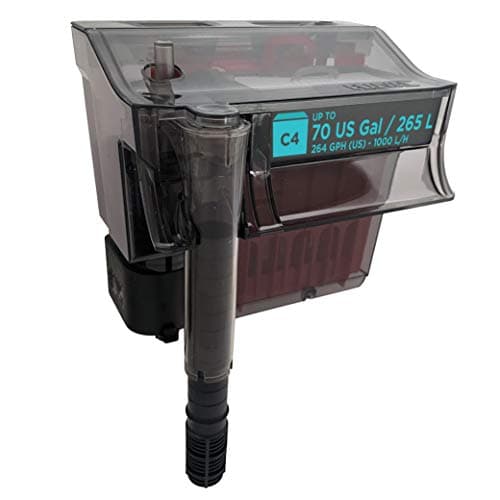 Fluval C4 Power Filter 264 GPH and five serviceable stages including a wet/dry trickle chamber — the answer to 'but a canister holds more media'. | The hang-on-back that closes most of the media gap | $54.37 on Amazon #ad How we’re funded · price as of September 25, 2026 |
| ! | 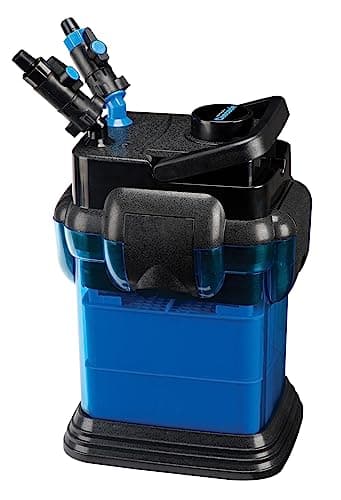 Penn-Plax Cascade 500 Canister Filter 115 GPH sold for tanks up to 30 gallons — a canister price for less flow than a mid-range hang-on-back. Skip this one — see why below | Not the way into canisters | $119.99 on Amazon #ad How we’re funded · price as of September 25, 2026 |
Rows link to the full write-up further down this page. Prices come from the live price layer only; where there is no live figure the button reads “Check price” rather than showing a remembered number.
The comparison, line by line
| Hang-on-back | Canister | |
|---|---|---|
| Where it lives | On the back glass, in view | In the cabinet, out of sight |
| Price at beginner sizes | A fraction of a canister | Several times a hang-on-back |
| Media volume | One basket | Stacked baskets, several times more |
| Service time | Minutes, with a jug | Unplumb, carry, open, rinse, reprime |
| Restart after a power cut | Refills itself as the pump runs | May need repriming |
| Failure mode | Stops filtering | Stops filtering, and hoses can leak onto the floor |
| Equipment in the tank | Intake tube | Intake and return pipes |
| Noise at the glass | Waterfall return | Quieter — the motor is in the cabinet |
| Sensible size range | Up to about 55 gallons | About 40 gallons and up |
Price positions are qualitative and relative; live prices are on each product card above. Size ranges are our recommendation, not a maker's claim.
Both categories overstate their tank ranges
It is tempting to assume the expensive format is the honest one. It is not. The Penn-Plax Cascade 500 is sold for tanks up to 30 gallons on 115 published GPH; a stocked 30 gallon tank needs about 257 rated GPH by our method. That is the same overstatement hang-on-back makers are criticized for, at three times the price.
So the rule does not change with the format: buy on published flow, not on the tank size printed on the box. The method, with worked examples, is on how to size an aquarium filter.
The maintenance difference is the one that decides it
A hang-on-back service is: lift the basket, squeeze the foam in a jug of old tank water, drop it back, done. It takes five minutes during a water change and nothing leaves the room.
A canister service is: close the valves, disconnect the head, carry a heavy tub of water to a sink or bucket, open it, rinse the baskets in old tank water, reassemble, reconnect, prime, and check for leaks. It is not hard. It is twenty minutes and a wet towel, and the honest observation from years of beginner forums is that canisters get serviced less often than hang-on-backs because of it.
When a canister is genuinely the right buy
- You want a tank with nothing visible in it. An aquascaped display with pipes tucked in a corner looks completely different to one with a box on the back. This is a real reason and nobody should apologize for it.
- You are running 55 gallons or more. Above that, hang-on-back options thin out fast and the flow figures stop keeping up.
- Your tank is heavily stocked or heavily planted. Media volume is the canister's real advantage, and those are the tanks that use it.
- The tank is in a quiet room. With the motor in the cabinet, the only noise at the glass is the return.
- You already know you will do the maintenance. If you have kept a tank for a year and never skipped a water change, you will service a canister too.
When it is the wrong buy
- A first tank of 40 gallons or less. The money does more good as a test kit, a heater and a second filter.
- A tank without a cabinet. A canister has to sit below the water line, on something that tolerates the occasional drip.
- A betta or shrimp tank. Gentle flow is the requirement, and a sponge filter does it for a few dollars — best sponge filters.
- A budget that only stretches to a cheap canister. At that price a mid-range hang-on-back filters better, as the skip entry above shows.
If your tank is at the top of the hang-on-back range and you are weighing options rather than formats, the size pages do the arithmetic for you: best filter for a 30 gallon tank, best filter for a 40 gallon tank and best filter for a 55 gallon tank. Whichever format you buy, it arrives with no bacteria in it and filters nothing biologically until you cycle the tank.
Questions people actually ask
Frequently asked questions
+ Is a canister filter better than a hang-on-back?
+ Do I need a canister filter for a 30 gallon tank?
+ Are canister filters harder to clean?
+ Can I run a canister and a hang-on-back together?
+ Do canister filters leak?
+ What size canister filter do I need?
Where the numbers came from
Sources
- Fluval 107 Performance Canister Filter, AquaCave listing reproducing Fluval's description (up to 30 US gal / 130 L, eTEC pump, media baskets, vertical pre-filter)
- Penn-Plax Cascade 500 Canister Filter, Amazon listing (115 GPH, up to 30 gallons, poly pads, bio-sponge, carbon)
- AquaClear 50 Power Filter, Fluval USA product page (757 L/h / 200 US GPH, 20-50 US gal, 5 W)
- Fluval C4 Power Filter up to 70 US Gal, Fluval USA product page (264 GPH, 40-70 gal, five-stage)
- Aquifarm, aquarium filter flow rate guidance (turnover multiples)
Read next
Related on Fin & Filter
The best filter for a 40 gallon tank
343 rated GPH is the target. One hang-on-back clears it, one gets close, and two filters beat one on a tank this size.
AquaClear Power Filter review
The media basket, the flow control range Fluval actually publishes, and the buyer who should pick a cartridge filter instead.

How to size an aquarium filter
Tank gallons times turnover, divided by 0.7. The formula, worked examples, and the table for every common size.