Model review
AquaClear Power Filter review
An open media basket instead of a disposable cartridge, and a flow control that genuinely reaches down to a third of maximum. Here is what that is worth, and what it costs you in exchange.
Fin & Filter earns a commission when you buy through the links on this page. It costs you nothing and it does not decide what we rank. How we’re funded.
We have not used any of this gear. Every pick below is chosen from published manufacturer specifications and the arithmetic on how we pick, which you can re-run yourself.
Yes, for most beginners. The AquaClear's open media basket means you rinse and reuse the surfaces your bacteria live on instead of throwing them away on a schedule, which is cheaper over the life of a tank and much safer for your cycle — and Fluval's own CycleGuard guidance tells you to change only one media insert at a time. The flow control is real rather than token: Fluval publishes 100 GPH down to 33 GPH on the AquaClear 20. Buy a cartridge filter instead only if you want a filter that asks nothing of you.
This is the filter recommended most often across this site, which makes it the one that most deserves a page explaining what it actually is rather than how it compares to something else. We have not used these units and do not claim to have. What follows is Fluval's published specification, the site's own turnover arithmetic applied to it, and the characteristics keepers consistently report.
Quick picks
The three sizes, and what they actually cover
| # | Product | Best for | Price |
|---|---|---|---|
| 1 | 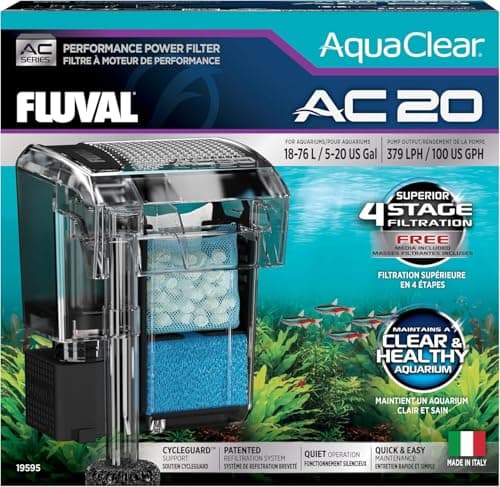 Fluval AquaClear 20 Power Filter 100 GPH at the top, 33 GPH at the bottom. That span is the reason it works on tanks a fixed-output filter cannot. | A 10 gallon tank, and the only model here with a published minimum flow | $41.99 on Amazon #ad How we’re funded · price as of September 14, 2026 |
| 2 | 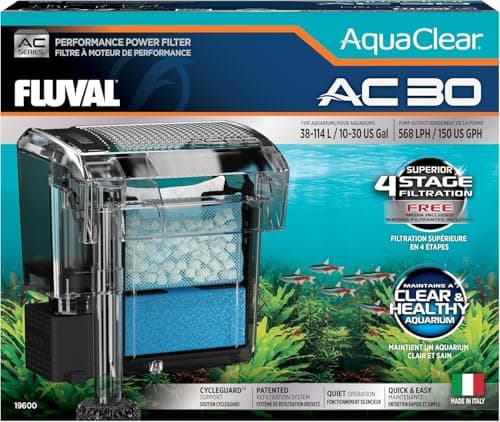 Fluval AquaClear 30 Power Filter 150 GPH with the same basket and the same media policy, and the size that covers the widest range of beginner tanks. | The most useful size in the line for a first or second tank | $49.99 on Amazon #ad How we’re funded · price as of September 14, 2026 |
| 3 | 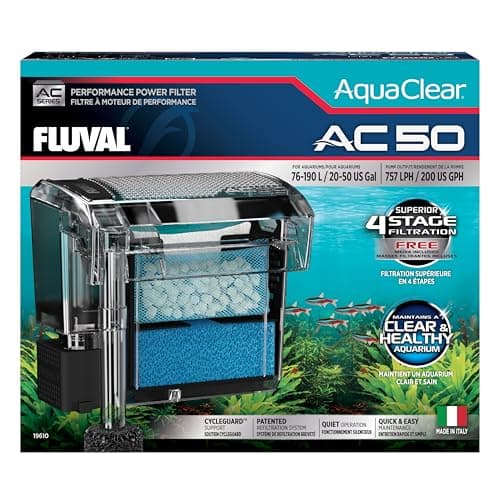 Fluval AquaClear 50 Power Filter 200 GPH and the same four-stage basket — short of a fully stocked 30 gallon on its own, and cheap to run for years. | A 30 gallon tank, with a sponge filter alongside it | |
| 4 | 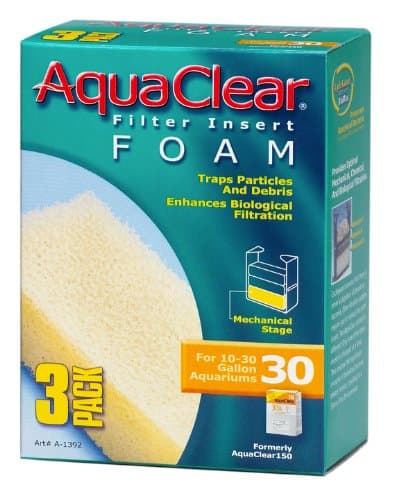 Fluval AquaClear 30 Foam Inserts, 3-Pack A foam block you rinse and reuse for years, sold for a few dollars — the whole running-cost argument in one part. | The reason this filter is cheap to own rather than cheap to buy | $4.99 on Amazon #ad How we’re funded · price as of September 14, 2026 |
| ! | 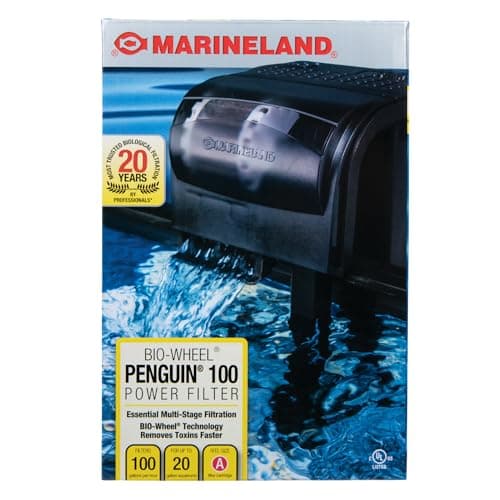 Marineland Penguin 100 Bio-Wheel Power Filter If you want a filter you never think about, a cartridge model is the honest recommendation instead. Skip this one — see why below | The buyer an AquaClear is genuinely wrong for |
Rows link to the full write-up further down this page. Prices come from the live price layer only; where there is no live figure the button reads “Check price” rather than showing a remembered number.
What the basket actually buys you
Every filter on the shelf holds media. The difference is whether that media is yours or the manufacturer's, and whether servicing it costs you your bacteria colony.
A cartridge filter combines the mechanical, chemical and biological stages into one disposable frame and prints a replacement schedule on the box. An AquaClear gives you an open chamber that ships with a pre-filter sponge, Bio-Foam, BIOMAX ceramic and activated carbon — four separable stages you service on four different timetables. Fluval states the filtration volume is up to seven times larger than comparable filters, and that a patented refiltration system recirculates water through the media at reduced flow to prolong contact time.
| AquaClear basket | A typical cartridge filter | |
|---|---|---|
| What holds the bacteria | Foam and ceramic you keep | A cartridge you discard |
| Routine service | Rinse foam in old tank water, replace nothing | Replace the cartridge on a schedule |
| Effect on the cycle | Colony survives the service | Colony leaves with the cartridge |
| Running cost | Effectively nothing for years | A recurring purchase, forever |
| Manufacturer's own guidance | CycleGuard: change one insert at a time | Replace the whole cartridge |
| Setup effort | Choose and stack the media | Slide it in |
| Chemical stage | Optional — use carbon or do not | Built into the cartridge whether you want it or not |
Media contents, the refiltration claim and the CycleGuard guidance are Fluval's own, cited at the foot of this page.
That CycleGuard row is worth dwelling on, because it is rare. Most of this category sells you a consumable and schedules its replacement. Fluval brands the opposite behavior and tells you to stagger changes so the colony stays intact — which is the same argument this site makes on the best aquarium filter media, except here it comes from the manufacturer.
The flow control, and why it is the underrated feature
Adjustable flow appears on a lot of spec sheets and usually means very little. On the AquaClear it is published as a figure, which lets you check it: Fluval states the AquaClear 20 runs from 100 GPH at maximum down to 33 GPH on full flow control.
A span of roughly a third to full changes what the filter can be used for. A fixed-output 100 GPH unit on a 5 gallon betta tank is about twenty turnovers an hour and will pin a long-finned fish against the glass. The same unit turned down is a usable nano filter. That single capability is why this line appears on our betta and 5 gallon pages at all.
Sizing it honestly against the arithmetic
This is where a review earns its keep, because the stated tank range on the box and the flow a stocked tank needs are not the same claim. Our method takes the turnover a tank needs and divides by 0.7, because rated flow is measured with empty media and no head height.
| Model | Max GPH | Fluval's stated range | Clears a 10 gal (85) | Clears a 20 gal (170) | Clears a 30 gal (257) |
|---|---|---|---|---|---|
| AquaClear 20 | 100 | 5-20 gallons | Yes | No — 41% short | No |
| AquaClear 30 | 150 | 10-30 gallons | Yes | No — 12% short (clears 5x at 143) | No |
| AquaClear 50 | 200 | 20-50 gallons | Yes | Yes | No — 22% short |
Required figures computed with the method on how we pick. Flow and range figures are Fluval's own, cited below.
Read down the right-hand column and the pattern is consistent: every model in this line falls short at the top of its own stated range. That is not dishonesty on Fluval's part so much as an industry convention — the top of a stated range assumes light stocking, and most beginners do not stock lightly. Once you know that, the label becomes readable rather than misleading.
Practically, it means sizing up. Buy the AquaClear 20 for a 10 gallon tank, the 30 for a lightly stocked 20, and the 50 for a planted 30 — or pair any of them with a sponge filter, which is our standing recommendation on 20 gallon and 30 gallon tanks and costs less than stepping up a model.
Pick 1
Fluval AquaClear 20 Power Filter
A 10 gallon tank, and the only model here with a published minimum flow
The number
Fluval publishes maximum output 100 US GPH and full flow control down to 33 GPH, for 5-20 US gallons at 6 watts. A 10 gallon community tank needs 85 rated GPH by our method, which the top of that range clears.
This is the model to understand first, because it is the one whose published numbers let you see what the flow control is actually worth. Fluval states a maximum output of 100 US GPH and a full flow control figure of 33 GPH — so the dial covers roughly a third of maximum to full, not the token adjustment most filters offer.
On a 10 gallon community tank that span brackets the requirement neatly. Our method asks for 85 rated GPH at six turnovers, and at full output this clears it with room. That is why it is our standing pick at that size.
The span matters more at the bottom end. On a 5 gallon betta tank, a fixed 100 GPH filter is roughly twenty turnovers an hour and pins the fish. Turned down, the same unit becomes usable — though note the arithmetic honestly: at its absolute minimum of 33 GPH it sits just under the 36 to 43 rated GPH a 5 gallon tank asks for, so you run it somewhere in the middle of the dial for a betta rather than at the floor.
The honest costs. Fluval's stated range runs to 20 gallons, and a 20 gallon community tank needs 170 rated GPH by our method — so the top of the stated range is a light-stocking figure, not a recommendation. It hangs off the back, so the tank cannot sit flush to a wall. And it asks a small setup decision a cartridge filter does not: what goes in the basket, and in what order.
| Rated output | 378 L/h (100 US gal./h) |
|---|---|
| Stated tank range | 18-76 L (5-20 US gallons) |
| Power draw | 6 watts |
| Media | Pre-filter sponge, Bio-Foam, BIOMAX, activated carbon |
| Flow control | Adjustable |
| What it does not do | No heater, no test kit and no substrate. The flow knob helps but does not turn it into a betta filter on its own; a pre-filter sponge or a baffle is still the usual fix. |
Specs from Fluval, AquaClear 20 Power Filter product page. We have not used this unit.
#ad How we’re funded · price as of September 14, 2026
Pick 2
Fluval AquaClear 30 Power Filter
The most useful size in the line for a first or second tank
The number
Fluval publishes 568 L/h (150 US GPH) for 38-114 L (10-30 US gallons). Listings reproducing Fluval's spec sheet give a full flow control figure of 50 GPH. Against our method it clears a 20 gallon tank at 5x (143 rated) and sits about 12% under the 6x figure of 170.
If someone asked which single AquaClear to own, this is it. It covers a 10 gallon tank comfortably, a lightly stocked or planted 20 gallon properly, and it is the unit we pair with a sponge filter on a fully stocked 20.
The published figure is 568 L/h, which is 150 US GPH, across a stated range of 10 to 30 US gallons. Listings that reproduce Fluval's specification sheet give the flow control minimum as 50 GPH — the same roughly one-third span as the smaller model, though we could not confirm that figure on a Fluval-hosted page directly.
What it does not do is clear a full community load on a 20 gallon tank on its own, and we say so on every page where it appears. At 150 rated GPH against the 170 our arithmetic asks for, it is about 12% short. That is not a reason to avoid it — it is a reason to add a sponge filter rather than pretend the gap is not there.
The honest costs. The 12% shortfall at the top of typical beginner stocking is the main one. Published wattage differs slightly between sources we checked (Fluval's own page gives 7 W at 120 V; some listings give 6 W), which is a small discrepancy but worth flagging rather than smoothing over. Same hang-on-back clearance requirement, same basket-loading decision.
| Rated output | 568 L/h (150 US gal./h) |
|---|---|
| Stated tank range | 38-114 L (10-30 US gallons) |
| Power draw | 7W at 120 V / 60 Hz |
| Media | Pre-filter sponge, Bio-Foam, BIOMAX, activated carbon |
| What it does not do | No heater, no test kit, no substrate. At full rated output this is more flow than a betta or a shrimp tank wants, so the flow control is not optional there. |
Specs from Fluval, AquaClear 30 Power Filter product page. We have not used this unit.
#ad How we’re funded · price as of September 14, 2026
Pick 3
Fluval AquaClear 50 Power Filter
A 30 gallon tank, with a sponge filter alongside it
The number
Fluval publishes 757 L/h (200 US GPH) for 20-50 US gallons at 5 W. A 30 gallon community tank needs 257 rated GPH by our method, so this is about 22% short at 6x and marginally short of the 214 a lightly stocked tank wants.
The large model in the beginner-relevant part of the line, and the one whose stated range overstates its reach most clearly. Fluval publishes 200 US GPH for tanks of 20 to 50 gallons at 5 watts.
Run that against the arithmetic and the picture is familiar. A fully stocked 30 gallon community tank wants 257 rated GPH, so this is roughly a fifth short; a lightly stocked or planted 30 wants 214, which it also misses, narrowly. At the top of its stated 50 gallon range it is not close.
None of which makes it a poor filter. On a planted 30 with a modest fish load it is a good choice, and paired with a sponge filter on a busier tank it is our standing recommendation at that size. The media economics are the same as the rest of the line, which over the years a tank runs is the larger number.
The honest costs. The stated range is the most optimistic in the line relative to what the arithmetic supports, so read 50 gallons as a very light stocking figure. We did not find a published full flow control minimum for this model on the sources we could reach, so unlike the smaller two we cannot tell you how far down it dials. It is physically the largest of the three on the back glass.
| Rated output | 757 L/h (200 US GPH) maximum flow |
|---|---|
| Stated tank range | 20 to 50 US gallons / 76 to 190 L |
| Power draw | 5 W |
| Media | Four-stage: pre-filter mechanical capture, Bio-Foam, activated carbon and BIOMAX |
| Flow control | Adjustable |
| What it does not do | At 200 rated GPH it sits under the 257 our method asks for on a fully stocked 30 gallon community tank, and under the 214 a lightly stocked one wants. It is an open-basket filter, so it is cheaper to run than a cartridge model, but on a 30 gallon tank plan to pair it rather than rely on it alone. No heater, no test kit, no substrate. |
Specs from AquaClear 50 Power Filter, Fluval USA product page (200 GPH / 757 L/h, 20-50 US gal, 5 W, four-stage media); AC50 Power Filter 20-50 US Gal, Amazon listing. We have not used this unit.
Pick 4
Fluval AquaClear 30 Foam Inserts, 3-Pack
The reason this filter is cheap to own rather than cheap to buy
The number
Sold as the replacement insert for the AquaClear 30. Fluval's CycleGuard guidance directs changing one of the three media inserts at a time so bacteria levels remain stable.
This is the part that decides what an AquaClear costs to own, and it is worth more attention than the filter body.
The foam does two jobs. It catches debris mechanically, and once colonized it carries the largest share of the nitrifying bacteria in the filter. That second job is why it should be rinsed in old tank water and put back rather than replaced — the brown gunk in it is the filter working, not dirt.
Fluval's own guidance backs this up, which is unusual and worth noting. The company brands the staggered approach CycleGuard and directs changing one of the three media inserts at a time so that bacteria levels remain stable and biological filtration stays continuous. That is the manufacturer telling you not to replace everything at once — the exact opposite of the monthly whole-cartridge schedule printed on most competing filters.
The honest costs. It is sized to one filter family, so an AquaClear 30 insert does not fit an AquaClear 50 — check the model before ordering. And the real warning is behavioral: if you are buying foam on a monthly schedule you have imported the cartridge habit into a filter designed to avoid it. Foam gets replaced when it physically falls apart, which takes years.
| Stage | Mechanical, and the main bacterial surface in an AquaClear basket |
|---|---|
| Fits | AquaClear 30 (sold as the 30-gallon insert) |
| Service | Rinsed in old tank water and reused; replaced only when it falls apart |
| What it does not do | This is a consumable you should be buying far less often than a cartridge. If you are replacing foam monthly you are throwing away the colony rather than maintaining it. Sized to one filter family, so check your model before ordering. |
Specs from AquaClear A1392 30-Gallon Foam Inserts 3-Pack, Amazon listing. We have not used this unit.
#ad How we’re funded · price as of September 14, 2026
Skip this
Marineland Penguin 100 Bio-Wheel Power Filter
The buyer an AquaClear is genuinely wrong for
The skip entry on a review should say who the reviewed product is wrong for, and for the AquaClear that answer is specific.
The open basket is the filter's biggest advantage and its only real demand on the owner. You choose what goes in it, you stack it in the right order, and you service the stages on different schedules. That is a small amount of thinking, and for most people it is repaid many times over in running cost and cycle stability. For some people it is friction they will not accept, and that is a legitimate preference rather than a failure.
If that is you, a cartridge filter is the honest alternative. The Penguin 100 is rated 100 GPH for tanks up to 20 gallons, with three-stage filtration and a rotating Bio-Wheel that provides a genuine wet/dry biological surface. You slide a cartridge in, and there is no decision to make.
Be clear about the trade, though. You will buy cartridges for as long as you own it, and each replacement discards live filtration unless you run the old and new together for a few weeks. At 100 rated GPH it is also a light-stocking filter on anything approaching a 20 gallon community tank, where our method asks for 170.
The other honest costs: the Bio-Wheel is noisier than a sealed hang-on-back, and a wheel that stalls or dries out contributes nothing while looking exactly like one that works.
| Rated flow | 100 GPH |
|---|---|
| Stated tank size | Up to 20 gallons |
| Filtration | Three-stage: mechanical, biological and chemical, with a rotating Bio-Wheel |
| Line range | 75 / 100 / 150 / 200 / 350 GPH across the Penguin range |
| What it does not do | The Bio-Wheel is a real wet/dry surface, but it also makes the filter noisier than a sealed hang-on-back, and a stalled or dried-out wheel does nothing at all. Cartridge-based. No heater, no test kit. |
Specs from Marineland Penguin 100 Bio-Wheel, Amazon listing. We have not used this unit.
What keepers consistently report
These are not manufacturer specifications and we have not measured them, so treat them as reported experience rather than tested fact. They come up often enough across keeper communities to be worth knowing before you buy.
- Restarting after a power cut. The most commonly raised AquaClear characteristic. Some units resume on their own and some need the impeller nudged, and the difference is usually a dirty impeller well or a water level that has dropped below the intake. Clean the impeller assembly periodically and keep the level up, and this mostly stops being a problem.
- The basket lifting. As the foam loads with mulm, water starts finding its way around the media rather than through it, and the basket can float slightly. It is a signal that the foam needs a rinse rather than a fault.
- Impeller noise with age. Long-running units are reported to get noisier as the impeller shaft wears, and replacing that part is the usual fix rather than replacing the filter.
- Media stacking order matters. Coarse foam at the bottom where the water enters, then finer media above it. Reversed, the fine media clogs immediately.
The common thread is that all four are maintenance items rather than design faults, and all four are cheap to address. That is a reasonable trade for a filter with no cartridge bill.
Who should buy something else
Three honest cases. If you want a filter that asks nothing of you, buy a cartridge model and accept the running cost — that is a legitimate preference and the skip entry above covers it.
If you keep a betta, shrimp or fry and want the gentlest possible filtration, a sponge filter beats a turned-down AquaClear on that specific axis, and costs a fraction as much: best sponge filters.
And if your tank sits flush against a wall or inside cabinetry with no clearance behind it, a hang-on-back of any brand is the wrong form factor. An internal filter solves that — see best filter for a 5 gallon tank for the nano version of that problem.
For everyone else, this is the filter we point at most often, and the reason is not performance — it is that servicing it does not cost you your cycle. Whichever you choose, a new filter is sterile on the day it arrives and converts no ammonia at all until you cycle the tank. The head-to-heads are on AquaClear vs Aqueon QuietFlow and AquaClear vs Penguin Bio-Wheel.
Questions people actually ask
Frequently asked questions
+ Is the AquaClear a good filter?
+ What size AquaClear do I need?
+ How far down does the AquaClear flow control go?
+ How often should I replace AquaClear media?
+ Why won't my AquaClear restart after a power outage?
+ Is an AquaClear 30 enough for a 20 gallon tank?
Where the numbers came from
Sources
- Fluval, AquaClear 20 Power Filter — published output, tank range and media
- AquaClear 20 with media, Aquarium Connection listing reproducing Fluval's spec sheet (100 GPH max, 33 GPH full flow control, 6 W, media list, refiltration and CycleGuard claims)
- Fluval, AquaClear 30 Power Filter — published output, tank range and power draw
- AquaClear 30 Power Filter listing (568 L/h / 150 US GPH, 10-30 US gal, included media)
- AquaClear 50 Power Filter, Fluval USA product page (757 L/h / 200 US GPH, 20-50 US gal, 5 W)
- AquaClear A1392 30-Gallon Foam Inserts 3-Pack, Amazon listing
- Marineland Penguin 100 Bio-Wheel — Amazon listing (rated flow, line range)
- Aquifarm, aquarium filter flow rate guidance (turnover multiples)
Read next
Related on Fin & Filter
AquaClear vs Penguin Bio-Wheel
Rinse-and-reuse media versus a replaceable cartridge with a Bio-Wheel. The deciding criterion, and the running cost.
The best aquarium filter media
Mechanical, biological and chemical — what each stage does, the order to stack them, and the cartridge habit to break.
The best filter for a 20 gallon tank
Why filters labeled for 20 gallons come up short on a stocked community tank, and the cheap fix that works.