Model review
Marineland Penguin Bio-Wheel review
A cartridge filter with one feature nothing else in its class has: a rotating wet/dry wheel that carries its own bacteria colony and, by the maker's own instructions, is never replaced. Here is what that is worth, and the sizing trap the model numbers set.
Fin & Filter earns a commission when you buy through the links on this page. It costs you nothing and it does not decide what we rank. How we’re funded.
We have not used any of this gear. Every pick below is chosen from published manufacturer specifications and the arithmetic on how we pick, which you can re-run yourself.
The Penguin is the cartridge filter to buy if you want a biological stage that survives cartridge changes: its rotating wet/dry Bio-Wheel carries its own bacteria colony and, by Marineland's own instructions, is never replaced and never cleaned. Size it by the arithmetic rather than the model number — the Penguin 100 for a 10 gallon tank and the Penguin 200 for a 20 — because every model in the line is named for a tank it does not quite clear on a full community load. A slowed or stained wheel is normal; a stopped one usually means mineral deposits on the bearings.
This is the third of the three hang-on-back filters a beginner is most likely to be choosing between, after the AquaClear and the Tetra Whisper IQ, and it is the one with the most distinctive design. We have not used these units and do not claim to have. What follows is Marineland's published specification and instructions, the site's own turnover arithmetic applied to them, and a fair account of the wheel's real strengths and its real failure modes.
Quick picks
The line, and what each size actually suits
| # | Product | Best for | Price |
|---|---|---|---|
| 1 | 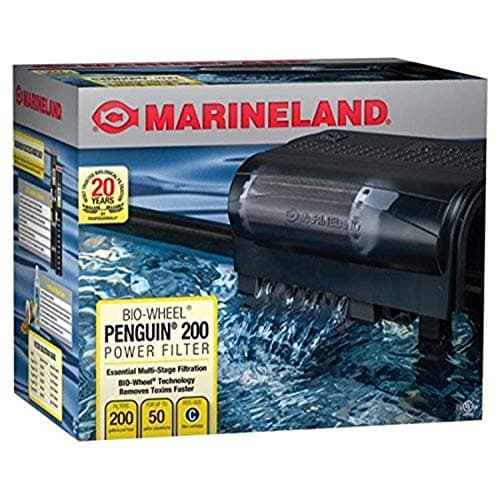 Marineland Penguin 200 Bio-Wheel Power Filter 200 GPH clears the 20 gallon figure outright with margin to spare — the model to buy for that tank, not the one named for it. | A fully stocked 20 gallon tank | $41.43 on Amazon #ad How we’re funded · price as of September 18, 2026 |
| 2 | 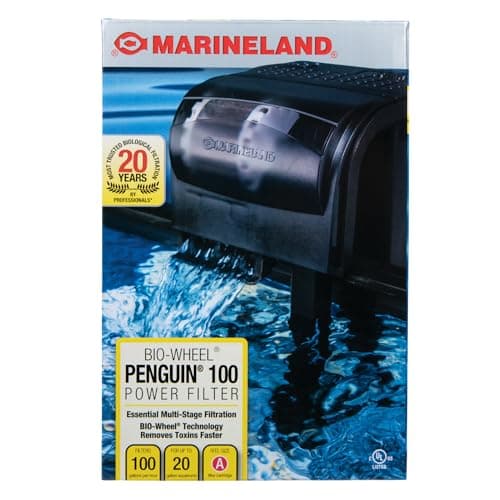 Marineland Penguin 100 Bio-Wheel Power Filter 100 GPH on a 10 gallon tank clears our method with an 18% margin, and it is the cheapest Penguin that does. | A 10 gallon tank — the model that clears the figure, not the one named for it | |
| 3 | 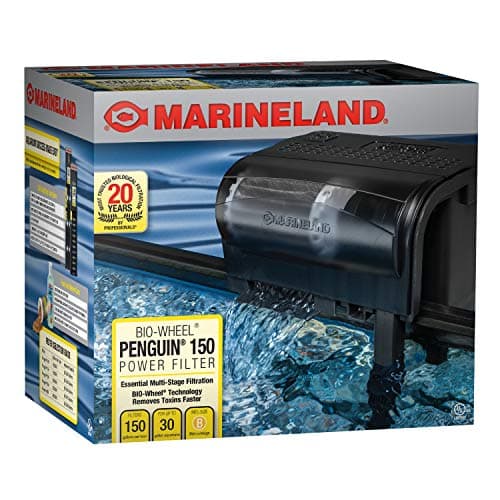 Marineland Penguin 150 Bio-Wheel Power Filter 150 GPH clears the 5x target for a planted 20 and sits about 12% under a full community load. | A lightly stocked or planted 20 gallon tank | $42.75 on Amazon #ad How we’re funded · price as of September 18, 2026 |
| 4 | 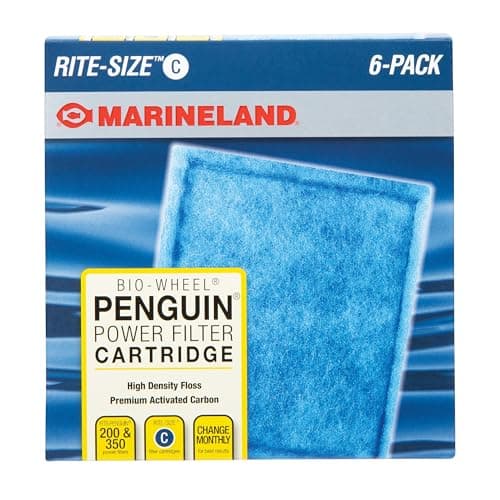 Marineland Penguin Rite-Size C Filter Cartridge, 6 Count Six cartridges for the 200 and up. What the Bio-Wheel changes is how much of your colony leaves with each one. | The running cost — and the reason the wheel matters | $19.97 on Amazon #ad How we’re funded · price as of September 18, 2026 |
| ! | 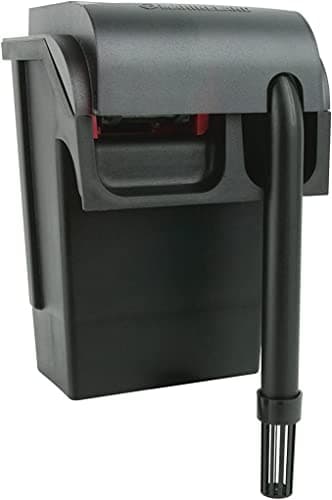 Marineland Penguin 75 Bio-Wheel Power Filter Sold for tanks up to 10 gallons, and about 12% short of what a 10 gallon community tank needs. Skip this one — see why below | Not a stocked 10 gallon tank, despite the label | $16.51 on Amazon #ad How we’re funded · price as of September 18, 2026 |
Rows link to the full write-up further down this page. Prices come from the live price layer only; where there is no live figure the button reads “Check price” rather than showing a remembered number.
What the Bio-Wheel actually is
A paddle wheel sits in the filter's outflow. Water pouring over it turns it, so each section of the wheel is alternately submerged and lifted into the air. Marineland's instructions describe this plainly: the patented wet/dry Bio-Wheel uses oxygen from the air, not your aquarium water, for biological filtration.
That is the whole idea, and it is a sound one. The bacteria that convert ammonia and nitrite are aerobic — they want oxygen as badly as they want food — and a surface that is repeatedly exposed to air gets more of it than a surface that sits submerged. It is the same principle as the large wet/dry sumps used on big tanks, scaled down to a wheel the size of a soup can.
The consequence for a beginner is the important part. On most cartridge filters the cartridge *is* the biological stage, so replacing it discards the colony. On a Penguin the cartridge is floss and carbon, and the colony lives largely on the wheel. Marineland's instructions state that unless damaged, you should never have to replace the Bio-Wheel, and separately: do not clean the Bio-Wheel. A discolored surface and slowed, even irregular, rotation from a heavy wheel is — in their words — normal and desired.
| Single-cartridge filter | Marineland Penguin | AquaClear basket | |
|---|---|---|---|
| Where the bacteria mainly live | In the disposable cartridge | On the Bio-Wheel, which is kept | In reusable foam and ceramic |
| What a cartridge change discards | Most of the colony | The floss's share only | Nothing — there is no cartridge |
| Maker's guidance on the biological stage | Replace with the cartridge | Never replace, never clean | Rinse and reuse; change one insert at a time |
| Ongoing cost | Cartridges forever | Cartridges forever | Near zero for years |
| Extra moving part | None | A wheel that must keep turning | None |
| Noise | Varies | Audible — the wheel | Sealed |
Penguin guidance is quoted from Marineland's Bio-Wheel instructions; AquaClear guidance is Fluval's. Both are cited at the foot of this page.

Sizing it honestly against the arithmetic
Marineland names the models by flow rather than by tank size, which is more honest than most of the category — but the stated tank ranges on the listings still overreach, and the 75's name invites a 10 gallon buyer to pick the wrong one. Our method takes the turnover a tank needs and divides by 0.7, because rated flow is measured with empty media and no head height.
| Model | Rated GPH | Stated tank size | Cartridge | 10 gal (85) | 20 gal (170) | 30 gal (257) |
|---|---|---|---|---|---|---|
| Penguin 75 | 75 | Up to 10 gal | Rite-Size A | No — 12% short | No | No |
| Penguin 100 | 100 | Up to 20 gal | Rite-Size A | Yes, 18% margin | No — 41% short | No |
| Penguin 150 | 150 | Up to 30 gal | Rite-Size B | Yes | No — 12% short (clears 5x at 143) | No |
| Penguin 200 | 200 | Up to 40 gal (Amazon); 30-50 (Walmart) | Rite-Size C | Yes | Yes, 18% margin | No — 22% short |
| Penguin 350 | 350 | Up to 75 gal | 2 x Rite-Size C, 2 wheels | Yes | Yes | Yes — but not stocked on Amazon at time of writing |
Flow, tank-size and cartridge figures from the retailer listings cited below. Required figures computed with the method on how we pick.
Read across any row and the same pattern appears that this site finds in every filter line: the top of the stated range is a light-stocking figure. The practical rule is to buy one model up from the one your tank's gallonage points at — the 100 for a 10, the 200 for a 20. For a 30 gallon community tank the Penguin 350 is the model that clears the figure, and it was not stocked on Amazon when this was written, which is why our 30 gallon page recommends a different filter at that size. The full method is on how we pick.
Pick 1
Marineland Penguin 200 Bio-Wheel Power Filter
A fully stocked 20 gallon tank
The number
Rated 200 GPH. A 20 gallon community tank needs 170 rated GPH by our method, which this clears by about 18%. A 30 gallon tank needs 257, which it misses by about 22%.
This is the pick for the tank most readers of this site are moving up to, and it is the model in the line that agrees with the arithmetic at that size. Marineland rates it at 200 GPH; the Amazon listing states aquariums up to 40 gallons and Walmart lists the same 200B unit at 30 to 50. Retailers disagree about the top of its range, which is normal, and it does not matter here — every version puts a 20 gallon tank comfortably inside it.
What matters is the 200 GPH against the 170 our method asks for on a stocked 20 gallon community tank. That is a real margin rather than a nominal one, and it is why this model rather than the Penguin 150 is the recommendation for a 20.
It takes the Rite-Size C cartridge, the same one the larger models use, and a single Bio-Wheel.
The honest costs. At 200 GPH on a 20 gallon tank the outflow is brisk, so anything long-finned will want a baffle. It is cartridge-based, so it carries a recurring bill. On a 30 gallon tank it falls about a fifth short of the figure, so it is not the step-up filter its stated range implies. The wheel is noisier than a sealed hang-on-back. No heater, no test kit.
| Rated flow | 200 GPH |
|---|---|
| Stated tank size | Up to 40 gallons on the Amazon listing; Walmart lists the same 200B unit as suiting 30 to 50 gallon aquariums |
| Filtration | Three-stage: mechanical, biological and chemical, with a rotating Bio-Wheel |
| Line range | 75 / 100 / 150 / 200 / 350 GPH across the Penguin range |
| What it does not do | Cartridge-based, so it carries a recurring cost, and the cartridge holds part of the bacteria colony. At 200 GPH it is more current than a 20 gallon tank with long-finned fish wants without a baffle. The Bio-Wheel is noisier than a sealed hang-on-back, and a stalled or dried-out wheel contributes nothing. No heater, no test kit, no substrate. |
Specs from Marineland Bio-Wheel Penguin 200 GPH Power Filter, Amazon listing; Marineland Penguin Power Filter 200B, Walmart listing. We have not used this unit.
#ad How we’re funded · price as of September 18, 2026
Pick 2
Marineland Penguin 100 Bio-Wheel Power Filter
A 10 gallon tank — the model that clears the figure, not the one named for it
The number
Rated 100 GPH for tanks up to 20 gallons on the Amazon listing. A 10 gallon community tank needs 85 rated GPH, which this clears. A 20 gallon tank needs 170, which it misses by about 41%.
Marineland does not name this model for a 10 gallon tank — that is the Penguin 75's job — but it is the Penguin a 10 gallon tank should actually get. At 100 rated GPH it clears the 85 our method asks for with room in hand, and it is inexpensive.
The Amazon listing states it suits aquariums up to 20 gallons, and that number deserves the same treatment every stated range gets on this site: it is a light-stocking figure. On a fully stocked 20 gallon community tank this filter is about 41% short, which is why the Penguin 200 is the pick at that size.
It takes the Rite-Size A cartridge — the small one — and a single Bio-Wheel.
The honest costs. Cartridge-based, with the cartridge holding part of the colony. The wheel makes it audibly noisier than a sealed hang-on-back, and a wheel that stalls contributes nothing while looking exactly like one that works — though, as the maker's own instructions say, a slow wheel is a different thing from a stopped one. No heater, no test kit.
| Rated flow | 100 GPH |
|---|---|
| Stated tank size | Up to 20 gallons |
| Filtration | Three-stage: mechanical, biological and chemical, with a rotating Bio-Wheel |
| Line range | 75 / 100 / 150 / 200 / 350 GPH across the Penguin range |
| What it does not do | The Bio-Wheel is a real wet/dry surface, but it also makes the filter noisier than a sealed hang-on-back, and a stalled or dried-out wheel does nothing at all. Cartridge-based. No heater, no test kit. |
Specs from Marineland Penguin 100 Bio-Wheel, Amazon listing. We have not used this unit.
Pick 3
Marineland Penguin 150 Bio-Wheel Power Filter
A lightly stocked or planted 20 gallon tank
The number
Rated 150 GPH for tanks up to 30 gallons, per the retailer listing. A lightly stocked or planted 20 gallon tank needs about 143 rated GPH at 5x, which this clears. At 6x it needs 170, which this misses by about 12%.
The middle model, and the one whose stated range overstates its reach most. The listing rates it for aquariums up to 30 gallons; our method says a stocked 30 gallon tank wants 257 rated GPH, so at the top of its own range it is delivering well under half.
Where it genuinely fits is a 20 gallon tank stocked lightly or planted, where a 5x turnover target of 143 rated GPH is the honest figure and 150 clears it. On that tank it is a good filter and the Rite-Size B cartridge is a sensible middle size.
On a fully stocked 20 it is about 12% short — close enough that adding a sponge filter alongside it is the cheap fix, rather than replacing it.
The honest costs. The stated up-to-30-gallons figure is the one to disregard. Cartridge-based, same wheel-noise caveat as the rest of the line, and if you are buying for a stocked 20 the Penguin 200 costs little more and clears the figure. No heater, no test kit.
| Rated flow | 150 GPH |
|---|---|
| Stated tank size | Up to 30 gallons, per the retailer listing |
| Cartridge | Rite-Size B |
| Filtration | Three-stage, with a patented Bio-Wheel that Marineland states provides oxygenated surface area for nitrifying bacteria |
| What it does not do | Rated for up to 30 gallons but well short of what a stocked 30 gallon tank needs by our method, and about 12% short on a fully stocked 20 gallon one. Cartridge-based, so a recurring cost, and the cartridge holds part of the colony. The wheel is noisier than a sealed hang-on-back. No heater, no test kit. |
Specs from Marineland Penguin 150 Power Filter, That Pet Place listing (150 GPH, up to 30 gal, Rite-Size B, Bio-Wheel claim); Marineland Bio-Wheel Penguin 150 GPH Power Filter, Amazon listing. We have not used this unit.
#ad How we’re funded · price as of September 18, 2026
Pick 4
Marineland Penguin Rite-Size C Filter Cartridge, 6 Count
The running cost — and the reason the wheel matters
The number
Fits the Penguin 200, 275, 350 and 375, per the compatibility listing. The 150 takes Rite-Size B and the 75 and 100 take Rite-Size A; the three sizes are not interchangeable.
Every cartridge filter on this site gets the same warning: the cartridge holds bacteria, and replacing it on a schedule discards live filtration. The Penguin is the line where that warning needs qualifying, and this cartridge is where to explain why.
A Rite-Size cartridge is mechanical floss and activated carbon in one frame. It does not contain the biological stage — that is the Bio-Wheel, a separate part that Marineland states should never be replaced. So when you change a Penguin cartridge you lose the bacteria living in the floss, which is real, but the wheel's colony carries on. That is a meaningfully softer landing than a whole-cartridge change on a filter with no other biological surface.
It is still a recurring purchase, and the honest advice is still to rinse a cartridge in old tank water and reuse it until the floss is physically failing, rather than swapping it because a schedule said so.
The honest costs. Check the size against your model before ordering; the A, B and C cartridges do not interchange. The activated carbon exhausts long before the floss does, which is fine — most tanks do not need a chemical stage running continuously anyway. And the recurring cost, however softened by the wheel, is the whole trade against an open-basket filter.
| Fits | Penguin 200, 275, 350 and 375, per the compatibility listing. The 150 takes Rite-Size B; the 75 and 100 take Rite-Size A |
|---|---|
| Stages | Mechanical floss and activated carbon in one frame; the Bio-Wheel is separate and is not part of the cartridge |
| Pack | 6 cartridges. The Penguin 350 takes two at a time |
| What it does not do | This is the running cost of the line and it never stops. Buy the size your model takes — the three sizes are not interchangeable. Because the Bio-Wheel carries a separate biological colony, replacing this cartridge is less damaging to a cycle than a whole-cartridge change on a filter with no other biological stage, but the cartridge still holds bacteria and should be rinsed and reused rather than swapped on a strict schedule. |
Specs from Marineland Bio-Wheel Penguin Rite-Size C Cartridge 6 Count, Amazon listing; Marine and Reef, Penguin cartridge compatibility by model. We have not used this unit.
#ad How we’re funded · price as of September 18, 2026
Skip this
Marineland Penguin 75 Bio-Wheel Power Filter
Not a stocked 10 gallon tank, despite the label
The skip entry, and it is the same lesson every filter line on this site teaches: the tank size on the box is a light-stocking figure, not a recommendation.
The Amazon listing sells the Penguin 75 for aquariums up to 10 gallons. Our method says a 10 gallon community tank needs 85 rated GPH, and this is rated 75 — about 12% short before the real-world throughput loss that the method already accounts for. It is the cheapest filter in the line and the one most likely to be bought for a 10 gallon tank precisely because it is named for one.
It is not a bad filter. On a 5 gallon tank, where our method asks for about 43 rated GPH, it is generous, and it brings the Bio-Wheel to a nano tank at a price nothing else in the line matches. That is a genuinely good use for it.
For a 10 gallon tank, spend slightly more on the Penguin 100. The difference in price is small; the difference between 12% short and 18% over is the difference between a filter that keeps up and one that does not.
The honest costs otherwise: it takes the small Rite-Size A cartridge, it carries the same wheel-noise caveat, and on a 5 gallon betta tank 75 GPH is brisk enough to want a baffle. No heater, no test kit.
| Rated flow | 75 GPH |
|---|---|
| Stated tank size | Up to 10 gallons, per the Amazon listing title |
| Cartridge | Rite-Size A |
| Filtration | Multi-stage with a Bio-Wheel, per the Amazon listing |
| What it does not do | Sold for tanks up to 10 gallons, and at 75 rated GPH it sits about 12% under the 85 a 10 gallon community tank needs by our method. It is the cheapest filter in the line and the one most likely to be bought for a tank it cannot quite carry. Cartridge-based. No heater, no test kit. |
Specs from Marineland Bio-Wheel Penguin 75 GPH Power Filter for aquariums up to 10 gallons, Amazon listing; Marine and Reef, Penguin cartridge compatibility (Rite-Size A fits the Mini/75 and 100). We have not used this unit.
When the wheel stops turning
This is the most-searched question about the line and the one that generates the most needless panic, so it gets its own section. Marineland's instructions cover it directly, and the answer separates three different situations.
- The wheel is slow, uneven, or stained brown. Per Marineland, this is normal and desired. A colonized wheel is heavier than a new one and turns irregularly. Do nothing. Above all, do not clean it — that discards the colony you are looking at.
- The wheel has stopped completely on an established filter. Marineland's instructions direct you to inspect the Bio-Wheel bearings and axle for dirt or mineral deposits. Hard water leaves scale on the small plastic bearings the wheel rides on, and a scaled bearing stops a wheel. Clean the bearings and the axle — not the wheel — and check every part is seated correctly.
- The wheel will not start on a brand-new filter. Marineland's instructions suggest swishing the wheel gently in a container of aquarium water and returning it to the filter. A dry new wheel is light and can sit on the spray bar without catching.
Two things a stopped wheel does not mean: it does not mean the filter is broken, and it does not mean you should buy a replacement wheel. Marineland's own guidance is that the wheel is kept for the life of the filter unless physically damaged. Replacement assemblies are sold, and the honest advice is that you will almost never need one.
Who should buy something else
If running cost matters more than simplicity, an open-basket filter has no cartridge bill at all and pays for its higher price within a year or two — the AquaClear Power Filter review covers that trade. If you want the quietest possible hang-on-back, the wheel is an audible moving part and a sealed design such as the Tetra Whisper IQ is the better match on that specific axis.
And if you keep a betta or shrimp in a small tank, no Penguin publishes a flow-control figure, so you cannot turn one down. A sponge filter is the gentler answer — best sponge filters — or an adjustable filter that publishes its minimum flow. Whichever you buy, a new filter is sterile on the day it arrives: the wheel carries no bacteria until you cycle the tank, and the head-to-head against the AquaClear is on AquaClear vs Penguin Bio-Wheel.
Questions people actually ask
Frequently asked questions
+ Is the Marineland Penguin a good filter?
+ Which Penguin filter do I need for a 10 gallon tank?
+ Which Penguin filter do I need for a 20 gallon tank?
+ Why is my Bio-Wheel not spinning?
+ Should I ever replace or clean the Bio-Wheel?
+ Which cartridge does my Penguin take?
+ How often should I change a Penguin cartridge?
Where the numbers came from
Sources
- Marineland Bio-Wheel instructions and troubleshooting, as reproduced on LiveAquaria's Emperor Bio-Wheel listing (never replace, do not clean, bearings and axle, initial swish)
- Marineland Bio-Wheel Penguin 200 GPH Power Filter, Amazon listing
- Marineland Penguin Power Filter 200B, Walmart listing (30-50 gal, 200 GPH)
- Marineland Penguin 100 Bio-Wheel — Amazon listing (rated flow, line range)
- Marineland Penguin 150 Bio-Wheel Power Filter, That Pet Place listing (150 GPH, up to 30 gal, Rite-Size B)
- Marineland Penguin 350 Power Filter, That Pet Place listing (350 GPH, 50-75 gal, includes Rite-Size C x2 and Bio-Wheel x2)
- Marineland Bio-Wheel Penguin 75 GPH Power Filter, Amazon listing (75 GPH, up to 10 gallons)
- Marineland Penguin Rite-Size cartridge and Bio-Wheel assembly compatibility, Marine and Reef listing index (A/B/C by model)
- Marineland Bio-Wheel Penguin Rite-Size C Filter Cartridge, 6 Count, Amazon listing
- Aquifarm, aquarium filter flow rate guidance (turnover multiples)
Read next
Related on Fin & Filter
AquaClear vs Penguin Bio-Wheel
Rinse-and-reuse media versus a replaceable cartridge with a Bio-Wheel. The deciding criterion, and the running cost.
AquaClear Power Filter review
The media basket, the flow control range Fluval actually publishes, and the buyer who should pick a cartridge filter instead.
The best filter for a 20 gallon tank
Why filters labeled for 20 gallons come up short on a stocked community tank, and the cheap fix that works.