Buying guide
The best aquarium algae scrapers
Scraping glass is the most satisfying two minutes in the hobby and the easiest way to ruin a tank permanently. The difference is entirely in the tool and the technique.
Fin & Filter earns a commission when you buy through the links on this page. It costs you nothing and it does not decide what we rank. How we’re funded.
We have not used any of this gear. Every pick below is chosen from published manufacturer specifications and the arithmetic on how we pick, which you can re-run yourself.
For a glass tank up to about 30 gallons, buy a floating magnet with a blade — one tool that handles both soft green film and the hard green spots, without putting your hand in the water. For acrylic, buy a handheld pad scraper and never a blade: acrylic scratches from grit and blades alike. Whatever you buy, the rule that saves the tank is the same: keep the magnet off the bottom inch of glass, where a single grain of sand caught under the pad will leave a permanent scratch in one pass. And scrape before a water change, so the debris leaves in the siphon rather than settling.
Algae on the glass is not a disease and it is not a sign you have done something wrong — it is what happens when light hits a surface in a nutrient-rich box of water. Every tank gets it. The question this page answers is what to clean it with, because the wrong tool ruins a tank in a way no amount of maintenance undoes.
Magnet or handheld
| Magnet cleaner | Handheld scraper | |
|---|---|---|
| Hands in the tank | No | Yes |
| Corners and edges | Poor — the body cannot reach | Good |
| Acrylic tanks | Risky — grit scratches | The safer option, with a pad |
| Hard green spot algae | Only with a blade version | Yes, on glass |
| Speed on a weekly film | Fast | Slower |
| The main risk | Trapped grit scratching the glass | A blade on acrylic, or on a silicone seam |
| Cost | Low to moderate | Low |
Both tools do the same job. Most keepers end up owning both: the magnet for the weekly pass, the handheld for the corners and the occasional hard patch.
The rule that protects the tank
One mistake accounts for almost every permanently scratched aquarium: dragging a magnet through the bottom inch of glass, where substrate sits against it. A single grain of sand or a sharp fragment of gravel caught under the pad turns the tool into a cutting edge, and the resulting arc across the front pane never comes out.
- Stop an inch above the substrate. Clean the lowest strip with a handheld pad, slowly, watching what is under it.
- Check the pad every time. Before each pass, look at the face of the magnet for trapped grit. It takes two seconds.
- If the halves separate, do not scoop. Let a floating type surface. On a sinking type, lift it out carefully rather than dragging it up the glass.
- Keep the blade off silicone. A blade run along a corner seam can cut the silicone that holds the tank together. Corners get the pad, not the edge.
- Never use a household scourer. Kitchen pads are abrasive by design and many carry detergent residue, which is toxic to fish.
How we judged these
- Matched to a beginner's tank size. A tool sized for a 75 gallon display is hard to control on 20 gallons of thin glass.
- Published glass-thickness rating. Where a maker states one, we quote it. Where none is published on a source we can reach, we say so rather than inventing a limit.
- Blade access. Green spot algae needs an edge. A pad-only tool is a partial answer on any tank more than a few months old.
- Failure behavior. A magnet that floats when it separates is meaningfully safer than one that drops into the sand.
- Currently purchasable. Every tool here had a live buy box when this page was written.
Quick picks
Tools that clean glass without ruining it
| # | Product | Best for | Price |
|---|---|---|---|
| 1 | 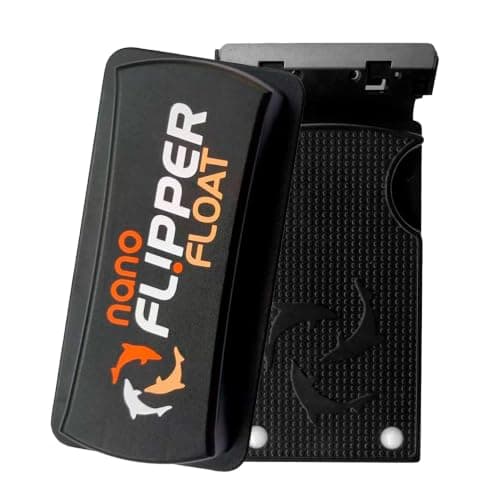 FL!PPER Float Nano Magnetic Cleaner A floating 2-in-1 magnet rated for glass up to 1/4 inch — the right size class for a beginner tank, with the blade built in. | A 10 or 20 gallon glass tank | $29.99 on Amazon #ad How we’re funded · price as of September 25, 2026 |
| 2 | 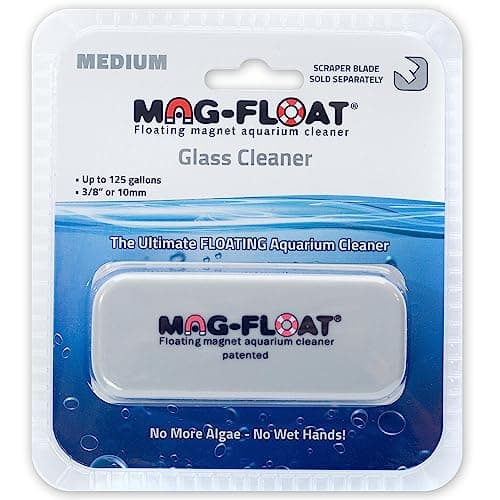 Mag-Float Mag-Float 125 Glass Floating Algae Scraper, Medium The standard floating magnet, in the medium size — simple, cheap and everywhere. | A 20 to 40 gallon glass tank, on a budget | $33.89 on Amazon #ad How we’re funded · price as of September 25, 2026 |
| 3 |  FL!PPER Platinum Hand Algae Scraper A handheld scraper on a 28 inch shaft, sold for both glass and acrylic — the tool for the jobs a magnet cannot do. | Acrylic tanks, and reaching into corners | $29.99 on Amazon #ad How we’re funded · price as of September 25, 2026 |
| 4 | 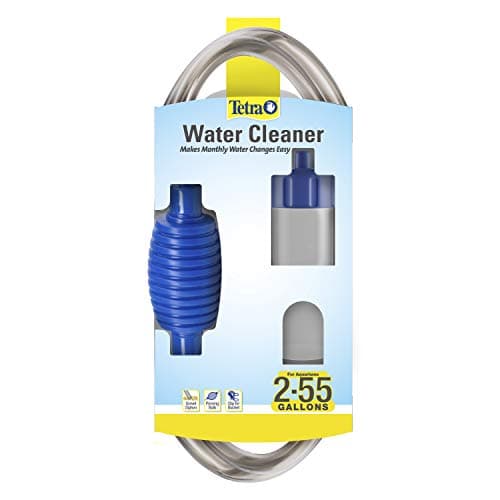 Tetra Water Cleaner Gravel Siphon Scraping loosens algae into the water column. The siphon is what removes it. | Getting the algae out of the tank rather than around it | $10.29 on Amazon #ad How we’re funded · price as of September 25, 2026 |
| ! | 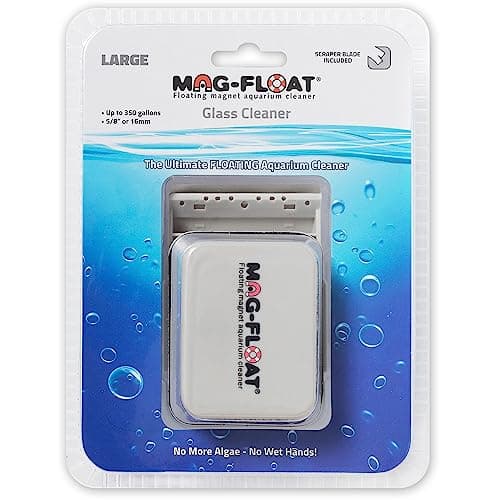 Mag-Float Mag-Float 350 with Scraper Blade, Large The large magnet with a blade attachment — genuinely strong, and more magnet than a 10 or 20 gallon tank wants. Skip this one — see why below | Not a beginner tank | $71.89 on Amazon #ad How we’re funded · price as of September 25, 2026 |
Rows link to the full write-up further down this page. Prices come from the live price layer only; where there is no live figure the button reads “Check price” rather than showing a remembered number.
Scraping is symptom management
Cleaning the glass treats the visible part of an algae problem. It does nothing about the cause, which is almost always light and nutrients — and if you are scraping weekly and it is back in three days, the cause is worth fixing rather than out-scrubbing.
- Shorten the photoperiod. Six hours a day on a timer is enough for low-light plants and starves most algae. This is the single biggest lever and it is free.
- Move the tank out of direct sunlight, or curtain the window. Sun is uncontrolled light and the usual cause of a green water bloom.
- Feed less. Uneaten food is nutrients, and nutrients the plants cannot use go to algae.
- Keep up the water changes. Nitrate accumulation feeds algae as reliably as it stresses fish — how often to change aquarium water.
- Add plants. Plants compete with algae for exactly the same nutrients, which is why a well-planted tank usually has cleaner glass than a bare one.
Note what is not on that list: an algae-killing chemical. Products that kill algae leave it dead in the water, where it decays and drives an ammonia spike — the reason we recommend fixing the inputs instead, and the reason a test kit matters more than a bottle.
The weekly routine, in order
- Scrape the glass first, while the water is still full — the magnet needs depth to work in.
- Wait ten minutes. Let the loosened algae settle onto the substrate instead of swirling.
- Vacuum and change water. The debris leaves with the siphon, which is the only step that actually removes algae from the tank.
- Rinse the filter's mechanical stage in the old tank water, if the flow has dropped. Never under the tap.
- Refill with dechlorinated water at tank temperature, and glance at the thermometer before you walk away.
Pick 1
FL!PPER Float Nano Magnetic Cleaner
A 10 or 20 gallon glass tank
The number
Stated for small glass tanks up to 1/4 inch (6 mm), which covers most tanks up to roughly 30 gallons. The 2-in-1 design flips in the water between a scrubber pad and a scraper blade.
Most magnet cleaners give you a pad. A pad shifts soft green film and slides straight over the hard green spots, which is why people end up with an arm in the tank and a razor blade in their hand anyway.
This one carries both: flip it under water and the blade comes into contact instead of the pad. For the two kinds of algae a beginner's glass actually grows, that covers both without ever putting your hand in.
It floats, which is the other feature that matters on a small tank. When the halves separate — and they will — the inner half surfaces instead of dropping into the substrate and picking up grit.
The honest costs. The 1/4 inch glass limit is real: on thicker glass the magnets simply will not hold. The flip action takes a few goes to learn. And like every magnet, it is only as safe as your discipline about the bottom inch of glass.
| Glass thickness | Small glass tanks up to 1/4 inch (6 mm), per the Amazon listing |
|---|---|
| Type | 2-in-1: flip it in the water to swap between scrubber pad and scraper |
| Floats | Floating design, so the inner half surfaces rather than dropping into the substrate |
| What it does not do | The 1/4 inch limit rules it out on thicker glass, which includes many tanks over about 30 gallons. The flip action takes practice, and like any magnet it will drag grit across the glass if you let it near the sand. |
Specs from FLIPPER Float Nano Magnetic Aquarium Cleaner, glass up to 1/4 inch (6 mm), Amazon listing. We have not used this unit.
#ad How we’re funded · price as of September 25, 2026
Pick 2
Mag-Float Mag-Float 125 Glass Floating Algae Scraper, Medium
A 20 to 40 gallon glass tank, on a budget
The number
Medium size class (model 125) for glass aquariums. The inner half floats if the magnets separate, which is the design feature the whole product line is named for.
This is the tool most aquarium keepers own, and it has a long track record for the obvious reason: two halves, one pad, nothing to break.
For weekly maintenance on soft algae it is all you need. Run it over the glass before a water change, let the debris settle, then siphon it out with the gravel vacuum.
The honest costs. It is a pad, not a blade, so hardened green spot algae will defeat it. Magfloat's own site does not publish a glass-thickness table we could load, so we cannot tell you a verified maximum — check your glass against the size class before buying. And it is sold for glass; magnets and acrylic are a scratch waiting to happen.
| Type | Two-part magnet: you move the outer half, the inner half scrubs |
|---|---|
| Floats | The inner half floats if the magnets separate, so it does not sink into the substrate |
| Size class | Medium (model 125), for glass tanks |
| What it does not do | Magfloat's own site does not publish a glass-thickness table we could load, so none is printed here. Magnets are the easiest tool to ruin a tank with: a grain of sand caught under the pad will scratch glass in one pass, and this one is not sold for acrylic. |
Specs from Mag-Float Medium Glass Floating Algae Scraper 125, Amazon listing. We have not used this unit.
#ad How we’re funded · price as of September 25, 2026
Pick 3
FL!PPER Platinum Hand Algae Scraper
Acrylic tanks, and reaching into corners
The number
A 28 inch rigid shaft, stated for freshwater and saltwater, glass and acrylic. The reach keeps your arm out of the water on a taller tank.
Two jobs defeat every magnet: the corners, where the magnet's body cannot reach, and acrylic, where a trapped grain of sand does permanent damage in one pass.
A handheld scraper on a long shaft handles both, and the shaft means you are not immersing your forearm to the elbow every week — which matters more than it sounds if you have just dosed anything.
The honest costs. Your hand is over an open tank, which is exactly what a magnet exists to prevent. On acrylic, use the pad and accept slower work: no blade belongs on acrylic regardless of what a listing says. And a rigid 28 inch shaft is awkward on a small tank with a hood.
| Type | Handheld scraper on a 28 inch rigid shaft, per the Amazon listing |
|---|---|
| Surfaces | Sold for both glass and acrylic aquariums |
| Reach | The shaft keeps your arm out of the water on a taller tank |
| What it does not do | A handheld tool means your hand is over the tank, which is the thing a magnet exists to avoid. Blades and acrylic are a bad combination regardless of what a listing says: on acrylic, use the pad and accept slower work. |
Specs from FLIPPER Platinum Hand Algae Scraper, 28 inch rigid shaft, glass and acrylic, Amazon listing. We have not used this unit.
#ad How we’re funded · price as of September 25, 2026
Pick 4
Tetra Water Cleaner Gravel Siphon
Getting the algae out of the tank rather than around it
This is the step people skip. Scraping the glass does not export anything — it turns a film on the glass into particles in the water, which settle in the substrate and feed the next bloom.
The sequence that works: scrape the glass, wait ten minutes for the debris to settle, then do the water change with the gravel vacuum and take the debris out with the water.
The honest costs. It is one more step in an already slow chore, and a siphon on a small tank removes water fast — have the replacement bucket ready and dechlorinated. Our full shortlist for this tool is on the gravel vacuum page, linked below.
| Type | Manual siphon into a bucket |
|---|---|
| Cost | The cheapest way to do a proper gravel-vac water change |
| What it does not do | You carry the water. On a 10 or 20 gallon tank that is fine. The moment the tank gets big, it is the reason people quietly stop doing water changes. |
The manufacturer does not publish a full spec sheet for this item, so nothing beyond the figures above is stated. We have not used this unit.
#ad How we’re funded · price as of September 25, 2026
Skip this
Mag-Float Mag-Float 350 with Scraper Blade, Large
Not a beginner tank
The skip entry is not a bad tool. It is the right tool for a 75 gallon display and the wrong one for the tank most readers of this page own.
The pull of a large magnet is difficult to control on thin glass. The halves snap together hard, they are awkward to separate, and on a small tank you have less room to work and more chance of trapping substrate against the glass.
The blade attachment is the reason people buy it, and it is genuinely what removes hardened green spot algae. On a beginner tank, a nano 2-in-1 with a blade does the same job at a size that suits the tank.
Buy this when your tank is big, its glass is thick, and you have already learned how to keep a magnet away from the sand.
| Type | Large floating magnet with a scraper blade attachment |
|---|---|
| Blade | The blade is what removes hardened green spot algae a pad only polishes |
| Size class | Large (model 350), for glass tanks |
| What it does not do | It is a lot of magnet for a beginner's tank, and the pull is strong enough to be genuinely awkward on a 10 or 20 gallon. A blade near a silicone seam is how a leak starts, so keep it off the corners. Not for acrylic. |
Specs from Mag-Float Large Glass Floating Algae Scraper 350 with blade attachment, Amazon listing. We have not used this unit.
Questions people actually ask
Frequently asked questions
+ What is the best tool for cleaning algae off aquarium glass?
+ Will a magnet cleaner scratch my aquarium?
+ Can I use a magnet cleaner on an acrylic tank?
+ How do I remove green spot algae from glass?
+ How often should I clean aquarium glass?
+ Should I use an algae killing chemical instead?
Where the numbers came from
Sources
- FLIPPER Float Nano Magnetic Aquarium Cleaner, 2-in-1 scrubber and scraper for glass up to 1/4 inch (6 mm), Amazon listing
- Mag-Float Medium Glass Floating Algae Scraper 125, Amazon listing
- FLIPPER Platinum Hand Algae Scraper, 28 inch rigid shaft, glass and acrylic, Amazon listing
- Mag-Float Large Glass Floating Algae Scraper 350 with scraper blade attachment, Amazon listing
Read next
Related on Fin & Filter

The best aquarium gravel vacuums
Bucket siphon versus hose-fed changer, the faucet fitting that catches people out, and which suits your tank.
Why is my fish tank water green?
A free-floating algae bloom, not dirt. Why scrubbing fails, how to starve it of light and nitrate, and what not to buy.

How often to change aquarium water
The 25%-weekly default, how nitrate sets your real schedule, and the water change mistakes to avoid.