Diagnosis
Why is my fish tank water green?
Green water is algae growing in the water column rather than on it. It is almost never dangerous to fish, it never clears by scrubbing, and the cause is nearly always too much light meeting too much nitrate.
Fin & Filter earns a commission when you buy through the links on this page. It costs you nothing and it does not decide what we rank. How we’re funded.
We have not used any of this gear. Every pick below is chosen from published manufacturer specifications and the arithmetic on how we pick, which you can re-run yourself.
Green water is a bloom of free-floating single-celled algae suspended in the water column, and it is caused by too much light meeting too much nitrate. It is not dirt, it does not respond to scrubbing or filter cleaning, and it is almost never directly harmful to fish. Fix it by cutting the light — shorten the lighting period and get the tank out of any direct sun — while removing nitrate with more frequent water changes and gravel vacuuming. Do both together; either alone tends to fail.
This is the one kind of cloudy water that will not clear if you leave it alone, which makes it different from the milky bacterial bloom a new tank goes through. If your water is milky white rather than green and the tank is only a few weeks old, you probably want why is my fish tank water cloudy instead — that one resolves by itself and fighting it makes it worse.
First, work out which green problem you have
Three different things get called “green algae” and they have three different answers. Getting this wrong is why people scrub glass for a fortnight while the water stays green.
| What you see | What it is | What actually works |
|---|---|---|
| The water itself is green and hazy. Objects at the back look faded | Green water — a free-floating algae bloom in the water column | Reduce light and nitrate. Scrubbing does nothing because the algae is not on a surface |
| A green film on the glass, water clear behind it | Green spot or film algae growing on surfaces | Wipe the glass at water changes. Normal in any lit tank |
| Green strands or tufts on plants and decor | Hair or thread algae | Manual removal plus the same light and nutrient control |
| Milky white, tank set up in the last few weeks | Bacterial bloom, not algae at all | Nothing. It clears on its own in days to a couple of weeks |
| Green water plus fish gasping at the surface | Possibly an oxygen problem alongside the bloom | Increase surface movement and test immediately. Treat as urgent |
The distinguishing test for green water is simple: fill a clean glass with tank water and hold it against something white. If the water in the glass is visibly green, the algae is in the water, not on the glass.
Quick picks
Why is my fish tank water green?
| # | Product | Best for | Price |
|---|---|---|---|
| 1 | No image API Freshwater Master Test Kit Green water is light plus nitrate. A test kit is the only way to see the second half. | Finding the nutrient half of the problem | |
| 2 | No image Various Bucket-and-siphon gravel vacuum Water changes are the treatment. This is how you do them. | Removing the nitrate that feeds the bloom | |
| 3 | No image Python No Spill Clean and Fill, 25 ft Does not clean better than a bucket. Makes you far more likely to actually do it. | Making the water changes frequent enough to matter | |
| 4 | No image Various Beginner live plants (java fern, anubias, hornwort) Plants eat the same nutrients the bloom does, and they are better at it once established. | Competing with the algae rather than fighting it |
Rows link to the full write-up further down this page. Prices come from the live price layer only; where there is no live figure the button reads “Check price” rather than showing a remembered number.
Why it happened
Green water needs light and nutrients simultaneously. Remove either and it cannot sustain itself, which is why the fix always attacks both. The usual triggers, in rough order of how often they turn out to be the answer:
- The tank gets direct sunlight, even for an hour a day. This is the most common single cause and the easiest to miss, because the sun only reaches the tank while you are at work.
- The light is on too long. Ten or twelve hours because it looks nice, or because it shares a timer with the room. Aquarium plants do not need that much and algae is delighted by it.
- Nitrate has been climbing. Missed water changes, a heavier stocking level than the routine supports, or a tank that has quietly grown since it was set up.
- Overfeeding. Uneaten food decomposes into exactly the nutrients the bloom is living on. This is the cause people are least willing to consider.
- A recent disturbance. A big substrate clean, a dead fish that went unnoticed, or a heavy plant trim can release a pulse of nutrients that triggers a bloom a week later.
- A new, brighter light. An upgrade intended for plants will feed algae first, because algae responds faster than plants do.
The fix, in order
Work down this list rather than doing the last item first. The first three are free.
- Test ammonia, nitrite and nitrate before changing anything. Green water is a nuisance; ammonia is an emergency. Establish which you are dealing with. High nitrate tells you the routine is the underlying problem.
- Move the tank out of direct sun, or block it. If sunlight reaches the glass at any point in the day, nothing else on this list will hold.
- Cut the lighting period. Six to eight hours a day is plenty for a planted beginner tank, and less during a bloom. Use a timer so it is consistent rather than depending on you.
- Increase water changes for a fortnight. More frequent partial changes with the substrate vacuumed, to pull nitrate down and physically remove suspended algae. See how often to change aquarium water for the baseline routine.
- Feed less. Only what is eaten in about two minutes, and remove the rest. The feeding guidance is on the best aquarium fish food.
- Consider a blackout. Three or four days with the light off and the tank covered kills a stubborn bloom outright. Fish tolerate it fine; established plants generally do too. Keep the filter running and do not feed heavily during it.
- Add plants, once the bloom is under control, so the nutrients have a permanent competitor.
Pick 1
API Freshwater Master Test Kit
Finding the nutrient half of the problem
The number
Over 800 tests per kit, covering pH, high-range pH, ammonia, nitrite and nitrate.
Algae needs two things to bloom: light and nutrients. You can assess the light by looking at the tank, but the nutrient side is invisible without a test, which is why guessing at green water so often fails.
Nitrate is the reading that matters here. A tank with high nitrate and moderate light will bloom; a tank with near-zero nitrate and quite strong light usually will not. If your nitrate is high, the real problem is the water change routine or the stocking level, and reducing the light alone will only suppress the symptom.
Test ammonia at the same time, for a different reason. In a tank under two months old a green tinge can coincide with an unfinished cycle, and ammonia is the reading that actually endangers fish. Green water does not, ammonia does, and only one of them is visible.
The honest downsides. Liquid reagents are slower and fiddlier than strips. The nitrate test specifically needs the second bottle shaken hard and then a wait, and skipping that step gives a falsely low reading — which on this page would send you looking in the wrong direction entirely. The color card is hard to read between adjacent shades in warm light.
| Tests | pH, High Range pH, Ammonia, Nitrite, Nitrate |
|---|---|
| Capacity | Over 800 tests per kit |
| Contents | 7 bottles of test solution, 1 color card, 4 glass tubes with caps, holding tub |
| Type | Liquid reagent |
| What it does not do | Does not test hardness, chlorine or alkalinity. It is slower than strips, the nitrate test needs vigorous shaking of the second bottle and a wait, and the color card is genuinely hard to read between adjacent shades. |
Specs from API Freshwater Master Test Kit, Amazon listing; API Freshwater Aquarium Master Test Kit, PetSmart listing. We have not used this unit.
Pick 2
Various Bucket-and-siphon gravel vacuum
Removing the nitrate that feeds the bloom
The fix for the nutrient half of green water is dull and effective: change water, and pull the accumulated waste out of the substrate while you do it.
Nitrate has no biological exit from a closed aquarium. The bacteria you spent weeks growing convert ammonia to nitrite and nitrite to nitrate, and then the chain stops — nitrate accumulates until you physically remove it or a plant consumes it. Decaying food and waste trapped in the gravel is the ongoing source, which is why vacuuming the substrate does more for a bloom than changing water alone.
It is worth being realistic about the timescale. Water changes fix the underlying cause but they clear a bloom slowly, because you are removing perhaps a quarter of the suspended algae each time while the rest keeps reproducing. Expect to combine this with the light reduction below rather than expecting it to work on its own.
The honest costs. It is manual work with buckets, and on anything above about 20 gallons it gets tedious enough that people quietly stop — which is the actual reason routines lapse. A siphon needs a height difference to work and will not start if the bucket is above the tank.
| Type | Manual siphon into a bucket |
|---|---|
| Cost | The cheapest way to do a proper gravel-vac water change |
| What it does not do | You carry the water. On a 10 or 20 gallon tank that is fine. The moment the tank gets big, it is the reason people quietly stop doing water changes. |
The manufacturer does not publish a full spec sheet for this item, so nothing beyond the figures above is stated. We have not used this unit.
Pick 3
Python No Spill Clean and Fill, 25 ft
Making the water changes frequent enough to matter
During a green water episode you may want to change water more often than usual for a couple of weeks, and that is exactly the situation where the bucket method breaks down.
A faucet-driven changer drains to and fills from a tap, so the volume of water stops being the limiting factor. The honest case for it is behavioral rather than technical: it does not clean better than a siphon and a bucket, it makes a job you were avoiding take a few minutes instead of half an hour, and a maintenance routine that is annoying is a routine that lapses.
That matters here specifically because the cure for green water is repetition. One large water change does little. Several across a fortnight, combined with less light, resolves it.
The honest costs. It needs a threaded faucet it can attach to, which not every kitchen or bathroom has. It runs tap water directly into the tank, so the conditioner has to be dosed for the whole tank volume as it fills rather than pre-mixed in a bucket. It wastes some water in operation. And on a small tank it is genuinely overkill — a bucket is fine for a 10 gallon aquarium. Full comparison on the Python versus bucket page.
| Length | 25 feet |
|---|---|
| How it works | Attaches to a faucet and uses water pressure to siphon out and refill, with no buckets |
| Included | Hose, gravel tube, switch, hose connectors, faucet pump, brass faucet adapter |
| Setup | Remove the faucet aerator and washer, fit the adapter, connect the tubing |
| What it does not do | It needs a threaded faucet, so a pull-out spray head or an unthreaded modern tap will not take the adapter without a separate part. It also runs tap water down the drain while it siphons, and it does not condition the refill for you. |
Specs from Python No Spill Clean and Fill 25 ft, Amazon listing; Python No Spill Clean & Fill, Chewy listing. We have not used this unit.
Pick 4
Various Beginner live plants (java fern, anubias, hornwort)
Competing with the algae rather than fighting it
The long-term answer to recurring algae is usually more plants rather than fewer nutrients, and it is the approach that stops the problem coming back.
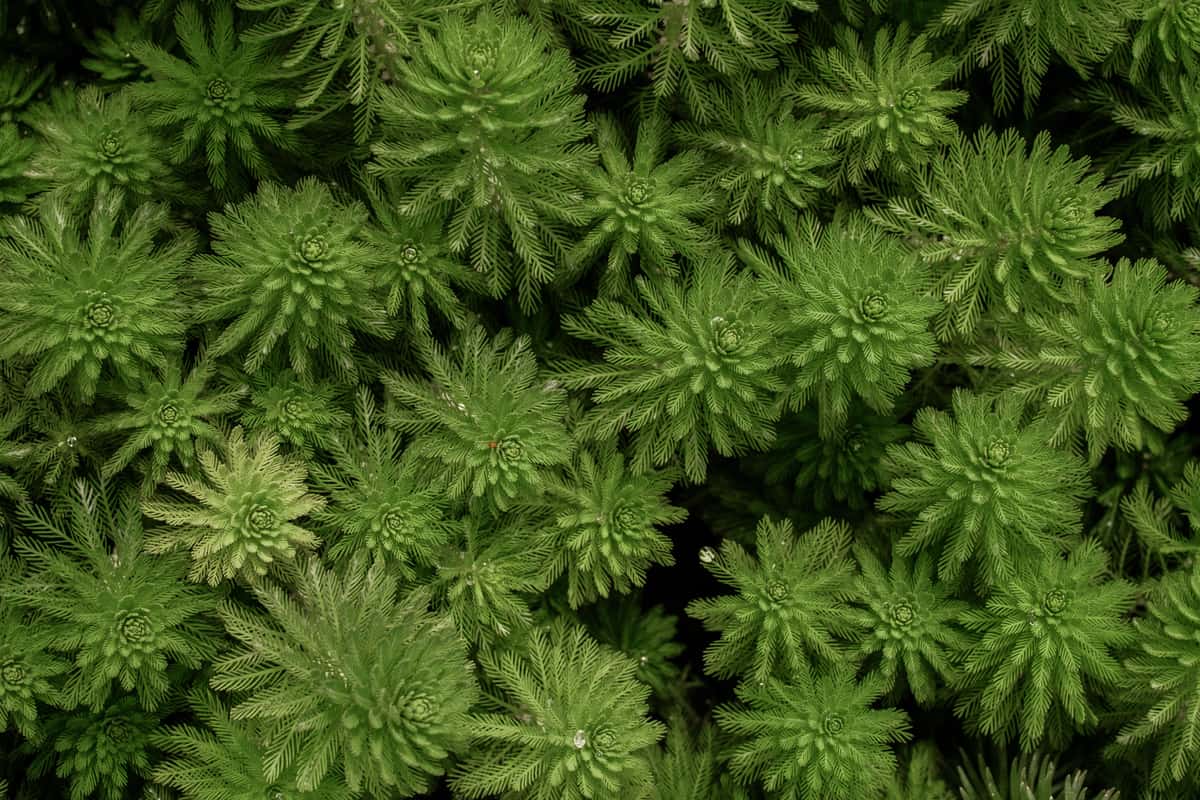
Algae and plants want the same things: light, nitrogen and phosphate. In a tank with plenty of nutrients and no plants, algae takes everything unopposed. A well-planted tank consumes those nutrients continuously, so a bloom has much less to work with — this is why heavily planted tanks tend to be the ones with the clearest water, which surprises people who assume plants make tanks messier.
Established is the key word. New plants take weeks to start drawing meaningful nutrients, so this is a fix for next month rather than this week. Combine it with the light and water-change measures now, and treat the planting as insurance against a repeat.
The honest costs. Plants need adequate light, which is awkward advice on a page telling you to reduce light — the resolution is fewer hours rather than a dimmer bulb, so plants still get a usable photoperiod. Plants that melt and rot add to the nutrient load rather than reducing it, which makes the problem worse. Species choice matters a lot here, and the beginner-tolerant species are covered in our live plants roundup.
| Why these three | They tolerate low light, need no injected CO2, and are not demanding root feeders |
|---|---|
| Planting note | Java fern and anubias must not be buried; the rhizome rots if you push it into the substrate |
| What it does not do | Live plants can arrive carrying snails, snail eggs or algae. They are also not a filter: plants consume nitrate, but they will not carry the ammonia load of a stocked tank on their own. |
The manufacturer does not publish a full spec sheet for this item, so nothing beyond the figures above is stated. We have not used this unit.
Is green water dangerous to fish?
Rarely, and it is worth saying so because the panic it causes is out of proportion to the risk. The algae itself is not toxic, and some fish keepers deliberately culture green water as live food for fry. Fish in a green tank are usually perfectly healthy fish you cannot see very well.
There are two real caveats. A very dense bloom consumes oxygen at night — algae photosynthesizes in light but respires in darkness — so a heavy bloom in a warm, poorly-circulated tank can pull dissolved oxygen down overnight. If fish are at the surface gulping in the morning and settle later in the day, that is the pattern, and the fix is more surface movement: see best aquarium air pumps.
The second caveat is what the bloom is telling you. Green water is frequently a visible symptom of high nitrate, and sustained high nitrate is not good for fish over months even though it is far less acutely toxic than ammonia. The bloom is the messenger rather than the problem.
If fish are actually unwell — gasping, clamped fins, sitting on the bottom, or dying — do not attribute it to the green water. Test the water and work through why do my fish keep dying, because something else is going on.
Stopping it coming back
A bloom that clears and returns a month later means the underlying conditions never changed. The durable version of the fix is unglamorous: a timer on the light set to a sensible photoperiod, a water change routine you actually keep, feeding restraint, a stocking level the routine can support, and enough easy live plants to compete for what is left.
If nitrate keeps climbing between water changes despite the routine, the tank is carrying more bioload than the schedule supports — that is a stocking question rather than an algae one, and how many fish in a 20 gallon tank works through what a tank can realistically hold.
Questions people actually ask
Frequently asked questions
+ Why is my fish tank water green?
+ Is green aquarium water harmful to fish?
+ How do I get rid of green water fast?
+ Will a water change fix green water?
+ What is the difference between green water and green algae on the glass?
+ Does an algae eater fix green water?
Where the numbers came from
Sources
- API Freshwater Master Test Kit — Amazon listing (parameters tested, test count)
- US EPA, Aquatic Life Criteria for Ammonia — toxicity and its dependence on pH and temperature
- USGS, The Nitrogen Cycle — nitrification as a two-stage bacterial oxidation
- Python No Spill Clean and Fill 25 ft — Amazon listing (length, contents, operation)
Read next
Related on Fin & Filter
Why is my fish tank water cloudy?
Milky, green or brown — what each means, which to leave alone, and why clarity says nothing about ammonia.

How often to change aquarium water
The 25%-weekly default, how nitrate sets your real schedule, and the water change mistakes to avoid.
Easy live plants for a beginner tank
Java fern, anubias and hornwort — why these three, how to plant them correctly, and what they will not do.