Model review
API Freshwater Master Test Kit review
The default liquid test kit in the hobby, and the one piece of equipment this site argues you cannot keep fish without. Here is what it does well, and the three places people get wrong readings from it.
Fin & Filter earns a commission when you buy through the links on this page. It costs you nothing and it does not decide what we rank. How we’re funded.
We have not used any of this gear. Every pick below is chosen from published manufacturer specifications and the arithmetic on how we pick, which you can re-run yourself.
Yes, buy it. The API Freshwater Master Test Kit reads ammonia, nitrite, nitrate, pH and high-range pH in liquid reagents, with over 800 tests per box, and it is the only common kit that lets a beginner distinguish 0 from 0.25 ppm — the distinction a cycle turns on. It is slower and fiddlier than strips and the color card is hard to read in warm light. Both of those are true and neither is a reason to buy the test that omits ammonia.
We have not run laboratory comparisons on this kit and are not going to pretend otherwise. What follows is what API publishes about it, what is physically in the box, and the specific procedural mistakes that produce wrong readings — which is the part most reviews skip and the part that actually costs people fish.
Quick picks
The kit, and what it is usually bought against
| # | Product | Best for | Price |
|---|---|---|---|
| 1 | 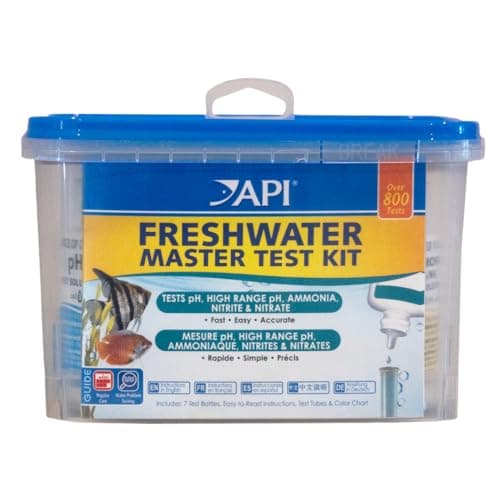 API Freshwater Master Test Kit Reads ammonia, nitrite, nitrate and pH in liquid reagents, and it is the reason a beginner can see a cycle at all. | Anyone cycling a tank, which is anyone with a new aquarium | $35.98 on Amazon #ad How we’re funded · price as of September 14, 2026 |
| ! | 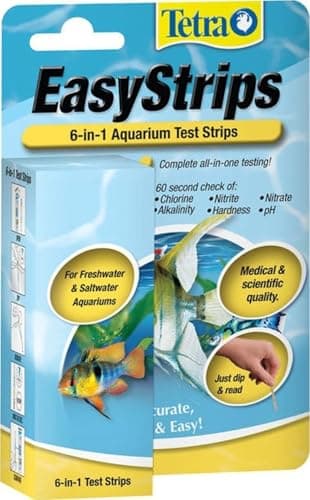 Tetra EasyStrips 6-in-1 Test Strips Six parameters in ten seconds, and ammonia is not one of them. Skip this one — see why below | A fast recheck on an established tank, and nothing else | $14.97 on Amazon #ad How we’re funded · price as of September 14, 2026 |
| 3 | No image Various Ammonia test strips Fills the missing parameter, at the resolution strips are worst at. | The gap the six-in-one leaves, if you insist on strips |
Rows link to the full write-up further down this page. Prices come from the live price layer only; where there is no live figure the button reads “Check price” rather than showing a remembered number.
What is actually in the box
| Item | Detail |
|---|---|
| Reagent bottles | Seven — including two each for the nitrite and nitrate tests |
| Test tubes | Four glass vials with snap caps |
| Color card | One laminated card covering all five tests |
| Holding tray | A plastic tub that holds the vials upright |
| Tests covered | pH, high-range pH, ammonia, nitrite, nitrate |
| Stated capacity | Over 800 tests |
| Not covered | General hardness, carbonate hardness, chlorine, phosphate |
Contents and the 800-test figure are API's own published specification, cited at the foot of this page.
Two absences are worth noting rather than glossing. There is no hardness test, which matters if your tap water is very soft or very hard and you are choosing species around it. And there is no chlorine test, which is fine in practice because you should be treating every drop of tap water with a conditioner regardless — see best aquarium water conditioners.
The three ways people get a wrong reading
This is the most useful section on the page. Every one of these produces a plausible-looking number that is wrong, which is worse than no number at all.
- Not shaking nitrate bottle #2 hard enough, or long enough. The reagent settles, and an under-shaken bottle gives a falsely LOW nitrate reading. API's instructions call for vigorous shaking of the second bottle before dosing, then shaking the capped vial afterwards. People do this gently, read a comfortable number, and conclude their water changes are keeping up when they are not.
- Reading the card under warm indoor light. The color card is the weak point of the whole system, and yellow-toned bulbs shift the greens and yellows the ammonia test depends on. Read it in daylight, against the white part of the card, not held up against a lamp.
- Rinsing vials with tap water and not drying them. Residual chlorinated tap water in a vial is a contaminant, and on a 5 mL sample it is a meaningful fraction. Rinse with tank water, not tap.
What to test, and when
Owning the kit is not the same as using it usefully. The schedule changes depending on where the tank is in its life.
| Tank stage | Test | How often |
|---|---|---|
| Cycling, no fish | Ammonia and nitrite; nitrate once it appears | Every day or two — this is what the kit is for |
| Just stocked | Ammonia and nitrite | Daily for the first week, then every few days |
| Established | Nitrate, plus ammonia as a spot check | Weekly, before the water change |
| Something is wrong | Ammonia and nitrite first, before buying anything | Immediately, then after each water change |
| After changing filter media | Ammonia | For several days — this is when a colony crash shows |
pH is worth knowing once and re-checking occasionally. It is not a daily test in a stable freshwater tank.
Pick 1
API Freshwater Master Test Kit
Anyone cycling a tank, which is anyone with a new aquarium
The number
API states over 800 tests per kit across five tests: pH, high-range pH, ammonia, nitrite and nitrate. The box contains seven reagent bottles, four glass tubes with caps, a color card and a holding tray.
This is the kit almost every experienced freshwater keeper owns, and the reason is coverage rather than sophistication. It reads the two compounds that kill fish in a new tank — ammonia and nitrite — plus nitrate, pH and high-range pH, using liquid reagents in glass vials rather than a dipped strip.
The liquid format is the whole argument. During a cycle the distinction that matters most is between 0 and 0.25 ppm, because that is the difference between a finished tank and one that will still poison fish. A banded color strip is at its weakest exactly there; a reagent compared against a printed card resolves it.
Eight hundred tests is a genuinely large number and it is worth converting into something meaningful: if you test daily through a six-week cycle and then weekly afterwards, one kit lasts years. Judged per test rather than per box, it is the cheapest thing in this hobby, which is the opposite of how it feels at the till.
The honest costs, and there are several. It is slow and fiddly compared with strips — five minutes and a rinsed vial rather than ten seconds. The color card is genuinely hard to read between adjacent shades, especially under warm indoor lighting. The nitrate test requires vigorously shaking the second bottle and then the vial, and skipping that gives a falsely low reading rather than no reading. It does not test hardness, chlorine or alkalinity. And the reagents expire — a kit found in a cupboard after several years deserves suspicion rather than trust.
| Tests | pH, High Range pH, Ammonia, Nitrite, Nitrate |
|---|---|
| Capacity | Over 800 tests per kit |
| Contents | 7 bottles of test solution, 1 color card, 4 glass tubes with caps, holding tub |
| Type | Liquid reagent |
| What it does not do | Does not test hardness, chlorine or alkalinity. It is slower than strips, the nitrate test needs vigorous shaking of the second bottle and a wait, and the color card is genuinely hard to read between adjacent shades. |
Specs from API Freshwater Master Test Kit, Amazon listing; API Freshwater Aquarium Master Test Kit, PetSmart listing. We have not used this unit.
#ad How we’re funded · price as of September 14, 2026
Skip this
Tetra EasyStrips 6-in-1 Test Strips
A fast recheck on an established tank, and nothing else
This is what most people buy instead, usually because it is cheaper on the shelf and much faster to use, and it is the comparison that makes the case for the liquid kit.
Tetra's EasyStrips 6-in-1 tests nitrate, nitrite, water hardness, chlorine, alkalinity and pH. Ammonia is not included. That is Tetra's own parameter list rather than our inference, and it is the entire problem: a beginner buys a six-in-one to watch a cycle and cannot see the compound doing the damage.
There is a legitimate use for them. On a cycled, stable tank a strip is a reasonable weekly confirmation of a zero you already expect, and the speed means it actually gets done. Bought in addition to a liquid ammonia test, they are fine.
Per test they are also not especially cheap. A strip tub holds far fewer tests than 800, so the saving is on the shelf price rather than on the cost of testing over a year.
The honest position: if you own these and nothing else, and your tank is under two months old, you are not monitoring a cycle. You are watching four parameters that will look acceptable while ammonia climbs.
| Tests | Nitrate, nitrite, water hardness, chlorine, alkalinity, pH |
|---|---|
| Does NOT test | Ammonia |
| Read time | 60 seconds after dipping |
| What it does not do | No ammonia test. Ammonia is the compound that kills fish in a new tank, so these strips cannot see the one thing a new fishkeeper buys them to see. Treat them as a fast check on a tank you already know is cycled. |
Specs from Tetra, EasyStrips 6-in-1 product page; Tetra EasyStrips 6-in-1, Chewy listing. We have not used this unit.
Pick 3
Various Ammonia test strips
The gap the six-in-one leaves, if you insist on strips
If the speed of strips is what you want, this is the honest way to use them: buy a dedicated ammonia strip alongside a multi-strip, so the parameter that matters is at least covered.
It is a real improvement over a six-in-one alone. Some ammonia information beats none, and for a quick daily glance during a cycle it will tell you whether something has gone badly wrong.
The limitation is resolution, and it is the same one that runs through this whole page. Strips read in color bands rather than fine increments, and the band that matters during cycling is the one between zero and a small positive reading. You end up unable to distinguish finished from nearly finished, which is the one question you are testing to answer.
The honest costs. Fewer tests per pack than the liquid kit, banded resolution at exactly the wrong point in the scale, and strips are more sensitive to humidity — a tub left open near a tank degrades. Treat this as a supplement to a liquid kit, not a replacement for one.
| Tests | Ammonia only |
|---|---|
| Why they exist | Because the common 6-in-1 multi-strips leave ammonia out |
| What it does not do | Strips read in color bands rather than fine increments, so the gap between 0 and 0.25 ppm, which is the gap that matters most in a new tank, is exactly where they are weakest. |
Specs from Tetra, EasyStrips 6-in-1 product page, confirming ammonia is absent from the 6-in-1. We have not used this unit.
Who should not buy this
Two honest cases. If you keep an established, lightly stocked tank that has read zero for a year and you simply want a weekly confirmation, strips are faster and you will actually use them — buy a dedicated ammonia strip alongside so the important parameter is covered.
And if manual dexterity or eyesight makes counting drops and comparing subtle color bands genuinely difficult, this kit will be a frustration rather than a tool. That is a real limitation of the format rather than a fault in the product, and a digital meter for pH plus strips for the rest may serve you better even though it costs more.
For everyone else — and especially for anyone with a tank under two months old — this is the purchase that makes the difference between watching a cycle and guessing at one. The wider comparison is on best aquarium test kits, the format argument is on test strips vs liquid test kits, and what you are actually watching for is on how long it takes to cycle a fish tank.
Questions people actually ask
Frequently asked questions
+ Is the API Freshwater Master Test Kit worth it?
+ How many tests are in an API Master Test Kit?
+ Why is my API nitrate reading always low?
+ Does the API kit test for chlorine or hardness?
+ Do API test kit reagents expire?
+ Why does ammonia still show after dosing Seachem Prime?
Where the numbers came from
Sources
- API Freshwater Master Test Kit — Amazon listing (parameters tested, test count, contents)
- API Freshwater Aquarium Master Test Kit — PetSmart listing
- Tetra EasyStrips 6-in-1 — product page (the six parameters, ammonia absent)
- Tetra EasyStrips 6-in-1 — Chewy listing
- Seachem Prime — product page (ammonia detoxification claim and dose)
Read next
Related on Fin & Filter
The best aquarium test kits
The kit that reads ammonia, the strips that quietly do not, and why that distinction decides everything.
Test strips vs liquid test kits
Where each format genuinely wins, the parameter one of them silently omits, and which to own.

How long does it take to cycle a fish tank?
Four to six weeks, usually. The three stages, what actually speeds them up, and the six things that stall a cycle.