Buyer's question
What to do with your fish tank when you go on vacation
The two failure modes are a neighbor who overfeeds and a block that dissolves on its own schedule. Both are avoidable, and a short trip needs no intervention at all.
Fin & Filter earns a commission when you buy through the links on this page. It costs you nothing and it does not decide what we rank. How we’re funded.
We have not used any of this gear. Every pick below is chosen from published manufacturer specifications and the arithmetic on how we pick, which you can re-run yourself.
For a trip of a few days, do nothing. NT Labs puts it plainly: "If it's a short break of only a few days, it is best to do nothing. Most fish will be fine without food for a short period of time, this is preferable to overfeeding." For a week, use an automatic feeder you have already tested — the Fish Mate F14 portions 14 meals you measure yourself. For longer than two weeks, arrange a person. Put the light on a timer either way, do the water change a few days before you leave rather than the night before, and do not use a feeder block: it decides the portion for you in a tank nobody is watching.
The instinct this page exists to correct is the generous one. Almost everything that goes wrong with an unattended tank goes wrong because somebody added more food, not less.
Quick picks
What to buy, by how long you are away
| # | Product | Best for | Price |
|---|---|---|---|
| 1 | 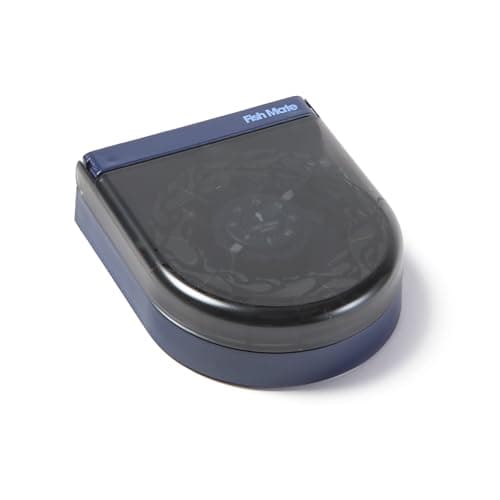 Fish Mate F14 Aquarium Fish Feeder Fourteen individually portioned compartments on a quartz timer. You decide the portion; it only decides the clock. | A trip of up to a week — the default answer | $19.99 on Amazon #ad How we’re funded · price as of November 3, 2026 |
| 2 | 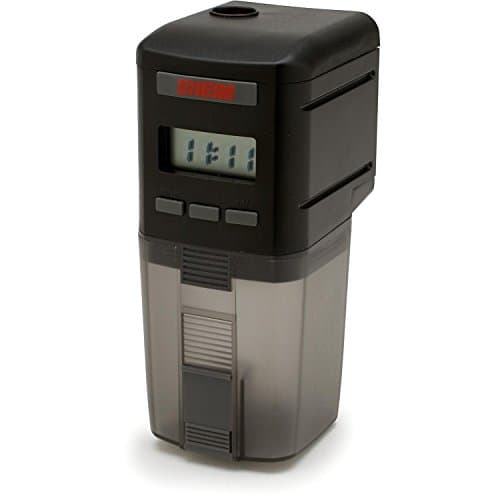 EHEIM Everyday Fish Feeder Programmable for up to four feeds a day with a fan to keep the food dry. The feature that matters is the ventilation. | Someone who travels regularly, in a humid room | $64.99 on Amazon #ad How we’re funded · price as of November 3, 2026 |
| 3 | 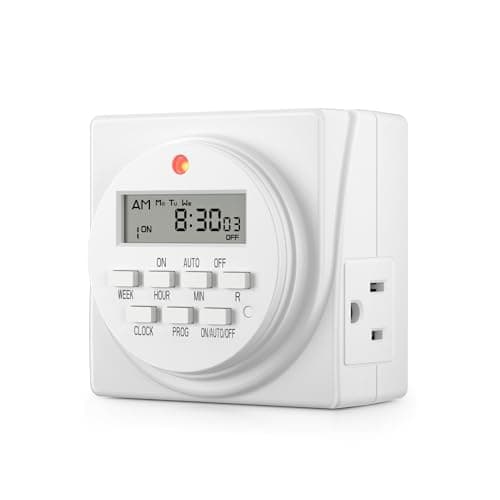 BN-LINK Indoor 7-Day Programmable Digital Timer Outlet A fixed photoperiod while you are away. Without it the tank gets either no light for a week or light around the clock. | The light, which matters more than the food on a short trip | |
| 4 | 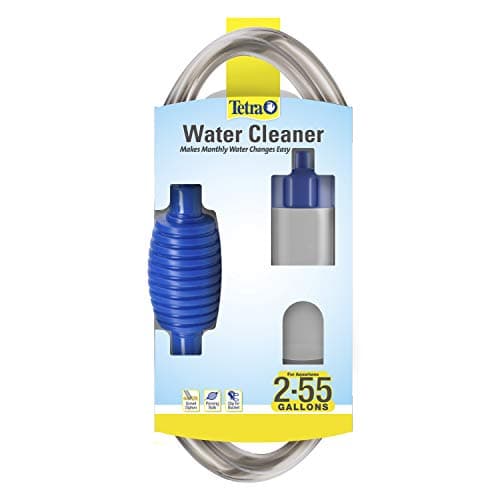 Tetra Water Cleaner Gravel Siphon The pre-trip water change is the single most effective thing you can do. Do it early, not late. | The water change you do a few days before you leave, not the night before | $10.29 on Amazon #ad How we’re funded · price as of November 3, 2026 |
| 5 | 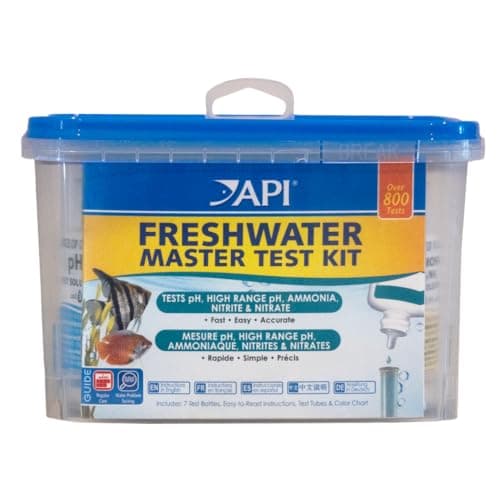 API Freshwater Master Test Kit Test the week before you travel. A tank reading anything other than zero ammonia is not a tank to leave. | Knowing the tank is stable before you leave it alone | $35.98 on Amazon #ad How we’re funded · price as of November 3, 2026 |
| ! | 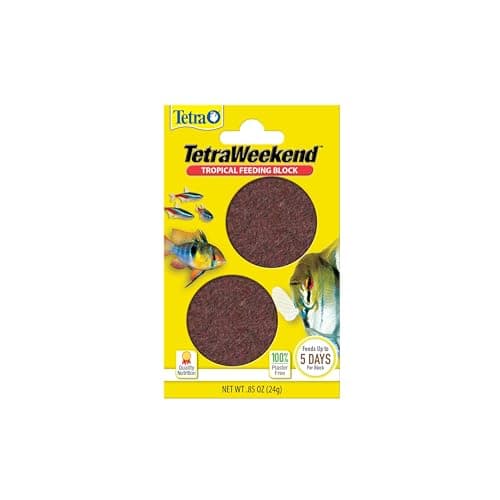 Tetra Weekend and Vacation Feeder A block releases food on its own schedule into a tank nobody is watching. No portion control, and the duration figures do not agree. Skip this one — see why below | Not the answer, on any length of trip | $4.09 on Amazon #ad How we’re funded · price as of November 3, 2026 |
Rows link to the full write-up further down this page. Prices come from the live price layer only; where there is no live figure the button reads “Check price” rather than showing a remembered number.
How we judged this, before any recommendation
Three criteria. Who controls the portion? — you, a machine following your instruction, or a dissolving object. What happens if it fails? — a feeder that jams leaves fish unfed, which they tolerate; a feeder that dumps leaves a tank fouled, which they do not. Does it need you to be there? — anything that needs judgment during the trip is not a solution.
On that last criterion, the single best-performing option for a short trip is nothing at all, which is why it is the answer at the top of this page rather than a product.
Match the plan to the length of the trip
| Away for | Feeding | Also do |
|---|---|---|
| 1 to 3 days | Nothing. Feed normally the morning you leave | Light on a timer; water change a few days before |
| 4 to 7 days | Nothing is still defensible for adult fish in a settled tank; a tested automatic feeder if you prefer | Light on a timer; water change 3-4 days before; test a week out |
| 7 to 14 days | Automatic feeder, portioned by you, tested for a week beforehand | Everything above, plus pre-portion spare food in case a helper is needed |
| Over 14 days | A person, with portions pre-measured into containers | Written instructions, your phone number, and the feeder as a backup |
| Any length, tank under 2 months old | Do not leave it unattended. A cycling tank needs daily testing | Arrange a competent person, or delay adding fish until after the trip |
| Any length, fry or a hospital tank | A person. Fry need frequent small feeds | Nothing automatic covers this case |
The short-break row follows NT Labs' published advice, cited at the foot of this page. Practical Fishkeeping notes a day or so unfed is unlikely to be an issue while a lengthy absence is likely to cause problems; the brackets in between are our own judgment for a settled beginner tank.
The week before you go
- Seven days out: test the water. Ammonia and nitrite at zero, nitrate not climbing. Anything else is a reason to reconsider leaving the tank alone.
- Five to three days out: do the water change. NT Labs specifically advises a few days before leaving rather than just before, so that you are present for the day or two afterwards. Vacuum the substrate as you siphon.
- Seven days out: set up and run the feeder, if you are using one. Both of our sources say the same thing — trial it. You are checking the portion size, that the food actually falls, and that it has not caked.
- Three days out: clean the glass and check the equipment. Filter flowing properly, heater holding temperature, thermometer reading what the heater claims. A filter you were going to service "soon" should be serviced now.
- Two days out: set the light timer to the tank's normal 6 to 8 hours and leave it running so you can confirm it switches.
- The day before: do not do anything new. No new fish, no new plants, no rearranging, no extra food. A disturbed tank is the last thing to walk away from.
- The morning you leave: feed normally. Not extra.
What actually goes wrong on an unattended tank
- Overfeeding, by a person or a block. Uneaten food becomes ammonia, and there is nobody testing or changing water. This is the number one cause by a wide margin, and the procedure for the aftermath is on how to lower ammonia in a fish tank fast.
- A light left on for the whole trip. Seven to fourteen days of continuous light with rising nutrients is how a clear tank turns green. Why is my fish tank water green covers the clean-up.
- Evaporation on an open-topped tank. A week of evaporation in a warm room drops the level noticeably, which can leave a filter intake sucking air or a heater element partly exposed. A lid largely solves this — see do I need a lid for a fish tank.
- A power cut you are not there for. Nothing in this list helps, but a digital light timer may lose its program and a filter that loses its prime may not restart. It is an argument for a self-priming filter rather than for anything you can do before you go.
- Leaving a brand-new tank. A tank under two months old is still establishing its bacteria colony, and that is the one state where a week alone is genuinely risky. If the trip is booked, delay the fish — how long does it take to cycle a fish tank explains why the clock does not care about your calendar.
Why fasting is safer than it sounds
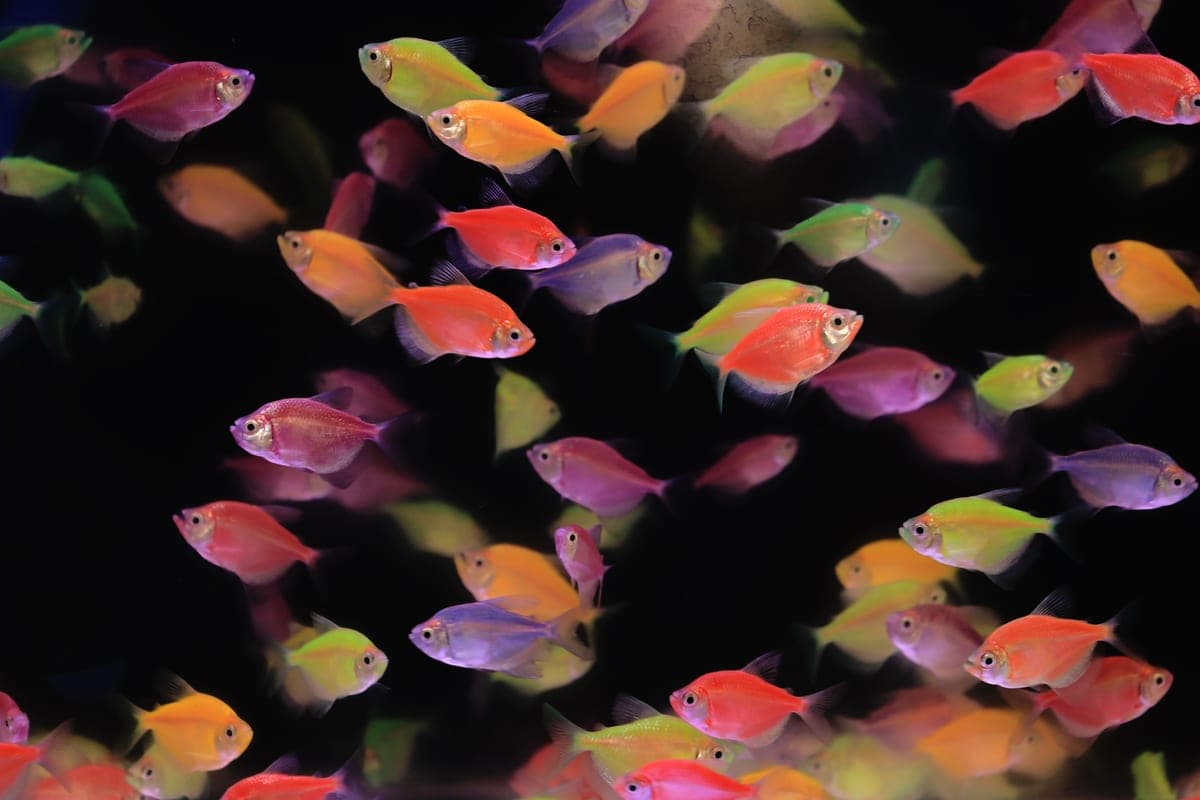
Adult fish in a settled, planted or established tank are not on a human eating schedule. They graze on biofilm, algae and whatever the substrate holds, and a few days without a feed is an ordinary condition rather than a deprivation — which is why the trade advice for a short break is to do nothing.
That is not a license to extend it indefinitely. Practical Fishkeeping is careful here: a day or so is unlikely to be an issue, a lengthy absence is likely to cause problems, and it cites a study in which goby cortisol levels were six times higher than usual after 20 days of fasting, while noting that results vary between species. Fry, recently imported fish and anything you are nursing are all exceptions.
The practical reading of all that: a week is comfortably inside the safe zone for adult community fish, two weeks needs a feeder or a person, and the risk you should actually be managing is water quality rather than hunger. If you are still deciding what to feed in normal weeks, that is the best aquarium fish food.
The scenario this page cannot plan for is a power cut while you are away. Nothing you can do remotely helps, but a backup air pump that arms itself does — see what to do with a fish tank in a power outage.
Pick 1
Fish Mate F14 Aquarium Fish Feeder
A trip of up to a week — the default answer
The number
Up to 14 meals total, 1 to 4 meals a day, one AA battery stated as over a year's continuous use, with a battery condition indicator.
A compartment feeder is the right shape of tool for this job, because it separates the two decisions. You portion each compartment yourself, with the food your fish already eat, in the amount they already get. The device's only job is to turn the drum on schedule.
That is the opposite of a feeder block, which decides the portion for you as it softens and keeps deciding while you are not there.
Fourteen meals at two a day is a one-week trip, which is exactly the case this page is written for. Mount it on a hood, a condensation tray or the glass edge with the included brackets, and run it for a week before you leave so you can see what it actually drops.
The honest costs. Fourteen compartments is a hard ceiling: at two meals a day it is seven days, not a fortnight, and there is no way to extend it. The battery is not included on the US listing. It needs a gap to drop food through, which a tank with a close-fitting glass top does not have until you make one. And a dry compartment feeder in a humid room can cake flake food into a plug that does not fall — the reason the trial run matters.
| Meals | Up to 14 individual meals in total |
|---|---|
| Meals per day | 1 to 4, set by a quartz timer |
| Battery | One AA battery, stated as over one year of continuous use, with a battery condition indicator |
| Mounting | Attaches to the aquarium hood, a condensation tray or the glass edge, using the included brackets |
| Food types | Flakes, pellets and sticks |
| Dimensions | 139 x 118 x 39 mm (5.5 x 4.625 x 1.5 in) |
| Guarantee | 3 years |
| What it does not do | Fourteen meals is a hard ceiling: at two meals a day that is a one-week trip, not a fortnight. The battery is not included on the US listing. It needs somewhere to sit and a gap to drop food through, which a tank with a close-fitting glass top does not have until you make one. And a compartment feeder meters by volume rather than by appetite, so you still portion every compartment yourself before you leave. |
Specs from Fish Mate 14-feed automatic aquarium fish feeder (F14), Closer Pets product page (14 meals, 1 to 4 meals per day, one AA battery, mounting options, food types, dimensions, 3-year guarantee); Fish Mate F14 Aquarium Fish Feeder, Amazon listing. We have not used this unit.
#ad How we’re funded · price as of November 3, 2026
Pick 2
EHEIM Everyday Fish Feeder
Someone who travels regularly, in a humid room
The number
Up to 4 programmed feeding times a day with a double-dose option, approximately 100 mL capacity, an integrated fan and ventilation system stated to prevent condensation, and a low-battery warning.
The reason to spend this much is not the programming — it is the fan. The failure mode of every drum feeder is damp food caking inside it, and a tank is a humidifier running directly underneath the device.
A unit with active ventilation is addressing the actual cause of automatic-feeder failures rather than adding feed times nobody needs. The low-battery warning is the other quietly valuable part: a feeder that dies silently on day three of a two-week trip is worse than no feeder at all.
If you travel a few times a year, a feeder that lives on the tank permanently and gets refilled is a better arrangement than one you set up each time.
The honest costs. It is roughly three times the price of a compartment feeder that will cover a one-week trip perfectly well. The clip bracket is reported not to open wide enough for some rimmed tanks, so check your rim first. The battery type is not published. And 100 mL is a capacity figure, not a portion figure — what it drops per feed depends entirely on the setting you dial in, which is another argument for testing it.
| Feeding times | Up to 4 programmed feeding times a day, with a double-dose option |
|---|---|
| Capacity | Approximately 100 mL feeding chamber |
| Moisture control | An integrated fan and ventilation system, stated to prevent condensation and keep the food dry |
| Battery | Battery operated, batteries included. The retailer does not name the battery type |
| Low battery | A warning system alerts you to low battery power |
| Dimensions | 6.25 x 2.875 x 3.75 in, including the mounting bracket |
| Manual feed | A button press gives an extra snack feed |
| What it does not do | It is the expensive answer to a cheap problem: for a single week away, a feeder costing a third as much does the same job. The clip bracket is reported not to open wide enough for some rimmed tanks, so check your rim before buying. The battery type is not published. And 100 mL is a capacity figure, not a portion figure, so what it actually drops per feed depends entirely on the setting you dial in. |
Specs from EHEIM Everyday Fish Feeder, Bulk Reef Supply listing (4 feeding times, approximately 100 mL capacity, integrated fan and ventilation, low battery warning, dimensions including bracket); EHEIM Everyday Fish Feeder, Amazon listing. We have not used this unit.
#ad How we’re funded · price as of November 3, 2026
Pick 3
BN-LINK Indoor 7-Day Programmable Digital Timer Outlet
The light, which matters more than the food on a short trip
The number
A 7-day programmable digital timer with two outlets, per the Amazon listing.
This is the cheapest pick here and the one most likely to be the difference between coming home to a normal tank and coming home to a green one.
An unattended tank is lit by whatever you left switched on. Left off for a week, live plants stall and start shedding. Left on for a week, you have given algae a seven-day uninterrupted photoperiod with nobody doing water changes.
A timer holding 6 to 8 hours a day keeps the tank on its normal schedule, which is also what the fish are used to.
The honest costs. No electrical rating is printed here because we could not verify one from a source that responds to us, so check the listing against what you are plugging in. A digital timer loses its program in a long outage unless it has battery backup, which is exactly the scenario you are not there for. Put only the light on it — a filter or heater on a timer is a far worse problem than any algae.
| Type | Plug-in digital timer, 7-day programmable, per the Amazon listing |
|---|---|
| Outlets | Two, so one timer runs a light and an air pump or a second tank |
| Why it matters | A fixed photoperiod is the cheapest algae control there is, and memory is not a schedule |
| What it does not do | No electrical rating is printed here because we could not verify one from a source that responds to us — check the listing against what you are plugging in. A digital timer also loses its program in a long outage unless it has battery backup, so check the schedule after the power goes out. A mechanical dial timer is cheaper and cruder if you prefer no programming at all. |
Specs from BN-LINK Indoor 7-Day Programmable Digital Timer Outlet, 2 outlets, Amazon listing. We have not used this unit.
Pick 4
Tetra Water Cleaner Gravel Siphon
The water change you do a few days before you leave, not the night before
The number
A manual siphon into a bucket: the cheapest way to do a proper gravel-vac water change.
NT Labs' advice on this is specific and worth following exactly: do a water change a few days before leaving rather than just before. The reason is that a water change is a disturbance, and you want to be present for the day or two afterwards in case something is off.
A tank with low nitrate and clean substrate when you walk out of the door has a much larger margin for a week of no maintenance than one you tidied up at 11pm the night before.
The honest costs. You carry the water, which is fine on a 10 or 20 gallon tank and the reason people stop doing changes on anything bigger. There is no flow control other than your thumb. And on a sand-bottomed tank the technique is different — hover rather than dig, which is covered on our sand page.
| Type | Manual siphon into a bucket |
|---|---|
| Cost | The cheapest way to do a proper gravel-vac water change |
| What it does not do | You carry the water. On a 10 or 20 gallon tank that is fine. The moment the tank gets big, it is the reason people quietly stop doing water changes. |
The manufacturer does not publish a full spec sheet for this item, so nothing beyond the figures above is stated. We have not used this unit.
#ad How we’re funded · price as of November 3, 2026
Pick 5
API Freshwater Master Test Kit
Knowing the tank is stable before you leave it alone
The number
Over 800 tests per kit, covering pH, high-range pH, ammonia, nitrite and nitrate.
This is the pick that decides whether you should be reading the rest of this page at all.
A settled tank with zero ammonia, zero nitrite and a sensible nitrate reading will coast through a week unattended. A tank that is still cycling, or newly stocked, or reading ammonia for any reason, is a tank that needs daily attention — and leaving it for a week with a feeder dropping food into it is how people come home to losses.
Test a week out, not the day before. That leaves time to do something about a bad number.
The honest costs. It does not test hardness, chlorine or alkalinity. It is slower and fiddlier than strips, the nitrate test needs the second bottle shaken hard and then a wait, and the color card is genuinely hard to read between adjacent shades under warm light. Reagents expire, so an old kit deserves suspicion before an important reading.
| Tests | pH, High Range pH, Ammonia, Nitrite, Nitrate |
|---|---|
| Capacity | Over 800 tests per kit |
| Contents | 7 bottles of test solution, 1 color card, 4 glass tubes with caps, holding tub |
| Type | Liquid reagent |
| What it does not do | Does not test hardness, chlorine or alkalinity. It is slower than strips, the nitrate test needs vigorous shaking of the second bottle and a wait, and the color card is genuinely hard to read between adjacent shades. |
Specs from API Freshwater Master Test Kit, Amazon listing; API Freshwater Aquarium Master Test Kit, PetSmart listing. We have not used this unit.
#ad How we’re funded · price as of November 3, 2026
Skip this
Tetra Weekend and Vacation Feeder
Not the answer, on any length of trip
The skip entry, and it is the product most people reach for first because it is the cheapest thing on the shelf.
The objection is not the formula. Practical Fishkeeping notes that the old plaster-of-Paris blocks could raise general hardness to unacceptable levels and that gel-carrier versions avoid that, so the modern products are better than their reputation on water chemistry.
The objection is control. A block releases food as it softens, at a rate set by your water and your fish's enthusiasm rather than by you, and whatever is not eaten becomes ammonia in a tank with nobody to test it. Practical Fishkeeping's own advice tells you something important by implication: run trial sessions with smaller pieces well before the holiday, because fish may not recognize a large unfamiliar object as food at all. A feeding method your fish might ignore is not a feeding method.
And for the trip most people buy it for — three or four days — the correct action according to the aquatics trade is to feed nothing at all.
The honest costs of the skip. It is very cheap, it needs no batteries and nothing can fail mechanically, which is a real argument in a tank with no feeding hole in the lid. Retailer listings for the Weekend and Vacation blocks disagree with each other on duration and we could not reach a Tetra document stating one, so if you do use it, read the package you bought rather than anything online.
| Type | A slow-release solid feeder block that sits in the tank |
|---|---|
| Stated duration | No figure is quoted here. Retailer listings for the Weekend block and the Vacation block disagree with each other, and we could not reach a Tetra document stating a duration for this item. Read the package you buy |
| Portioning | None. The block releases food as it softens, at a rate you do not set |
| What it does not do | This is the entry we tell readers to skip, and the reason is the row above it: a block releases food on its own schedule into a tank nobody is watching, and whatever the fish do not eat becomes ammonia. It does not replace a feeder, it is not needed at all for a trip under a week, and it is the cheapest way to come home to cloudy water. |
Specs from Tetra Weekend and Vacation Feeder slow-release fish food for tropical fish, Amazon listing. We have not used this unit.
Questions people actually ask
Frequently asked questions
+ How long can fish go without food?
+ Do I need an automatic fish feeder for a week away?
+ Are vacation feeder blocks safe?
+ Should I leave my fish tank light on while on vacation?
+ Should I do a water change before going on vacation?
+ Can I leave a new fish tank for a week?
+ What should I tell the person feeding my fish?
+ Should I turn the filter off while I am away?
Where the numbers came from
Sources
- NT Labs, What to do when you go on holiday ("If it's a short break of only a few days, it is best to do nothing"; do not provide more food just before going away; trial electronic feeders for a week beforehand; do a water change a few days before leaving rather than just before)
- Practical Fishkeeping, How to successfully feed fish during the holiday season (traditional plaster-of-Paris blocks can raise general hardness to unacceptably high levels; gel-carrier blocks avoid that; run trial sessions with smaller pieces well before the holiday; a day or so unfed is unlikely to be an issue while a lengthy absence is likely to cause problems)
- Fish Mate 14-feed automatic aquarium fish feeder (F14), Closer Pets product page (up to 14 meals, 1 to 4 meals per day on a quartz timer, one AA battery stated as over a year's use, mounts to hood, condensation tray or glass edge)
- EHEIM Everyday Fish Feeder, Bulk Reef Supply listing (up to 4 programmed feeding times a day, approximately 100 mL capacity, integrated fan and ventilation to keep food dry, low battery warning)
- Tetra Weekend and Vacation Feeder slow-release fish food for tropical fish, Amazon listing
- BN-LINK Indoor 7-Day Programmable Digital Timer Outlet, 2 outlets, Amazon listing
- API Freshwater Master Test Kit — Amazon listing (parameters tested, test count)
Read next
Related on Fin & Filter

The best aquarium fish food
Guaranteed analyses compared side by side, what the first ingredient tells you, and the treat sold as a staple.

How often to change aquarium water
The 25%-weekly default, how nitrate sets your real schedule, and the water change mistakes to avoid.
Do I need a lid for a fish tank?
Yes for almost every stocked tank. Glass versus mesh, what a hood gets you, and the fish that make it compulsory.