Head to head
Seachem Prime vs Tetra AquaSafe Plus
Two conditioners that do the same compulsory job. The difference is concentration, one extra claim, and what happens when your tank goes wrong at 11pm.
Fin & Filter earns a commission when you buy through the links on this page. It costs you nothing and it does not decide what we rank. How we’re funded.
We have not used any of this gear. Every pick below is chosen from published manufacturer specifications and the arithmetic on how we pick, which you can re-run yourself.
Buy Seachem Prime if your tank is new, cycling, recently stocked or in any kind of trouble: it asks for about 0.1 mL per gallon of new water against AquaSafe Plus's 0.5 mL, and Seachem states it detoxifies ammonia, nitrite and nitrate for up to 48 hours — a claim Tetra does not make. Tetra AquaSafe Plus is fine for an established, stable tank on a weekly water change, and it is probably already in your starter kit, where the sachet is a two-change sample rather than a supply. Neither is a substitute for the other in an ammonia emergency, because only one of them claims to help.
Both bottles clear the same bar: they make municipal tap water safe to put in an aquarium, which is a compulsory step rather than an optional one. Everything below is about what you get beyond that bar, and about the arithmetic that makes the shelf prices misleading.
Quick picks
Seachem Prime vs Tetra AquaSafe Plus
| # | Product | Best for | Price |
|---|---|---|---|
| 1 | 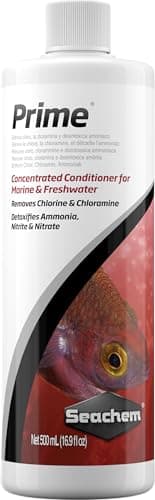 Seachem Prime Five times more concentrated per gallon treated, and it carries an ammonia-binding claim AquaSafe does not. | A tank that is new, cycling, recently stocked, or ever in trouble | $16.62 on Amazon #ad How we’re funded · price as of November 3, 2026 |
| 2 | 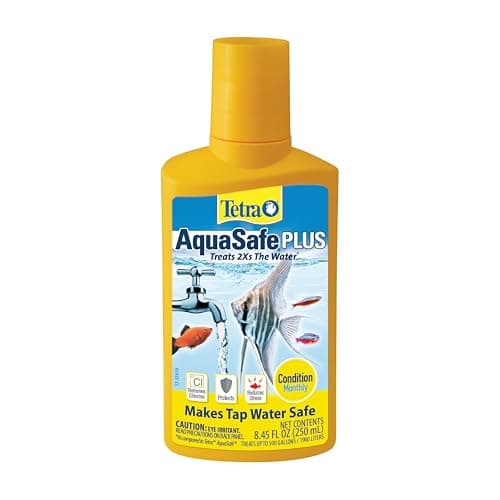 Tetra AquaSafe Plus Water Conditioner A competent dechlorinator with a slime-coat additive, dosed at five times the volume per gallon and sold in a sample size. | The bottle already in your starter kit, and an established tank on a weekly routine | $10.07 on Amazon #ad How we’re funded · price as of November 3, 2026 |
| 3 | 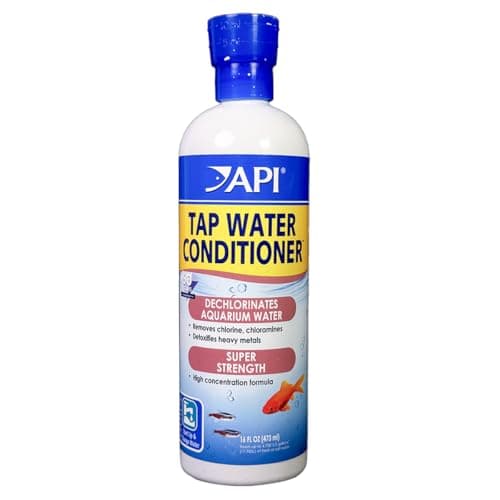 API Tap Water Conditioner, 16 oz Drops rather than capfuls, no extra claims, and a published dose that triples where chloramine is used. | The third option, if the only job you need doing is dechlorinating |
Rows link to the full write-up further down this page. Prices come from the live price layer only; where there is no live figure the button reads “Check price” rather than showing a remembered number.
How we judged this, before any recommendation
Four criteria, and the first one is the only one both products pass identically. Does it handle chloramine, not just chlorine? Both do. How much product per gallon treated? This is where they separate by a factor of five. Does it claim anything about ammonia? Only one does, and only in a specific window. Is the dose published clearly enough to follow? One is published by the manufacturer; the other reaches us through retailers who disagree with each other.
We are deliberately not ranking them on price. Shelf price is the wrong comparison for a product you dose by the millilitre, and the live price for each is on its buy row above, refreshed daily.
Side by side
| Seachem Prime | Tetra AquaSafe Plus | |
|---|---|---|
| Removes chlorine | Yes | Yes |
| Neutralizes chloramine | Yes | Yes — by breaking the chlorine-ammonia bond |
| Published dose | 1 capful (5 mL) per 50 US gal | 1 teaspoon (5 mL) per 10 US gal |
| Product per gallon treated | About 0.1 mL | About 0.5 mL — five times as much |
| Detoxifies ammonia | Yes — Seachem states up to 48 hours | No such claim |
| Detoxifies nitrite and nitrate | Seachem states yes | No claim |
| Slime-coat additive | No | Yes — Tetra's claim |
| Who publishes the dose | Seachem, on its own product page | Printed on the bottle; retailer listings disagree |
| Stated bottle coverage | Dose-derived from Seachem's figure | 8.45 oz treats up to 500 gal |
| The emergency bottle? | Yes | No |
Doses are each maker's own published figures as reproduced by the sources at the foot of this page. The per-gallon column is our arithmetic on those doses.
The row that decides most purchases is the fifth one. Chlorine removal is commodity chemistry and every conditioner on the shelf does it competently. A temporary ammonia-binding claim is the thing that separates these two bottles, and whether it is worth paying for depends entirely on whether your tank ever has ammonia in it — which is a test result, not a preference.
The dose arithmetic, which reverses the intuition
People compare these products by looking at two bottles on a shelf, and the bottle is not where the money goes. The dose is.
| Treating this much new water | Prime | AquaSafe Plus |
|---|---|---|
| 5 gallons (a bucket) | 0.5 mL — a few drops over half a capful mark | 2.5 mL — half a teaspoon |
| 10 gallons | 1 mL | 5 mL — one teaspoon |
| 25 gallons (a 20 gal tank, full change) | 2.5 mL — half a capful | 12.5 mL — two and a half teaspoons |
| 50 gallons | 5 mL — one capful | 25 mL — five teaspoons |
| 500 gallons (a year of weekly changes on a 20 gal tank) | 50 mL | 250 mL — a whole 8.45 oz bottle |
Computed from each product's published dose: 5 mL per 50 US gallons for Prime, 5 mL per 10 US gallons for AquaSafe Plus. The 500 gallon row matches Tetra's own stated coverage for the 8.45 oz bottle, which is the arithmetic checking itself.
That last row is the useful one. A year of ordinary maintenance on a 20 gallon tank — a 25% change most weeks — gets through roughly 250 to 300 gallons of new water. One small bottle of AquaSafe covers about that. The same year needs a fraction of a bottle of Prime. Whether that makes Prime cheaper in your hands depends on today's prices, which is why they are on the buy rows rather than in this paragraph.
The one situation where the cheaper bottle is the wrong buy
This is why we recommend Prime for the first six months of a tank's life regardless of what the starter kit supplied. It is not that AquaSafe is a bad conditioner; it is that the first six months are when ammonia readings happen, and the cheap insurance is worth having before you need it. The emergency procedure itself, in order, is on how to lower ammonia in a fish tank fast.
What neither of them does
- Neither cycles a tank. Conditioned water is safe water, not cycled water. That is how to cycle a fish tank, and no bottle on this page shortens it.
- Neither adds bacteria. The Seachem bottle people confuse with Prime is Stability, which is bottled bacteria and does nothing about chlorine — the mix-up is taken apart on Seachem Prime vs Stability.
- Neither removes ammonia. Prime binds it temporarily; AquaSafe makes no claim at all. Only a water change physically removes it.
- Neither replaces testing. The only way to know which of these two bottles your tank needs is to know whether it ever reads ammonia, and that is the best aquarium test kits.
- Neither fixes overstocking. A tank holding more fish than its filter supports will keep producing ammonia, and dosing either bottle is treating the symptom.
If the broader question is which conditioner to own at all rather than which of these two, the full shortlist is on the best aquarium water conditioners, and whether Prime's premium is justified against a basic dechlorinator is argued out on is Seachem Prime worth it. If the question underneath all of this is whether tap water is usable in the first place, start at can you use tap water in a fish tank.
Pick 1
Seachem Prime
A tank that is new, cycling, recently stocked, or ever in trouble
The number
Seachem's published dose is 1 capful (5 mL) per 200 L (50 US gallons) of new water — about 0.1 mL per gallon treated. Seachem states the binding of ammonia, nitrite and nitrate lasts up to 48 hours.
Two things separate this bottle from the other one, and only one of them is printed on the front.
The first is concentration. At 5 mL per 50 gallons, a dose is a capful for a volume most beginners will never change at once. That is why a bottle of Prime outlasts the tank's first year, and why comparing the two on shelf price is the wrong comparison.
The second is the ammonia claim, and it is the real reason to own it. Seachem states Prime detoxifies ammonia, nitrite and nitrate, binding them into a less toxic form for up to 48 hours. During a fish-in cycle, after a filter failure, or on the evening a test comes back wrong, that window is what buys you time to do water changes while the bacteria catch up. AquaSafe makes no equivalent claim.
The honest costs. It does not remove ammonia — it binds it, and your test kit will still read it afterwards, which confuses everyone the first time. The 48 hours is a window, not a fix, and using it as one is how fish end up living in slowly worsening water. It smells strongly of sulfur. And on a settled, cycled, lightly stocked tank the ammonia feature is insurance you pay for and never claim.
| Dose | 1 capful (5 mL) for each 200 L (50 US gallons) of new water |
|---|---|
| Removes | Chlorine, chloramine |
| Detoxifies | Ammonia, nitrite and nitrate |
| Binding duration | Seachem states it binds those compounds for up to 48 hours |
| What it does not do | It does not remove ammonia. It binds it into a less toxic form for up to 48 hours, and your test kit will still read the ammonia as present. It is not a bacteria product and it will not cycle a tank. |
Specs from Seachem, Prime product page. We have not used this unit.
#ad How we’re funded · price as of November 3, 2026
Pick 2
Tetra AquaSafe Plus Water Conditioner
The bottle already in your starter kit, and an established tank on a weekly routine
The number
Retailer-published dose: one teaspoon (5 mL) per 10 US gallons — about 0.5 mL per gallon treated. The 8.45 oz bottle is stated to treat up to 500 gallons.
On the compulsory job, this is a competent product. Retailers reproducing Tetra's label describe it neutralizing chloramine by breaking the bond between chlorine and ammonia, which is the mechanism that matters, and eliminating chlorine and heavy metals.
It also adds a slime coating that Tetra states helps wounds heal and protects fish from abrasions. That is the maker's claim rather than something we can verify, and it is the kind of claim that is genuinely plausible and genuinely unmeasurable from outside.
The quantity is the thing to understand. At a teaspoon per 10 gallons it asks for five times as much product per gallon as Prime does, and the sachet in a starter kit is a sample sized to get you started rather than to keep you going — about two water changes on a 20 gallon tank.
The honest costs. No ammonia-detoxifying claim, which is the one capability that matters in an emergency. Published doses disagree across retailers: one says a teaspoon per 10 gallons, another adds a capful per 20 gallons, so this is a product where you follow your own bottle and not a web page. And LiveAquaria's own listing states plainly that it will not remove ammonia from an un-cycled, overstocked or under-filtered aquarium.
| Type | Tap water conditioner for freshwater aquariums |
|---|---|
| Dosing | Printed on the bottle and varies by size. Follow the label. |
| What it does not do | A conditioner neutralizes tap water. It is not a substitute for a water change and it does not carry the ammonia-binding claim Prime does. |
The manufacturer does not publish a full spec sheet for this item, so nothing beyond the figures above is stated. We have not used this unit.
#ad How we’re funded · price as of November 3, 2026
Pick 3
API Tap Water Conditioner, 16 oz
The third option, if the only job you need doing is dechlorinating
The number
The retailer states about 1 drop per gallon for chlorine and heavy metals, about 3 drops per gallon where chloramine is used, and 9,460 gallons treated per 16 oz bottle.
Worth knowing about because it reframes the comparison. If you have a cycled, stable tank and you only ever need chlorine and chloramine gone, this does that job in drops and a bottle lasts years.
It is also the clearest published illustration of the chloramine point: the dose triples where the utility uses it. Most labels bury that; this one states it.
The honest costs. It makes no ammonia claim either, so it is not the emergency bottle. The retailer dose figures disagree with each other — drops per gallon in one place, teaspoons per hundred gallons in another — which again sends you to your own label. And dosing a 5 gallon bucket by counting drops is tedious enough that people guess, which defeats the point of a published figure.
| Job | Dechlorinator. Removes chlorine and neutralizes chloramine |
|---|---|
| Concentration | API markets it as highly concentrated, so a small bottle treats a large volume |
| Scope | A dechlorinator, and only that |
| What it does not do | It is not an ammonia detoxifier. That is the specific thing Prime does and this does not, and it is the whole reason the two are not interchangeable in an emergency. No bacteria, no slime-coat additive. |
Specs from API Tap Water Conditioner 16 oz, Amazon listing. We have not used this unit.
Questions people actually ask
Frequently asked questions
+ Is Seachem Prime better than Tetra AquaSafe?
+ Can I use Tetra AquaSafe instead of Seachem Prime?
+ How much Tetra AquaSafe Plus do I use per gallon?
+ How much Seachem Prime do I use per gallon?
+ Does Tetra AquaSafe remove chloramine?
+ Can I mix the two conditioners?
+ Is the AquaSafe sachet in my starter kit enough?
+ Does the slime-coat additive in AquaSafe matter?
Where the numbers came from
Sources
- Seachem Prime — product page (dose, what it removes, what it detoxifies, 48-hour binding claim)
- Tetra AquaSafe Plus 8.45 oz, That Pet Place listing (add one teaspoon / 5 mL for every 10 gallons; treats up to 500 gallons; neutralizes chloramine by breaking the bond between chlorine and ammonia; adds a slime coating)
- Tetra AquaSafe Plus, LiveAquaria listing (one teaspoon per 10 gallons, and separately one full capful per 20 gallons; 16.9 oz treats 1,000 gallons; will not remove ammonia from an un-cycled, overstocked or under-filtered aquarium)
- API Tap Water Conditioner 16 oz, That Pet Place listing (about 1 drop per gallon for chlorine and heavy metals, about 3 drops per gallon where chloramine is used; 16 oz stated to treat 9,460 gallons)
- US EPA, Chloramines in Drinking Water — why many utilities use chloramine rather than free chlorine
Read next
Related on Fin & Filter

Is Seachem Prime worth it?
Concentration, the ammonia-binding claim, and the specific situations where a cheaper dechlorinator is the right buy.
The best aquarium water conditioners
What conditioners actually remove, the ammonia-binding claim that matters in an emergency, and which to keep on the shelf.
Can you use tap water in a fish tank?
Yes, treated. Chlorine versus chloramine, why distilled water is a mistake, and the bottle to buy for your water.