Buying guide
The best heater for a 30 gallon tank
Thirty gallons is where heater labels stop being approximately right and start being wrong. Three of the heaters sold for this size hold the temperature only in a room that never gets cold, and the box does not say so.
Fin & Filter earns a commission when you buy through the links on this page. It costs you nothing and it does not decide what we rank. How we’re funded.
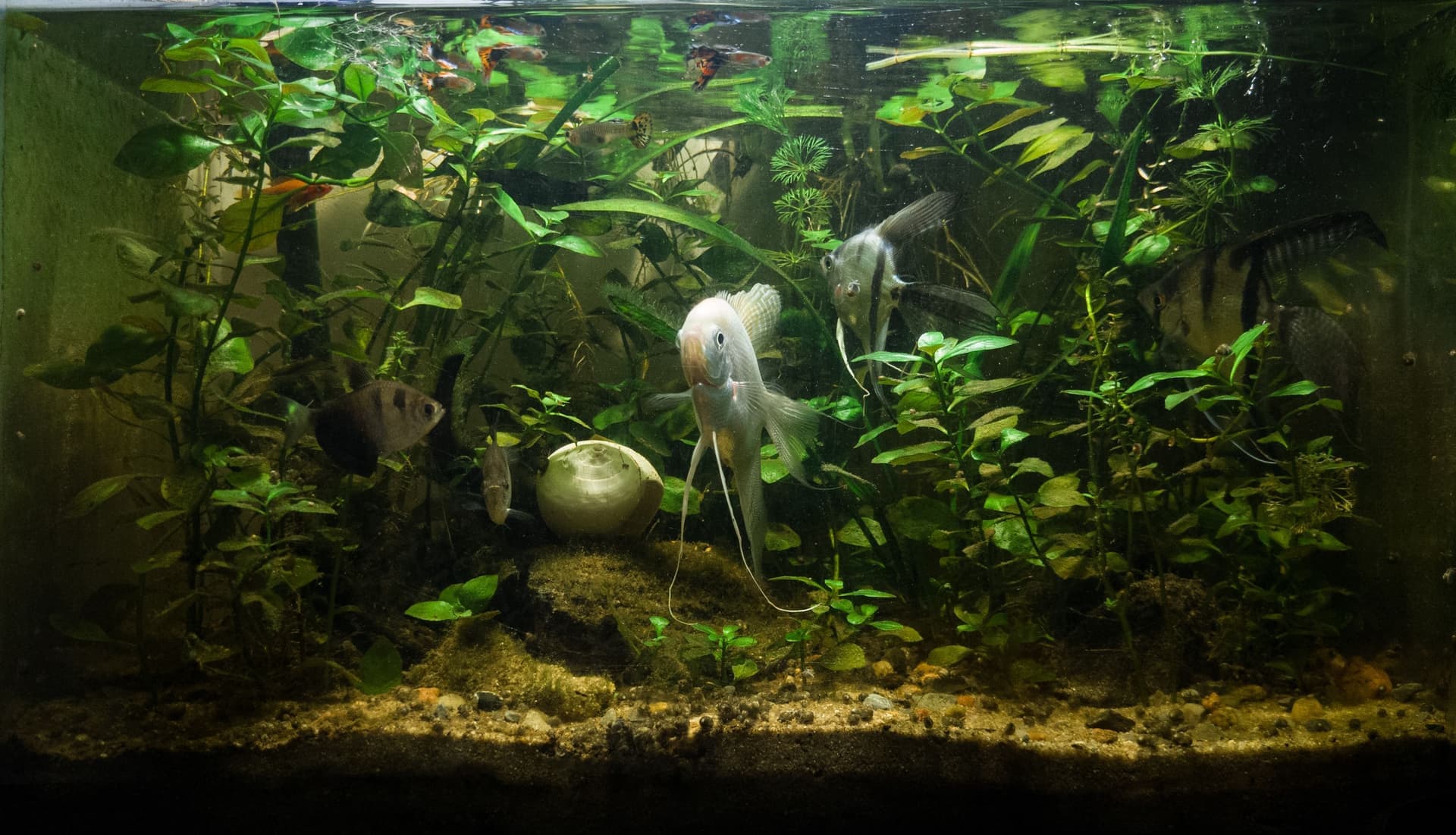
We have not used any of this gear. Every pick below is chosen from published manufacturer specifications and the arithmetic on how we pick, which you can re-run yourself.
About 150 watts in a normal room. A 30 gallon tank needs roughly 5 watts per gallon to hold a 78 F tank in a room that bottoms out near 68 F, which is a 10 degrees F lift. Allow 90 W if the room never gets cold and 225 W if it drops into the low 60s. The 100 W unit labeled for 30 gallons is the warm-room case only.
Thirty gallons is the point where this stops being a formality. On a 10 gallon tank almost any heater sold for it is close enough; the volume is small, the swings are fast but shallow, and a 50 W unit has margin. At 30 gallons the margins are gone, and the gap between the wattage on the box and the wattage the tank needs is wide enough to leave a tank running cold all winter.
The criterion: wattage is a function of lift, not just volume
State the criterion before the shortlist. A heater does not heat water to a temperature; it replaces heat the tank loses to the room. So the figure that decides the wattage is not the tank volume on its own — it is the volume multiplied by how far above the coldest realistic room temperature you need to hold the water. That gap is the lift, and the whole method is on how we pick.
| Tank | Warm room (5 F lift) | Normal room (10 F lift) | Cold room (15 F lift) | Very cold (20 F lift) |
|---|---|---|---|---|
| 29 gallon | 85 W | 145 W | 220 W | 290 W |
| 30 gallon | 90 W | 150 W | 225 W | 300 W |
| 40 gallon | 120 W | 200 W | 300 W | 400 W |
| 55 gallon | 165 W | 275 W | 415 W | 550 W |
Our bands are 3 W per gallon for a 5 F lift, 5 for 10 F, 7.5 for 15 F and 10 for 20 F. The bolded column is the one most houses need: a 78 F tank in a room that reaches about 68 F on a winter night. Measure your own room on the coldest morning of the year rather than guessing, because this is the input the answer is most sensitive to.
Every label in this class is written for a warmer room than yours
This is the finding that produced the page. We put each heater's own stated tank ceiling next to the watts-per-gallon it implies, and then next to what our method says that wattage actually holds. Four of the six disagree with their own box, in the same direction, by roughly a factor of two.
| Heater | Its label says | W per gallon at that label | What our method says it holds |
|---|---|---|---|
| Aqueon Pro 100 | Up to 30 gallons | 3.3 | 30 gallons in a warm room only (5 F lift) |
| Aqueon Pro 150 | Up to 55 gallons | 2.7 | 29 to 30 gallons at a 10 F lift |
| Fluval M150 | Up to 45 gallons | 3.3 | 29 to 30 gallons at a 10 F lift |
| Aqueon Pro 200 | Up to 75 gallons | 2.7 | 40 gallons at a 10 F lift |
| hygger 300 W titanium | 50 to 60 gallons | 5.0 to 6.0 | 50 to 60 gallons at a 10 F lift — the label agrees |
| Eheim Jager 150 and 250 | No per-model gallon rating published | n/a | 150 W: 30 gallons. 250 W: 50 gallons. Both at a 10 F lift |
Label figures are quoted from each maker's or listing's own published specification, all cited in Sources. The watts-per-gallon column is arithmetic on those two numbers and nothing else.
Two things are worth drawing out, because they are the page's actual value. The first is that the pattern is not universal: the hygger titanium listing claims 50 to 60 gallons for 300 W and our method agrees with it, which means the others are making a choice rather than following an industry standard. The second is that Eheim declines to print a per-model gallon figure at all and publishes a wattage and a tolerance instead. That looks less helpful on a shelf and is the more honest answer, because the correct tank for a given wattage depends on the room.
How we judged these
- Wattage against the lift, not against the label. Every pick is sized with the table above and the arithmetic is printed on each entry.
- A published thermostat tolerance, where one exists. A heater is a thermostat first. Brands that publish an accuracy figure are ranked above brands that ask you to trust them.
- Whether the body is glass. The common way a heater dies is impact during a water change, not electronics, so a shatterproof or titanium body is a real durability difference.
- Whether it physically fits. A 29 gallon tank is 18 inches tall. Heater length is printed where the maker publishes it, and flagged where it forces horizontal mounting.
- Adjustability. Preset heaters are excluded at this size: a fixed target you cannot move is not usable across a cold winter and a warm summer in the same room.
- What the maker does not publish. Where a figure is absent we say so rather than filling it in. Two heaters here are missing an accuracy tolerance, and one is missing almost everything.
Quick picks
Heaters that suit 29 to 30 gallons, and the sizes above it
| # | Product | Best for | Price |
|---|---|---|---|
| 1 | 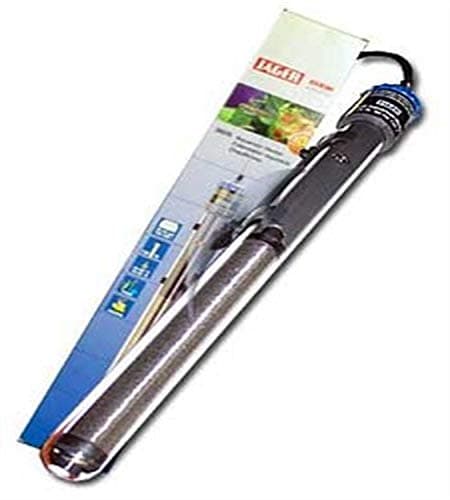 Eheim Jager TruTemp Heater, 150W 150 W with a published accuracy tolerance and a dial you can recalibrate — the only heater here that tells you how precise it is. | A 29 or 30 gallon tank in almost any room | $45.98 on Amazon #ad How we’re funded · price as of November 3, 2026 |
| 2 | 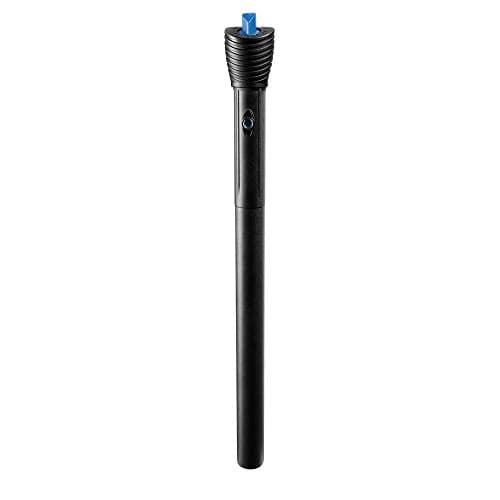 Aqueon Pro 150 Submersible Heater, 150 W The same 150 W in a shatterproof body with no glass components, at a noticeably higher price. | A tank near children, a heavy hand, or a history of broken glass | $64.95 on Amazon #ad How we’re funded · price as of November 3, 2026 |
| 3 | 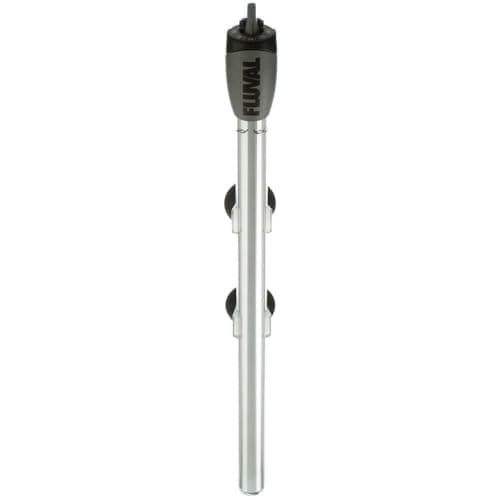 Fluval M150 Submersible Heater (150W) 150 W at the lowest price here, from a brand whose site will not tell us anything else about it. | The cheapest sound way to put 150 W in the tank | $36.94 on Amazon #ad How we’re funded · price as of November 3, 2026 |
| 4 | 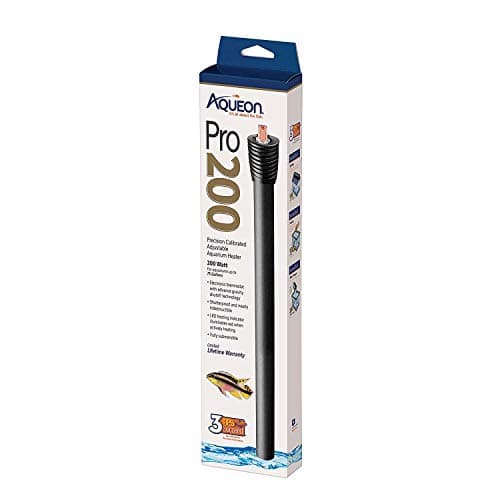 Aqueon Pro 200 Submersible Heater, 200 W 200 W of shatterproof headroom — the right answer when the room, not the tank, is the problem. | A 30 gallon tank in a cold room, or a 40 gallon tank in a normal one | $66.95 on Amazon #ad How we’re funded · price as of November 3, 2026 |
| 5 | Eheim Jager TruTemp Heater, 250W The same published thermostat as the 150 W Jager, with enough wattage for the top of this range. | A 50 gallon tank, or a 40 gallon one somewhere genuinely cold | $54.98 on Amazon #ad How we’re funded · price as of November 3, 2026 |
| 6 | 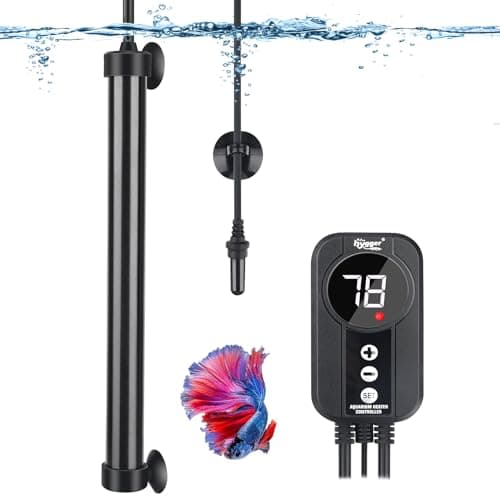 hygger Titanium Aquarium Heater, 300 W Titanium rather than glass, with an external controller — and the only heater here whose own tank label agrees with our arithmetic. | The 55 to 60 gallon end, and anyone who has broken a glass heater twice | |
| ! | 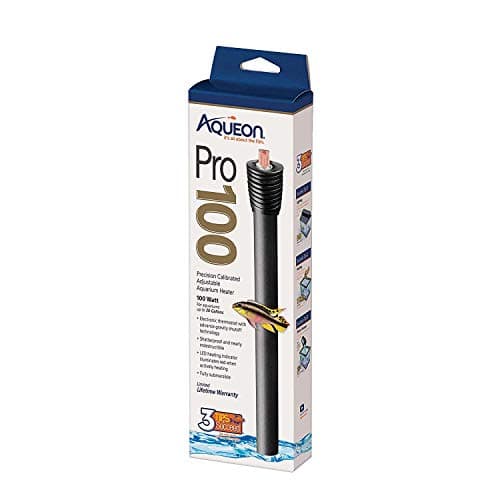 Aqueon Pro 100 Submersible Heater, 100 W A good 100 W heater carrying a label that reads up to 30 gallons — which is true only in a room that never gets cold. Skip this one — see why below | Not a 30 gallon tank, despite what the box says | $62.95 on Amazon #ad How we’re funded · price as of November 3, 2026 |
Rows link to the full write-up further down this page. Prices come from the live price layer only; where there is no live figure the button reads “Check price” rather than showing a remembered number.

If your tank is 40 or 55 gallons
The table above carries both sizes, and the short version is 200 W for a 40 gallon tank and 275 W for a 55 in a normal room. The Aqueon Pro 200 lands exactly on the 40 gallon figure, the Eheim Jager 250 is the honest choice for a 50 gallon tank and the warm-room option at 55, and the hygger 300 W is the general answer at the top of the range.
Filtration at those sizes is already worked out here: the best filter for a 40 gallon tank and the best filter for a 55 gallon tank. If you are at 30 gallons, the matching filter shortlist is the best filter for a 30 gallon tank, which uses the same arithmetic-first approach on flow instead of watts.
Pick 1
Eheim Jager TruTemp Heater, 150W
A 29 or 30 gallon tank in almost any room
The number
150 W in a 30 gallon tank is 5 W per gallon, which covers roughly a 10 degrees F lift: a 78 F tank in a room that bottoms out near 68 F. Eheim states an adjustment range of 18 to 34 C, a control accuracy of plus or minus 0.5 C, and recalibration at plus or minus 2 C.
This is the default for the size, and the reason is a number on a spec sheet rather than a brand preference. Eheim publishes a control accuracy tolerance. Almost nobody else in this class does, and a heater is a thermostat first and a heating element second — the element is a coil of wire, while the thermostat is the entire product.
Recalibration is the feature that matters in year three rather than week one. Thermostats drift. A heater you can bring back into line against a thermometer stays correct; one you cannot gets quietly replaced after it has been running two degrees low for a season.
Eheim is also the only brand on this page that does not print a per-model gallon rating. It publishes a line-wide range of 20 to 1000 liters across nine sizes and leaves the sizing to you. That looks unhelpful next to a box that says a number, and it is the more honest position, because the right tank for a given wattage depends on the room as much as the volume.
The honest costs. It is glass-bodied, so it breaks if you knock it against the rim or leave it exposed while the tank is drained, which is how most heaters actually die. At 13.75 inches it is long for a standard 29 gallon tank, which is only 18 inches tall, so plan on mounting it horizontally along the back rather than vertically. And no thermometer is included, which on an adjustable heater is not optional.
| Wattage | 150 W |
|---|---|
| Adjustment range | 18 to 34 C |
| Control accuracy | Plus or minus 0.5 C |
| Recalibration | User-recalibratable at plus or minus 2 C |
| Length | 13.75 inches |
| Body | Jacket of special laboratory glass |
| What it does not do | Eheim publishes no per-model gallon rating — only a line-wide range of 20 to 1000 liters across nine sizes — so the tank it suits is arithmetic rather than a label. Glass-bodied, and at 13.75 inches it is long for a standard 29 gallon tank, which usually means mounting it horizontally along the back. No thermometer included. |
Specs from Eheim Jager TruTemp 150W, retailer spec sheet (150 W, 18-34 C adjustment, plus or minus 0.5 C control accuracy, recalibration at plus or minus 2 C, 13.75 inch length, laboratory glass jacket). We have not used this unit.
#ad How we’re funded · price as of November 3, 2026
Pick 2
Aqueon Pro 150 Submersible Heater, 150 W
A tank near children, a heavy hand, or a history of broken glass
The number
150 W, which is 5 W per gallon on 30 gallons and about a 10 degrees F lift. Aqueon states it is recommended for aquariums up to 55 gallons — a claim this page disagrees with, because 150 W across 55 gallons is 2.7 W per gallon, below even our warm-room figure.
Every other adjustable heater here is a glass tube. This one is not, and if you have ever swept broken glass out of a bucket you already know what that is worth. Aqueon states a shatterproof body with no glass components, which removes the failure mode that kills heaters in practice: physical impact during a water change rather than any electrical fault.
The auto shut-off is a real safety feature rather than packaging language. Aqueon states it protects the heater from overheating, which covers the classic mistake of leaving the unit powered with the water level dropped below it. The red and green monitor light shows heating and set-temperature status, so you can see at a glance whether it is calling for heat.
Buy it at 150 W for a 29 or 30 gallon tank and it is a good heater. Buy it for the 55 gallon tank on the label and it will run continuously through a cold week and still lose ground.
The honest costs. It is by a distance the most expensive heater on this page, and it is the one whose label is furthest from the arithmetic. Aqueon publishes no thermostat accuracy tolerance and no length on the product page, so neither is printed here — you are trusting the brand rather than a figure, which is exactly the trade the Eheim lets you avoid.
| Wattage | 150 W |
|---|---|
| Stated tank size | Recommended for aquariums up to 55 gallons |
| Temperature range | 68 to 88 F |
| Housing | Shatterproof heater body with no glass components |
| Safety | Auto shut-off protects the heater from overheating; red/green monitor light shows heating and set-temperature status |
| What it does not do | The stated ceiling of 55 gallons is 2.7 W per gallon, which is below even the warm-room figure our method uses — treat 150 W as a 29 to 30 gallon heater, not a 55 gallon one. Aqueon publishes no thermostat accuracy tolerance and no length on this product page, so neither is printed here. No thermometer included. |
Specs from Aqueon Pro Aquarium Heater 150 Watt, retailer listing (150 W, recommended up to 55 gallons, 68-88 F, shatterproof body with no glass components, auto shut-off, red/green monitor light). We have not used this unit.
#ad How we’re funded · price as of November 3, 2026
Pick 3
Fluval M150 Submersible Heater (150W)
The cheapest sound way to put 150 W in the tank
The number
150 W is 5 W per gallon on a 30 gallon tank, the same 10 degrees F lift as the two above. The listing states up to 45 gallons, which works out at 3.3 W per gallon — a warm-room figure rather than a general one.
The M series is the compact, flat-profile heater that disappears against the back glass better than a cylindrical tube does, and at this wattage it is the least expensive legitimate option on the page by a wide margin.
It belongs here because the wattage is the thing that matters most, and 150 W is 150 W. A heater that holds the right temperature for half the price of the shatterproof option is a reasonable purchase for a tank that lives somewhere nothing gets knocked.
The honest costs, and they are mostly about what we cannot tell you. Fluval's own site does not respond to us, so the only figures printed are the ones the listing itself states: the wattage and the 45 gallon claim. No temperature range, no cord length, no accuracy tolerance. That is a real gap next to the Eheim, and it is why this is not the default pick despite being the cheapest. It is also glass-bodied, and no thermometer is included.
| Wattage | 150 W |
|---|---|
| Stated tank size | Up to 45 gallons, per the Amazon listing |
| What it does not do | Fluval's own site does not respond to us, so only the figures the listing itself states are printed — no temperature range, no cord length and no accuracy tolerance. The stated 45 gallon ceiling is 3.3 W per gallon, which is a warm-room figure rather than a general one. No thermometer included. |
Specs from Fluval M 150-Watt Submersible Aquarium Heater, up to 45 gallons, Amazon listing. We have not used this unit.
#ad How we’re funded · price as of November 3, 2026
Pick 4
Aqueon Pro 200 Submersible Heater, 200 W
A 30 gallon tank in a cold room, or a 40 gallon tank in a normal one
The number
200 W on a 40 gallon tank is 5 W per gallon, our 10 degrees F lift figure, so this is the correct size for 40 gallons. On a 30 gallon tank it is 6.7 W per gallon, which buys margin for a room that drops into the low 60s. Aqueon states it is recommended for aquariums up to 75 gallons; 200 W across 75 gallons is 2.7 W per gallon, so read that ceiling as a warm-room claim.
Wattage is not only a function of volume. It is a function of how far above the coldest realistic room temperature you have to hold the tank, and that is why there is no single right answer for 30 gallons. If your tank sits in a room that genuinely drops to the low 60s overnight in winter, 150 W is marginal and this is the honest purchase.
It is also the correct default if your tank is actually 40 gallons rather than 30. The arithmetic lands exactly on 200 W there, with the same shatterproof body and auto shut-off as the 150 W version.
There is a limit to how far oversizing helps, which is worth saying because the instinct is to buy the biggest heater available. A heater that is far too large heats the water faster than the thermostat reacts, which produces a wider swing around the set point rather than a tighter one. One size of headroom is sensible; three is not.
The honest costs. The same missing specification as the 150 W model: no published accuracy tolerance and no length. It is the most expensive unit here. And on a 30 gallon tank in a warm room it is simply more heater than you need, at a higher price and a higher swing.
| Wattage | 200 W |
|---|---|
| Stated tank size | Recommended for aquariums up to 75 gallons |
| Temperature range | 68 to 88 F |
| Housing | Shatterproof construction with no glass components |
| Safety | Auto shut-off when overheated or left out of water; power monitor light |
| What it does not do | Aqueon publishes no thermostat accuracy tolerance or heater length on this product page, so neither is printed here. No thermometer included. It appears on this site as a deliberate OVERSIZE example: 200 W is rated for up to 75 gallons, which is seven times the volume of a 10 gallon tank, and nothing about the heater's quality changes that arithmetic. |
Specs from Aqueon Pro Aquarium Heater 200 Watt, retailer listing (200 W, recommended up to 75 gallons, 68-88 F, shatterproof with no glass components, auto shut-off, power monitor light). We have not used this unit.
#ad How we’re funded · price as of November 3, 2026
Pick 5
Eheim Jager TruTemp Heater, 250W
A 50 gallon tank, or a 40 gallon one somewhere genuinely cold
The number
250 W is 5 W per gallon on a 50 gallon tank — our 10 degrees F lift figure, so it is the correct size there. On 40 gallons it is 6.3 W per gallon, which covers a cold room. On 55 gallons it falls to 4.5 W per gallon, short of the 275 W our method asks for.
Included because the sizes above 30 gallons are the ones this site had no heater page for at all, and because a reader whose filter research brought them here from our 40 or 55 gallon pages needs a wattage that actually matches.
Everything that makes the 150 W Jager the default applies identically: the same 18 to 34 C adjustment range, the same plus or minus 0.5 C stated control accuracy, the same user recalibration. Eheim does not change the thermostat between sizes, it changes the element.
Note what it does not do. On a 55 gallon tank it is 25 W short of our figure, and we would rather say that than round it off — at 55 gallons this is the warm-room option and the 300 W unit below is the general one.
The honest costs. It is 18 inches long, which is longer than the water is deep in most 29 and 40 gallon tanks, so it has to lie horizontally or at a steep angle. Glass-bodied again. No per-model gallon rating published, no thermometer included.
| Wattage | 250 W |
|---|---|
| Adjustment range | 18 to 34 C |
| Control accuracy | Plus or minus 0.5 C |
| Recalibration | User-recalibratable at plus or minus 2 C |
| Length | 18 inches |
| Body | Jacket of special laboratory glass |
| What it does not do | At 18 inches it is longer than the water is deep in most 29 and 40 gallon tanks, so it has to lie at an angle or horizontally. Eheim publishes no per-model gallon rating. Glass-bodied, and no thermometer included. |
Specs from Eheim Jager TruTemp 250W, retailer spec sheet (250 W, 18-34 C adjustment, plus or minus 0.5 C control accuracy, recalibration at plus or minus 2 C, 18 inch length, laboratory glass jacket). We have not used this unit.
#ad How we’re funded · price as of November 3, 2026
Pick 6
hygger Titanium Aquarium Heater, 300 W
The 55 to 60 gallon end, and anyone who has broken a glass heater twice
The number
300 W is 5 W per gallon on 60 gallons and 6 W per gallon on 50 — a 10 degrees F lift across the whole range the listing claims. The listing states 50 to 60 gallon tanks, and our method asks for 250 W at 50 gallons and 300 W at 60. That is the one label on this page we do not have to argue with.
It would be easy to write a page saying every manufacturer inflates its tank ratings, and it would be wrong. This listing claims 50 to 60 gallons for 300 W, our method asks for 250 to 300 W across that range, and the two agree. It is worth naming because it is the exception that shows the others are a choice rather than an industry convention.
The titanium element is the other reason it is here. Glass heaters break, and they break in the one situation where it matters — a hand in the tank, a rim knocked during a water change. Titanium removes that failure mode in a way a plastic sleeve over glass does not.
The external controller means setting and reading the temperature without putting an arm in the water, which in practice is the difference between a heater you adjust when the seasons change and one you set once and never touch again.
The honest costs. No accuracy tolerance is published, so the temperature-calibration feature is a claim rather than a specification, and we have printed it as one. The controller is another component to place, keep dry and eventually replace, and its readout is not an independent thermometer in the water. hygger is a marketplace brand, so expect less support continuity than Eheim or Aqueon.
| Wattage | 300 W |
|---|---|
| Stated tank range | 50 to 60 gallons, per the Amazon listing |
| Element | Titanium rather than glass |
| Control | Digital LED controller with a separate temperature probe |
| Calibration | Temperature calibration, per the listing |
| What it does not do | No accuracy tolerance is published, so the calibration feature is a claim rather than a specification. The external controller is another component to place, keep dry and eventually replace, and its readout is not an independent thermometer in the water. hygger is a marketplace brand, so expect less support continuity than Eheim or Aqueon. No thermometer included. |
Specs from hygger Aquarium Heater 300W titanium with digital LED controller and temperature probe, for 50-60 gallon tanks, Amazon listing. We have not used this unit.
Skip this
Aqueon Pro 100 Submersible Heater, 100 W
Not a 30 gallon tank, despite what the box says
This is the entry this page exists for. Aqueon states the Pro 100 is for aquariums up to 30 gallons, so it is the unit a 30 gallon owner reaches for, and on our own filter and heater pages it is a recommended product at 20 gallons. The heater is not the problem; the label is.
Run the arithmetic. 100 W across 30 gallons is 3.3 W per gallon, which is the band our method ties to a 5 degrees F lift. It will hold a 78 F tank in a room that never drops below about 73 F. In a house that sits at 68 F overnight it runs continuously and still comes up short, and in a cold snap it loses several degrees.
The failure is quiet, which is what makes it worth a skip entry rather than a footnote. A heater that is slightly undersized does not trip a breaker or flash a warning. It simply runs all the time, and the tank sits a few degrees low all winter, and the fish are stressed for months without anything looking broken.
If you already own one and your tank is 30 gallons, you do not necessarily need to replace it — put a thermometer in the water, watch it through a cold week, and buy the 150 W only if the reading drops. That is cheaper than our advice and more likely to be right than either of us guessing about your house.
| Wattage | 100 W |
|---|---|
| Stated tank size | Up to 30 gallons |
| Temperature range | 68 to 88 F |
| Housing | Shatterproof construction with no glass components |
| Safety | Auto shut-off if overheated or not properly positioned; power monitor light |
| What it does not do | Aqueon does not publish a thermostat accuracy tolerance or a heater length on this product page, so neither is printed here. No thermometer included, and it is the most expensive heater on our 20 gallon shortlist. |
Specs from Aqueon Pro Aquarium Heater 100 Watt, retailer listing (100 W, up to 30 gallons, 68-88 F, shatterproof with no glass components, auto shut-off, power monitor light). We have not used this unit.
One heater or two
At 30 gallons and above, splitting the wattage across two smaller heaters is a genuine option rather than an indulgence, and it is the one piece of advice here that costs more than it saves.
- A stuck-on thermostat cooks half as fast. Two 75 W heaters cannot boil a 30 gallon tank the way one 150 W unit left jammed closed can. This is the real argument.
- A failure is survivable rather than total. If one unit dies in January, the tank drifts down slowly instead of falling to room temperature.
- It evens out the temperature in a long tank, where one end can sit a degree or two below the other.
- It costs more and clutters the tank. Two heaters, two cords, two things to hide. On a first tank this is usually not worth it; by a third tank most people have been burned once and do it anyway.
The thermometer is not optional
Every heater on this page is sold without one, and a heater dial is a setting rather than a reading. Without an independent thermometer in the water you have no way to know whether the unit is holding the temperature it claims, and no way to catch the slow drift that makes an old thermostat dangerous. The shortlist is on the best aquarium thermometers, and it is the cheapest item on any of these pages.
Where it goes, and the one mistake everyone makes once
Near the filter outflow, so moving water carries the heat around the tank instead of letting it stratify in one corner. The full placement argument, for both the heater and the filter, is on where to place a filter and heater.
The mistake is draining the tank for a water change with the heater still plugged in. Exposed to air, the element keeps heating and either cracks the glass or cooks itself, and the shatterproof and auto shut-off features on the Aqueon units exist specifically because of how often this happens. Unplug it first, and give it a few minutes before refilling.
One more thing worth stating plainly: not every tank needs a heater at all. If you are keeping goldfish, the answer is no, and heating the tank actively makes the water quality worse — the argument is on whether goldfish need a filter and a heater. And if the tank is not cycled yet, the heater is not the thing to fix first: start at how to cycle a fish tank.
Questions people actually ask
Frequently asked questions
+ What size heater do I need for a 30 gallon tank?
+ Is a 100 watt heater enough for a 30 gallon tank?
+ Can a heater be too powerful for a tank?
+ Why do heater boxes say a bigger tank than you recommend?
+ How long should a heater be for a 29 gallon tank?
+ Should I use two heaters instead of one?
+ Do I need a thermometer if the heater has a dial?
+ Does a goldfish tank need a heater?
Where the numbers came from
Sources
- Eheim Jager TruTemp 150W, retailer spec sheet (150 W, 18-34 C adjustment, plus or minus 0.5 C control accuracy, recalibration at plus or minus 2 C, 13.75 inch length)
- Eheim Jager TruTemp 250W, retailer spec sheet (250 W, same 18-34 C adjustment and plus or minus 0.5 C accuracy, 18 inch length)
- Aqueon Pro Aquarium Heater 150 Watt, retailer listing (150 W, recommended up to 55 gallons, 68-88 F, shatterproof body with no glass components, auto shut-off, red/green monitor light)
- Aqueon Pro Aquarium Heater 100 Watt, retailer listing (100 W, up to 30 gallons, 68-88 F, shatterproof)
- Aqueon Pro Aquarium Heater 200 Watt, retailer listing (200 W, recommended up to 75 gallons, 68-88 F, shatterproof)
- Fluval M 150-Watt Submersible Aquarium Heater, stated up to 45 gallons, Amazon listing
- hygger Aquarium Heater 300W titanium with digital LED controller and temperature probe, stated for 50-60 gallon tanks, Amazon listing
- Aquarium Co-Op forum, heater sizing chart: temperature, watts, gallons
- Petco, aquarium heater types and wattage guide
Read next
Related on Fin & Filter
The best heater for a 20 gallon tank
100 W is the default and 60 W is the warm-room floor. Which heaters hit it, and why a 50 W unit sold for 20 gallons does not.

The best filter for a 30 gallon tank
The 257 GPH figure a stocked 30 gallon needs, which filters clear it, and the tank-size label that misleads worst.
The best aquarium thermometers
Why a heater dial is not a reading, which thermometer to trust, and the stick-on strip to avoid relying on.