Buying guide
The best heater for a 20 gallon tank
Twenty gallons is the first tank size where the heater stops being a formality. It is big enough that an undersized unit runs constantly and never gets there, and small enough that an oversized one still moves the temperature faster than you would like.
Fin & Filter earns a commission when you buy through the links on this page. It costs you nothing and it does not decide what we rank. How we’re funded.

We have not used any of this gear. Every pick below is chosen from published manufacturer specifications and the arithmetic on how we pick, which you can re-run yourself.
A 20 gallon tank held at 78 °F needs about 60 watts in a room that stays near 75 °F, and about 100 watts in a room that drops to the mid 60s — 20 gallons at roughly 3 W per gallon for a 5 degree lift, and 5 W per gallon for a 10 degree lift. Buy 100 W unless you have actually measured your room overnight, prefer an adjustable model over a preset one, and ignore any 50 W heater whose listing claims it covers 20 gallons: that is 2.5 W per gallon, which holds temperature only in a room that barely needs heating. Buy a thermometer at the same time — the dial is a setting, not a reading.
Twenty gallons is a genuinely forgiving tank size, and the heater is where that forgiveness is most obvious. There is enough water here that a stuck thermostat gives you hours to notice rather than minutes, which is the opposite of the problem on a nano tank — we cover that end of the scale on the best heater for a 5 gallon tank, and the middle of the range on the best heater for a 10 gallon tank. What 20 gallons does introduce is the undersizing problem: it is the first tank big enough that a heater chosen from the box label, rather than from the arithmetic, will quietly never reach your target temperature.
The arithmetic for a 20 gallon tank
Heater wattage is not a property of the heater. It is a relationship between three things: your tank volume, your target temperature, and the coldest your room genuinely gets — including overnight, in winter, with the heating off. That last number is the one people guess at, and it is the one that decides the answer. The gap between your target and your room's floor is the lift, and the lift is what you are buying watts for.
The method we use across this site: roughly 3 W per gallon covers a 5 degrees F lift, 5 W per gallon covers 10 degrees F, and 7.5 W per gallon covers 15 degrees F, with small tanks sitting at the top of each band because they shed heat faster per gallon than large ones. A 20 gallon tank is big enough to sit at the honest middle of those bands rather than the pessimistic top.
| Required lift | W per gallon | 20 gallon tank | What to buy |
|---|---|---|---|
| About 5 F (warm, stable room) | ~3 | ~60 W | 75 W |
| About 10 F (ordinary room) | ~5 | ~100 W | 100 W |
| About 15 F (cold room or basement) | ~7.5 | ~150 W | 150 W |
| About 20 F (unheated space) | ~10 | ~200 W | 200 W, and insulate the tank |
The same sizing method as our main heater guide, worked through for 20 gallons. Nothing on the shelf is sold as a 60 W aquarium heater, which is why the warm-room row resolves to 75 W.
Two practical consequences fall out of that table. First, 100 W is the right default for a 20 gallon tank in a normal home, and 75 W is a deliberate choice for a room you have measured rather than assumed. Second, there is no 60 W heater — the market jumps from 50 to 75 to 100 — so the warm-room answer rounds up, not down. The same arithmetic applied across the common first-tank sizes is on the best aquarium heaters, and if you are deciding between the two adjustable lines most people end up comparing, that is Eheim Jager vs Fluval M.
How we judged these
- Wattage against volume and room, not against the box. Every pick is sized from the lift arithmetic above. Where a maker's stated tank range disagrees with that arithmetic, we say so — which is why there is a skip entry on this page.
- A published thermostat specification, where one exists. A heater is a thermostat. Makers who publish an accuracy tolerance are rewarded for it here; where a maker publishes nothing we can verify, we print nothing rather than inventing a figure.
- Adjustable over preset. On 20 gallons the price difference is small and the room is the variable a factory setting cannot know about.
- Physical survival. Glass tubes break during water changes. A shatterproof body is a real durability advantage, and we have ranked one accordingly.
- Physical fit. A 20 gallon high is about 16 inches tall. A heater longer than the tank is deep has to sit at an angle or horizontally, so published length matters when it is published.
- Currently purchasable. Every product here was matched to a live Amazon listing with a buy-box price when this page was written. Prices on this page come from that live data layer with the date attached, never typed into the text.
Quick picks
Heaters that suit 20 gallons
| # | Product | Best for | Price |
|---|---|---|---|
| 1 | 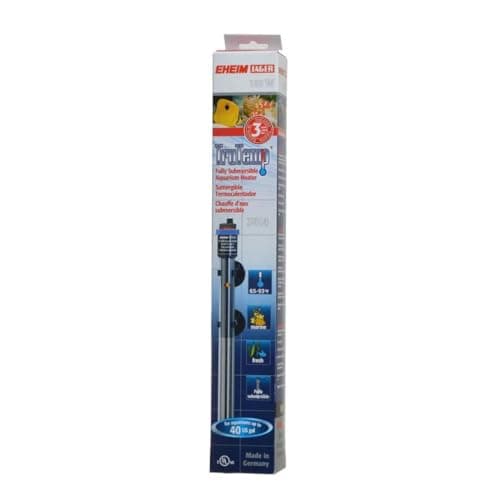 Eheim Jager TruTemp Heater, 100W 100 W, adjustable, and the only heater here with a published control-accuracy figure from the manufacturer. | A 20 gallon tank in almost any room | $33.99 on Amazon #ad How we’re funded · price as of November 3, 2026 |
| 2 | 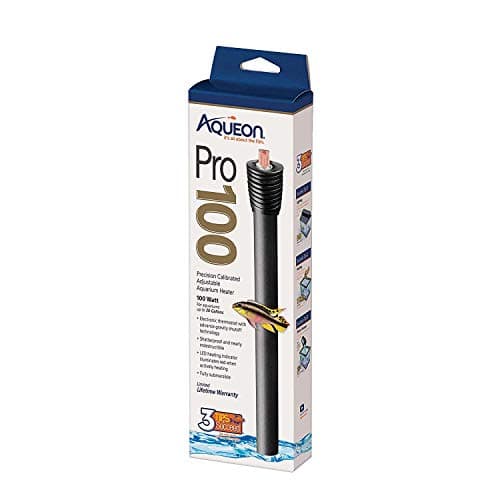 Aqueon Pro 100 Submersible Heater, 100 W 100 W with a shatterproof body and no glass components — the one here that survives being knocked. | A tank with children, cleaning accidents, or a heavy hand | $62.95 on Amazon #ad How we’re funded · price as of November 3, 2026 |
| 3 | 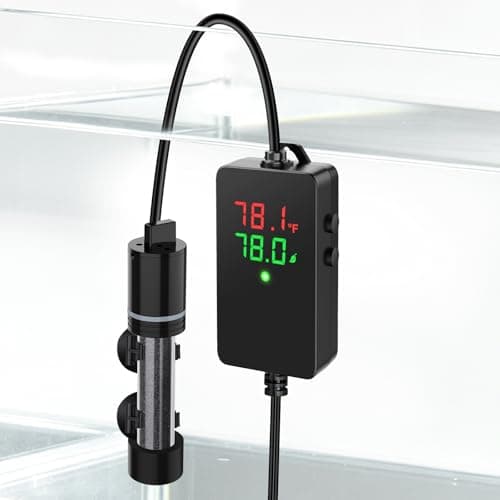 hygger ECO Precise Aquarium Heater, 100 W 100 W with an external dual-probe controller, sold specifically for 10 to 20 gallon tanks, at the lowest price here. | Setting and checking the temperature without reaching into the tank | $23.99 on Amazon #ad How we’re funded · price as of November 3, 2026 |
| 4 | 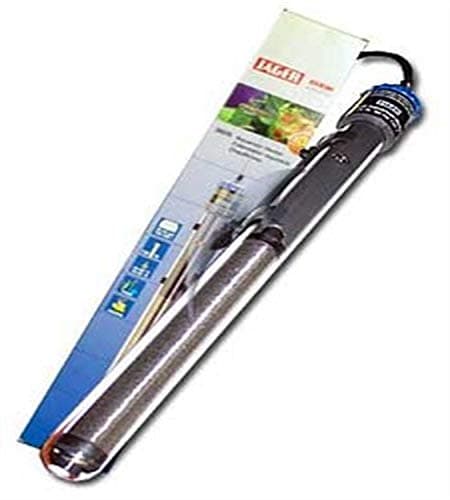 Eheim Jager TruTemp Heater, 75W 75 W with the same thermostat and accuracy figure as the 100 W Jager — the right call only if your room never gets cold. | A 20 gallon tank in a genuinely warm, stable room | |
| 5 | 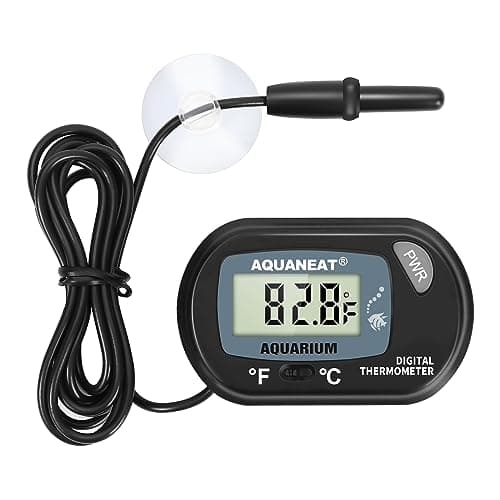 AQUANEAT Digital Aquarium Thermometer The cheapest item on this page, and the only one that reports what the water is actually doing. | Finding out whether any of the above is telling the truth | $5.45 on Amazon #ad How we’re funded · price as of November 3, 2026 |
| ! | 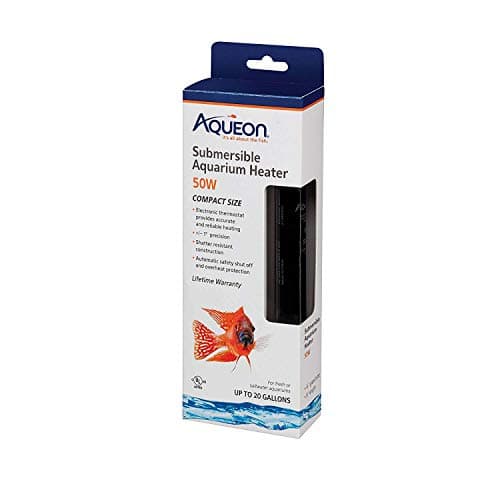 Aqueon Submersible Aquarium Heater, 50 W A good 50 W heater whose own listing claims it covers 20 gallons — at 2.5 W per gallon, it does not. Skip this one — see why below | Not a 20 gallon tank, whatever the listing says |
Rows link to the full write-up further down this page. Prices come from the live price layer only; where there is no live figure the button reads “Check price” rather than showing a remembered number.
Why a 50 watt heater labeled “up to 20 gallons” is not enough
This deserves its own section because it is the single most common sizing mistake on this tank size, and the listings cause it. A 50 W heater rated by its maker for 20 gallons is being quoted for a best case: a room already close to your target temperature, a lid on the tank, and no draft. Change any one of those and 2.5 W per gallon runs out of headroom.
The failure is undramatic, which is why it goes unnoticed. The heater does not break. It simply runs — all day, every day — and the tank settles two or three degrees below where you set it. Your fish are not killed by that, but they are held permanently at the wrong temperature, which is a slow stress rather than an event. Meanwhile the heater is at 100% duty cycle, which is how a two-year heater becomes a one-year heater.
Treat every “up to X gallons” claim in this category as a ceiling under ideal conditions, then size from the lift instead. It is the one piece of advice on this page that applies to every brand on the shelf.
One 100 watt heater, or two smaller ones?
Running two 50 W heaters instead of one 100 W is a real technique, and the logic is sound: if one thermostat sticks off, the other holds part of the lift, and if one sticks on, it can only deliver half the heat. On a large tank that redundancy is genuinely worth the second unit.
On 20 gallons we do not recommend it, for two reasons. It doubles the hardware in a tank that does not have much room to hide it, and it doubles the number of thermostats that can drift — two heaters disagreeing with each other is a harder problem for a beginner to diagnose than one heater disagreeing with a thermometer. The 20 gallon answer is one correctly sized heater plus a thermometer, which costs less and fails more legibly.
Does a 20 high or a 20 long change the heater?
Not the wattage — both hold the same volume of water, so the arithmetic is identical. It changes the placement. A 20 gallon high is roughly 24 inches long and 16 inches tall; a 20 gallon long is roughly 30 inches and about 12 inches tall. On the long tank a foot-long glass heater lies almost flat along the back, which is fine and often tidier; on the high tank it sits at an angle. Either is correct as long as the unit is fully submerged and water moves past it. Where to put it relative to the filter is covered on where to place a filter and heater, and the footprint difference matters much more for lighting, which is on the best aquarium light for a 20 gallon tank.
What a heater does not fix
A stable temperature is one of two things keeping a tank alive, and it is the easier one. The other is a cycled filter, and no heater helps with it: a 20 gallon tank that has not been cycled will kill fish at a perfect 78 °F, because the problem is ammonia rather than cold. If the tank is new, how to cycle a fish tank is the page that matters more than this one, and the filtration side of a 20 gallon build is on the best filter for a 20 gallon tank.
A heater also does not excuse a kit's included one. Many 20 gallon starter kits ship a preset heater sized for the box rather than your room — one of several gaps we document on what starter kits leave out. If the kit heater is preset and your room runs cold, the heater on this page is the upgrade, and the kit's unit becomes a spare. If the tank you are buying for is actually a 29 or 30 gallon, the wattage roughly doubles and the labels get much less reliable — that is the best heater for a 30 gallon tank.
A 100 watt heater does not draw 100 watts all day, which is why the electricity bill is a smaller worry than it looks: do aquarium heaters use a lot of electricity.
Pick 1
Eheim Jager TruTemp Heater, 100W
A 20 gallon tank in almost any room
The number
100 W in a 20 gallon tank is 5 W per gallon, which covers roughly a 10 degrees F lift — a 78 F tank in a room that bottoms out near 68 F. Eheim states an adjustment range of 18 to 34 C and a control accuracy of plus or minus 0.5 C, and the TruTemp dial is user-recalibratable at plus or minus 2 C.
This is the default recommendation for a 20 gallon tank, and the reason is the specification sheet rather than the brand. Eheim publishes an accuracy tolerance. Almost nobody else in this price class does, and a heater is a thermostat first and a heating element second — the element is trivial, the thermostat is the whole product.
The recalibration feature is the part that matters over years rather than weeks. Thermostats drift. A heater you can bring back into line against a thermometer is a heater that stays correct in year three, instead of one you replace because it has quietly settled two degrees low.
At 5 W per gallon it is sized for a genuinely cold room, not just a mild one. That headroom is why we recommend 100 W over 75 W as the default: a heater that is slightly generous cycles on and off, while a heater that is slightly short runs continuously and still loses on the coldest night of the year.
The honest costs. It is glass-bodied, so it breaks if you knock it against the rim or leave it exposed while draining the tank — the single most common way these die. It is long, at around a foot, which on a 20 gallon high means mounting it at an angle or horizontally along the back. And no thermometer is included, which on an adjustable heater is not optional: the dial is a setting, not a reading.
| Wattage | 100 W |
|---|---|
| Adjustment range | 18 to 34 C |
| Control accuracy | Plus or minus 0.5 C |
| Recalibration | User-recalibratable at plus or minus 2 C |
| Length | 12.5 inches |
| What it does not do | Glass-bodied, and at 12.5 inches it is taller than the water is deep in a 20 gallon long, so in that tank it has to be mounted horizontally. No thermometer included. |
Specs from Eheim Jager TruTemp 100W, retailer spec sheet. We have not used this unit.
#ad How we’re funded · price as of November 3, 2026
Pick 2
Aqueon Pro 100 Submersible Heater, 100 W
A tank with children, cleaning accidents, or a heavy hand
The number
100 W, stated by Aqueon for aquariums up to 30 gallons. On 20 gallons that is 5 W per gallon, roughly a 10 degrees F lift, with the tank sitting comfortably below the heater's stated ceiling rather than at the top of it. Adjustable across a stated 68 to 88 F.
Every other adjustable heater on this page is a glass tube. This one is not, and if you have broken a heater before you already understand why that is worth paying for. Aqueon states shatterproof construction with no glass components, which removes the failure mode that actually kills heaters in a home aquarium — physical impact during a water change, not electronics.
The stated ceiling of 30 gallons is the useful part of the specification for a 20 gallon owner. It means the tank sits inside the heater's range with margin, rather than at the edge of it, so the unit is not working at its limit on a cold night.
The auto shut-off is a genuine safety feature rather than marketing: Aqueon states it protects the heater if it overheats or is not properly positioned, which covers the classic beginner mistake of running a heater with the water level dropped below it during a change.
The honest costs. It is the most expensive heater on this shortlist by a clear margin. Aqueon publishes no thermostat accuracy tolerance and no length on the product page, so we print neither — you are trusting the brand rather than a number, which is exactly the trade the Eheim lets you avoid. And as always, no thermometer is included.
| Wattage | 100 W |
|---|---|
| Stated tank size | Up to 30 gallons |
| Temperature range | 68 to 88 F |
| Housing | Shatterproof construction with no glass components |
| Safety | Auto shut-off if overheated or not properly positioned; power monitor light |
| What it does not do | Aqueon does not publish a thermostat accuracy tolerance or a heater length on this product page, so neither is printed here. No thermometer included, and it is the most expensive heater on our 20 gallon shortlist. |
Specs from Aqueon Pro Aquarium Heater 100 Watt, retailer listing (100 W, up to 30 gallons, 68-88 F, shatterproof with no glass components, auto shut-off, power monitor light). We have not used this unit.
#ad How we’re funded · price as of November 3, 2026
Pick 3
hygger ECO Precise Aquarium Heater, 100 W
Setting and checking the temperature without reaching into the tank
The number
100 W, stated for 10 to 20 gallon tanks. On 20 gallons that is 5 W per gallon — roughly a 10 degrees F lift — and the listing claims control to plus or minus 0.5 C via a dual probe, with overheat and dry-run protection.
The appeal is the controller sitting outside the tank: a readout and buttons you can reach without rolling up a sleeve, which is the difference between a heater you adjust when the seasons change and one you set once and never touch again.
The dual-probe arrangement is the interesting design choice. A single-probe heater measures temperature at the heating element, where the water is warmest; a separate probe reads the tank away from that heat. It is the right idea, and it is the reason this listing can make an accuracy claim at all.
This is also the only heater here whose listing names the exact tank size this page is about, which makes it the one a 20 gallon owner is most likely to buy without further thought. At 5 W per gallon, that instinct happens to be correct.
The honest costs. The accuracy figure is the listing's own claim, not a manufacturer document we can check, so treat it as a claim rather than a specification — we have printed it as such. The external controller is one more component to place, keep dry and eventually replace, and a controller readout is still not an independent thermometer in the water. hygger is a marketplace brand, so expect less support continuity than Eheim or Aqueon.
| Wattage | 100 W |
|---|---|
| Stated tank range | 10 to 20 gallons, per the Amazon listing |
| Control accuracy | Plus or minus 0.5 C, per the Amazon listing |
| Control | Dual probe controller |
| Protection | Overheat and dry-run protection, per the listing |
| What it does not do | The stated accuracy figure is the listing's own claim rather than a manufacturer document we can check, so treat it as a claim. The external controller is one more component to place and keep dry, and a controller readout is not a thermometer in the water. No thermometer included. |
Specs from hygger ECO Precise 100W Aquarium Heater Submersible for 10-20 Gallon Fish Tank, plus or minus 0.5 C dual probe controller, overheat and dry-run protection, Amazon listing. We have not used this unit.
#ad How we’re funded · price as of November 3, 2026
Pick 4
Eheim Jager TruTemp Heater, 75W
A 20 gallon tank in a genuinely warm, stable room
The number
75 W in a 20 gallon tank is 3.75 W per gallon, which sits between the roughly 3 W per gallon that covers a 5 degrees F lift and the 5 W per gallon that covers 10. Eheim states the same 18 to 34 C adjustment range and plus or minus 0.5 C accuracy as the 100 W model, at 10.75 inches long.
Same thermostat, same accuracy, same recalibration, less element. In a room that genuinely holds near 75 F day and night — a centrally heated living room, not a spare bedroom with the radiator off — 75 W is enough, and a heater that is not oversized cycles less and lasts longer.
It is also the shorter unit, at just under 11 inches, which on a 20 gallon high is easier to place than the longer 100 W tube. On a tank 16 inches tall that difference is real.
We are not recommending this as the default, and the reason is honest rather than cautious: most people do not know how cold their room gets at 4am in February. If you have measured it, buy this. If you are guessing, buy the 100 W.
The honest costs. Glass-bodied and breakable, like the 100 W. Eheim publishes no per-wattage gallon rating for this model — only that the Jager line spans aquariums from 20 to 1000 liters — so there is no official 'up to X gallons' figure to lean on, and the sizing above is our arithmetic rather than their claim. No thermometer included.
| Wattage | 75 W |
|---|---|
| Adjustment range | 18 to 34 C |
| Control accuracy | Plus or minus 0.5 C |
| Recalibration | User-recalibratable at plus or minus 2 C |
| Length | 10.75 inches |
| What it does not do | Glass-bodied, so it breaks if you knock it against the rim or leave it exposed while draining the tank. Eheim publishes no per-wattage gallon rating for this model — only that the Jager line covers aquariums from 20 to 1000 liters — so no tank-size ceiling is printed here. No thermometer included. |
Specs from Eheim Jager TruTemp 75W, retailer spec sheet (wattage, 18-34 C range, plus or minus 0.5 C accuracy, 10.75 inch length, recalibration). We have not used this unit.
Pick 5
AQUANEAT Digital Aquarium Thermometer
Finding out whether any of the above is telling the truth
Every heater above is a thermostat making a claim. A thermometer is the only thing on this list that checks it, and the two disagree more often than beginners expect — a heater set to 78 F holding the tank at 74 F is a common and completely invisible problem without one.
On 20 gallons you have a real buffer, which is the good news: a heater that sticks on takes hours rather than minutes to become dangerous. That buffer only helps if something is telling you the temperature has moved, which is the entire argument for spending a few dollars here.
Put it at the opposite end of the tank from the heater. A thermometer next to the heating element reads the heater, not the aquarium, and that is the one placement that makes the reading useless.
The honest costs. A stick-on strip type reads the glass and gets pulled around by room temperature, so use an in-tank unit instead. Our thermometer roundup covers the tradeoffs between the digital and glass types in full.
| Why it matters | A heater dial is a setting and a thermometer is a reading. They disagree more often than beginners expect. |
|---|---|
| What it does not do | Stick-on strip thermometers read the glass rather than the water, so room temperature pulls them off. |
The manufacturer does not publish a full spec sheet for this item, so nothing beyond the figures above is stated. We have not used this unit.
#ad How we’re funded · price as of November 3, 2026
Skip this
Aqueon Submersible Aquarium Heater, 50 W
Not a 20 gallon tank, whatever the listing says
This is the most useful entry on the page, because it is the heater a 20 gallon owner is most likely to buy by mistake. The product is fine. The listing states 'up to 20 gallons', and that figure is the problem.
50 W in a 20 gallon tank is 2.5 W per gallon. That is below the roughly 3 W per gallon our sizing method needs for even a 5 degrees F lift, which means it only holds temperature in a room that is already close to your target. In a room that drops into the 60s overnight it will run continuously and still fall short — and a heater running continuously is a heater failing early.
Manufacturer tank ratings are generous across this whole category, because they are quoted for a warm room and no maker wants a smaller number than its competitor. Our rule is to treat any 'up to X gallons' claim as the absolute ceiling in ideal conditions, then size from the arithmetic instead.
Where this heater is genuinely the right answer is a 5 gallon tank, where 50 W is 10 W per gallon and generous — which is exactly why it appears on our 5 gallon heater guide, linked above. On 20 gallons, buy 100 W.
| Wattage | 50 W |
|---|---|
| Stated tank range | Up to 20 gallons, per the Amazon listing |
| Control | Adjustable |
| What it does not do | Rated up to 20 gallons at 50 W, which is 2.5 W per gallon on that tank — enough for a small lift only. On a 5 gallon tank it is generous rather than marginal, which is the reason it is here. No accuracy tolerance published that we can verify. |
Specs from Aqueon Submersible Aquarium Heater, 50 Watts, up to 20 gallons, Amazon listing. We have not used this unit.
Questions people actually ask
Frequently asked questions
+ What size heater do I need for a 20 gallon tank?
+ Is a 50 watt heater enough for a 20 gallon tank?
+ Is a 100 watt heater too big for a 20 gallon tank?
+ Should I get an adjustable or preset heater for a 20 gallon tank?
+ Do I need two heaters in a 20 gallon tank?
+ Where should the heater go in a 20 gallon tank?
+ Does a 20 gallon long need a different heater than a 20 gallon high?
Where the numbers came from
Sources
- Eheim Jager TruTemp 100W, retailer spec sheet
- Eheim Jager TruTemp 75W, retailer spec sheet
- Aqueon Pro Aquarium Heater 100 Watt, retailer listing (100 W, up to 30 gallons, 68-88 F, shatterproof)
- hygger ECO Precise 100W Aquarium Heater for 10-20 gallon tanks, dual probe controller, Amazon listing
- Aqueon Submersible Aquarium Heater, 50 W, up to 20 gallons, Amazon listing
- Aquarium Co-Op forum, heater sizing chart: temperature, watts, gallons
- Petco, aquarium heater types and wattage guide
Read next
Related on Fin & Filter
The best aquarium heaters for a first tank
The wattage your room actually needs, worked out, and the heaters that can hold it.

The best heater for a 5 gallon tank
25 W is the arithmetic, 50 W is what the shelf sells. Which of those is safe on 5 gallons, and which heaters get it right.
The best filter for a 20 gallon tank
Why filters labeled for 20 gallons come up short on a stocked community tank, and the cheap fix that works.