Buyer's question
Do aquarium heaters use a lot of electricity?
A 100 watt heater does not draw 100 watts all day. What it costs is set by how often it switches on, which is set by your room — not by the brand on the box.
Fin & Filter earns a commission when you buy through the links on this page. It costs you nothing and it does not decide what we rank. How we’re funded.

We have not used any of this gear. Every pick below is chosen from published manufacturer specifications and the arithmetic on how we pick, which you can re-run yourself.
No. On a 10 or 20 gallon tank a correctly sized heater costs cents a day, not dollars. The reason is duty cycle: a 100 watt heater draws 100 watts only while the element is actually on, and in a normally heated room that is a fraction of the day. At the current US average residential electricity price of 18.16 cents per kWh, a 100 W heater running at a 25% duty cycle costs about 11 cents a day — roughly $3.30 a month, and under $2 a month at a 15% duty cycle. The things that move that number are your room temperature, whether the tank has a lid, and whether the thermostat holds a tight band. The brand on the box does not.
The question gets asked because a heater is the only thing in the tank with a big wattage number printed on it, and because an aquarium runs 24 hours a day. Both facts are true and the conclusion people draw from them is wrong, for one reason.
Quick picks
What to buy if the running cost is what worries you
| # | Product | Best for | Price |
|---|---|---|---|
| 1 | 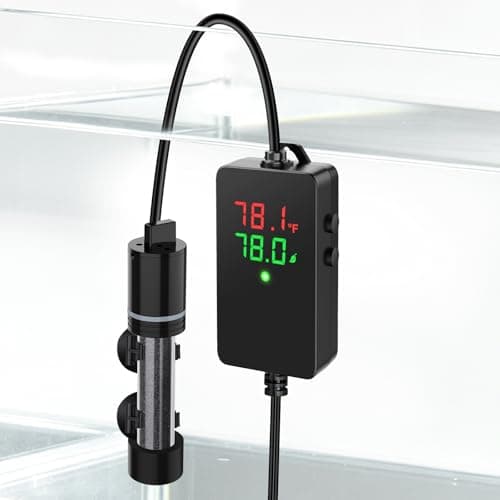 hygger ECO Precise Aquarium Heater, 100 W A dual-probe controller with a stated accuracy figure — the spec that decides how much your heater overshoots and reheats. | A 10 to 20 gallon tank where you want the thermostat to be the accurate part | $23.99 on Amazon #ad How we’re funded · price as of November 3, 2026 |
| 2 | 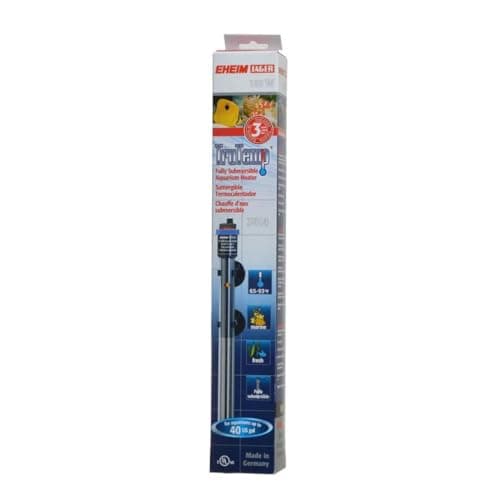 Eheim Jager TruTemp Heater, 100W The thermostat people trust, with a recalibration ring so a drifting unit can be corrected rather than replaced. | A 20 gallon tank, and anyone who would rather buy the heater once | $33.99 on Amazon #ad How we’re funded · price as of November 3, 2026 |
| 3 | 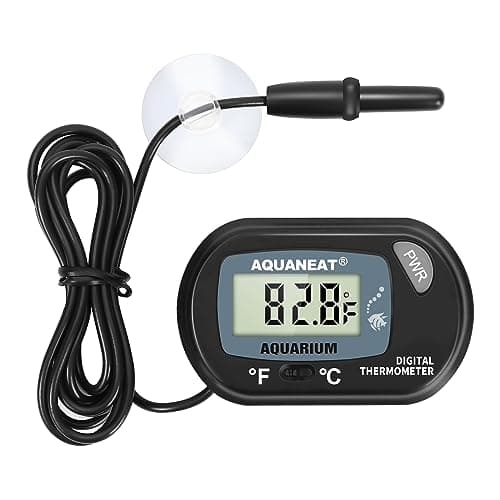 AQUANEAT Digital Aquarium Thermometer A few dollars, and the only way to know whether your heater is working or fighting the room. | Finding out whether your heater is cycling or running flat out | $5.45 on Amazon #ad How we’re funded · price as of November 3, 2026 |
| 4 | 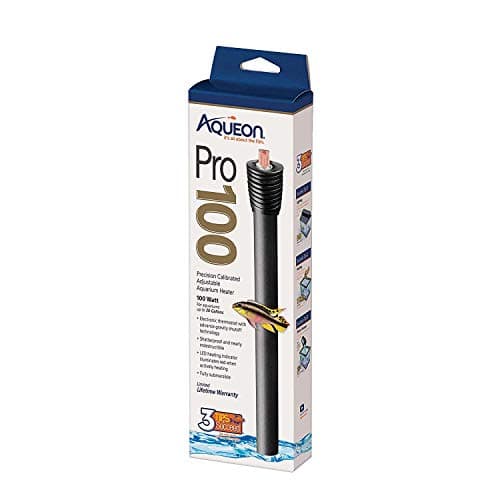 Aqueon Pro 100 Submersible Heater, 100 W Shatterproof and electronically controlled, at a price that buys two glass heaters. | A tank where a broken glass tube is the cost you are actually worried about | $62.95 on Amazon #ad How we’re funded · price as of November 3, 2026 |
| ! | 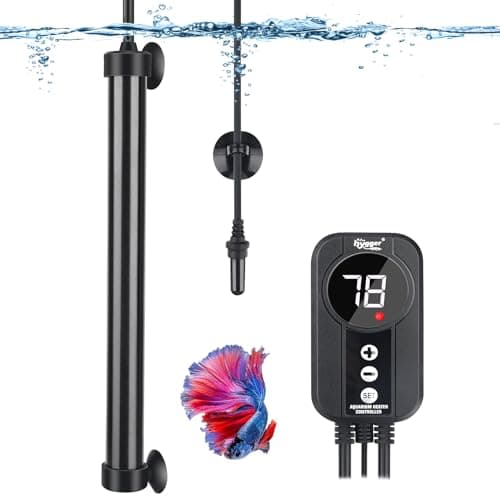 hygger Titanium Aquarium Heater, 300 W 300 W aimed at 50 to 60 gallon tanks. On a small tank it is wasted capacity and a worse failure mode. Skip this one — see why below | Not a 10 or 20 gallon tank |
Rows link to the full write-up further down this page. Prices come from the live price layer only; where there is no live figure the button reads “Check price” rather than showing a remembered number.
A heater does not run continuously. That is the whole answer.
A 100 watt heater is not a 100 watt load. It is a 100 watt element with a thermostat in front of it, and the thermostat's job is to keep it switched off most of the time. The wattage tells you how fast it can add heat; the duty cycle — the fraction of the day the element is actually energized — tells you what you pay.
Duty cycle is set almost entirely by the gap between your room temperature and your target water temperature. A tank at 78 F in a room at 72 F loses heat slowly and the heater cycles briefly. The same tank in a garage at 55 F loses heat continuously and the heater runs most of the day. Same heater, same tank, a bill several times larger — and nothing about the equipment changed.
The arithmetic, at the current national price
The EIA publishes the average retail price of electricity to US residential customers: 18.16 cents per kWh in August 2026, and 18.04 cents averaged over the rolling 12 months to that date. Your own rate is on your bill and varies a great deal by state, so substitute it if you want a local figure.
| Heater | At 15% duty | At 25% duty | At 50% duty |
|---|---|---|---|
| 50 W (a 10 gal tank) | $0.03 / day, about $0.82 / month | $0.05 / day, about $1.36 / month | $0.11 / day, about $2.73 / month |
| 100 W (a 20 gal tank) | $0.07 / day, about $1.64 / month | $0.11 / day, about $2.73 / month | $0.22 / day, about $5.45 / month |
| 150 W (a 30 gal tank) | $0.10 / day, about $2.45 / month | $0.16 / day, about $4.09 / month | $0.33 / day, about $8.18 / month |
| 200 W (a 40-55 gal tank) | $0.13 / day, about $3.27 / month | $0.22 / day, about $5.45 / month | $0.44 / day, about $10.90 / month |
Our arithmetic: wattage x 24 hours x duty fraction / 1000 = kWh per day, priced at the EIA's 18.16 cents per kWh for August 2026. The duty-cycle columns are stated assumptions covering a warm room, an average room and a cold one — they are not measurements, and a heater's real duty cycle depends on your room, your lid and your tank's surface area.
The useful conclusion is in the first two rows. On the tank sizes this site is written for, the heater's contribution to a household electricity bill is somewhere between a cup of coffee and two cups of coffee a month. It is not a reason to choose one heater over another, and it is certainly not a reason to run a tank cold.
The three things that actually change the bill
- Room temperature. This is the whole game. Every degree you close the gap between room and tank cuts the duty cycle. A tank in a heated living room is cheap to run; the same tank in an unheated basement or a garage is not, and that is a placement decision rather than an equipment one.
- A lid. Evaporation is the biggest single heat loss from an open-topped tank, because turning water to vapor takes energy and that energy comes out of the water. A glass top cuts it substantially, which lowers the duty cycle and the amount of top-off water you carry. This is the one upgrade that genuinely reduces a heater's workload, and it is covered on do I need a lid for a fish tank.
- Thermostat accuracy. A thermostat that overshoots and then lets the tank drift well below target spends more energy than one holding a tight band, because it is repeatedly reheating from a lower starting point. It is a second-order effect next to the first two, but it is the only one you buy rather than arrange.
Two things that do not change the bill, despite being the things people ask about: wattage and brand. A bigger heater does not cost more to run on the same tank in the same room, because heating a given volume by a given number of degrees takes the same energy either way — the bigger element simply delivers it faster and then switches off for longer. And there is no efficiency rating to shop for: the wattage is the draw while the element is on, and what it draws ends up as heat in the water.
Sizing, because the wrong size does cost you
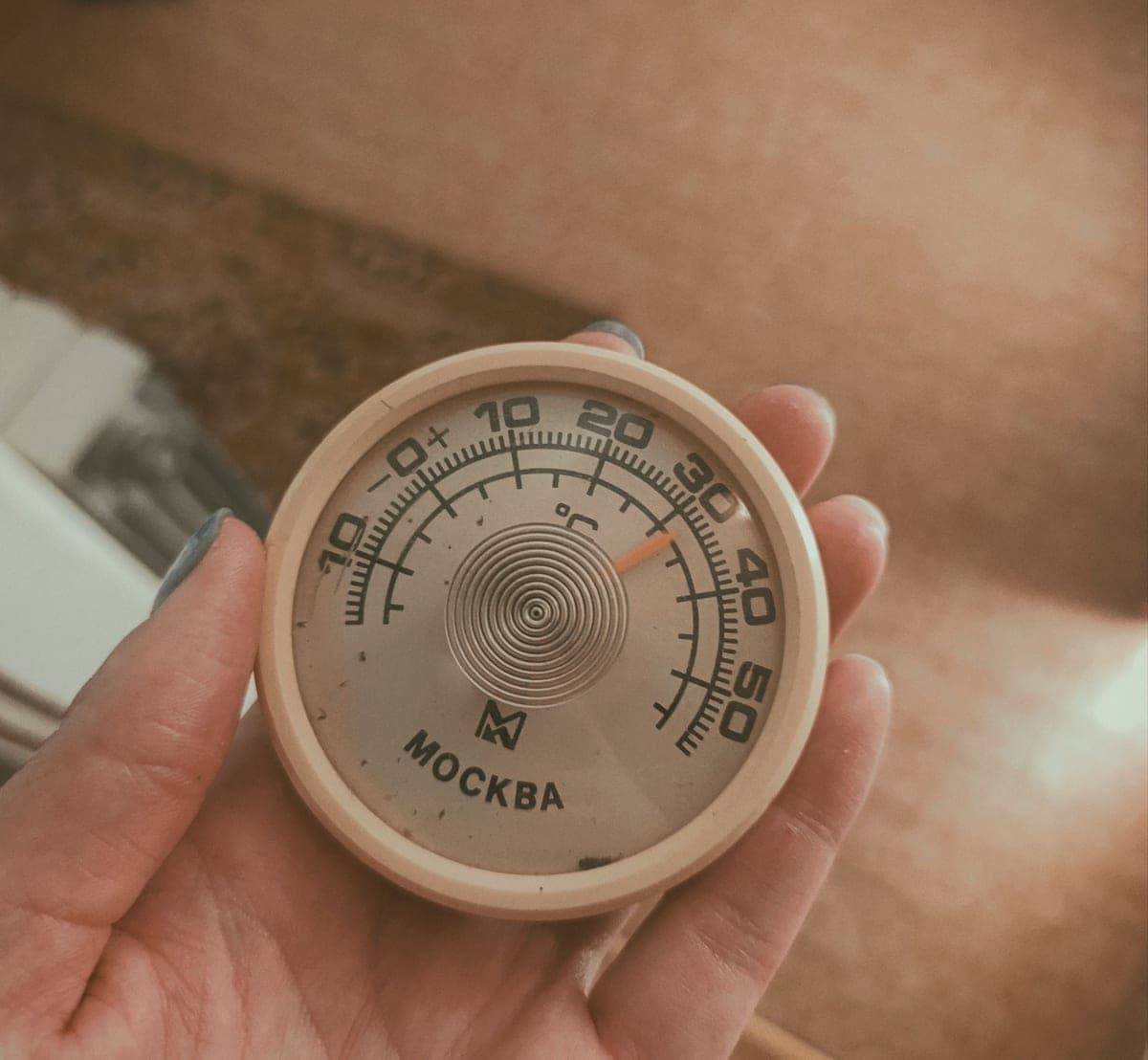
Our method is 5 watts per gallon for a 10 F lift above room temperature, which is where the wattages in the table above come from: 50 W for a 10 gallon tank, 100 W for a 20, 150 W for a 30. In a warm room you can go lower; in a cold one you go higher or you accept a heater that never switches off.
An undersized heater is the one that costs you — not in electricity, but in a tank that never reaches temperature while the element runs continuously and wears out early. An oversized heater costs nothing extra to run and carries a worse failure mode if the thermostat sticks. The per-size shortlists are on the best heater for a 10 gallon tank, the best heater for a 20 gallon tank and the best heater for a 30 gallon tank, and the full wattage reasoning is on the best aquarium heaters.
What else in the tank is drawing power
- The filter runs continuously and draws very little: an AquaClear 20 is rated at 6 watts and an AquaClear 30 at 7 watts, which at 24 hours a day is under a dollar a month at the EIA's price. Filters are never the expensive item, and they must never be put on a timer.
- The light draws its rated wattage only while it is on, which should be 6 to 8 hours a day — and a timer is the cheapest algae control there is. See do I need a light for my fish tank.
- An air pump is a few watts and runs continuously. Whether you need one at all is argued on do I need an air pump.
- Nothing else. A beginner aquarium has no other loads. Added together, a 20 gallon tank's filter, light and heater are a rounding error on a household bill that includes a refrigerator.
If the real question behind this one is what the whole hobby costs rather than what the heater costs, that is worked through month by month on what a first aquarium really costs.
Pick 1
hygger ECO Precise Aquarium Heater, 100 W
A 10 to 20 gallon tank where you want the thermostat to be the accurate part
The number
100 W, stated for 10 to 20 gallon tanks, with control accuracy of plus or minus 0.5 C per the listing.
Running cost is a thermostat question, not a wattage question, and this is the pick that takes the thermostat seriously.
A heater with a sloppy thermostat overshoots the target, then waits while the tank drifts well below it, then runs hard to catch up. A tighter band means shorter, more frequent cycles and less total energy spent climbing back from a lower starting point. It is also better for the fish, which care about stability far more than about the exact number.
The external controller has a second benefit nobody advertises: you can see what the heater is actually doing. A heater with an internal dial gives you no feedback at all until the tank is already wrong.
The honest costs. The accuracy figure is the listing's own claim rather than a manufacturer document we can check, so treat it as a claim. The external controller is one more component to place, keep dry and eventually replace. A controller readout is not a thermometer in the water, and hygger is a marketplace brand, so expect less support continuity than Eheim or Aqueon. No thermometer is included.
| Wattage | 100 W |
|---|---|
| Stated tank range | 10 to 20 gallons, per the Amazon listing |
| Control accuracy | Plus or minus 0.5 C, per the Amazon listing |
| Control | Dual probe controller |
| Protection | Overheat and dry-run protection, per the listing |
| What it does not do | The stated accuracy figure is the listing's own claim rather than a manufacturer document we can check, so treat it as a claim. The external controller is one more component to place and keep dry, and a controller readout is not a thermometer in the water. No thermometer included. |
Specs from hygger ECO Precise 100W Aquarium Heater Submersible for 10-20 Gallon Fish Tank, plus or minus 0.5 C dual probe controller, overheat and dry-run protection, Amazon listing. We have not used this unit.
#ad How we’re funded · price as of November 3, 2026
Pick 2
Eheim Jager TruTemp Heater, 100W
A 20 gallon tank, and anyone who would rather buy the heater once
The number
100 W, 12.5 inches long. At our method's 5 watts per gallon this covers a 20 gallon tank for a 10 F lift above room temperature.
The Jager's reputation is built on the one component that decides both your fish's comfort and your electricity bill: the thermostat. It holds a tight band, and when it eventually drifts there is a calibration ring to correct it instead of a replacement to buy.
On running cost specifically, a heater that holds temperature without hunting is doing less work than one that overshoots and recovers, and over a year that difference is larger than any difference between brands of the same wattage.
The honest costs. It is a glass tube, and glass heaters break — usually when someone forgets to unplug it during a water change and the element fires in air. It is 12.5 inches long, which is awkward in a short tank and in a 20 gallon long in particular. No digital readout, no external controller, and no thermometer included, so you need one of those separately to know what it is really doing.
| Wattage | 100 W |
|---|---|
| Adjustment range | 18 to 34 C |
| Control accuracy | Plus or minus 0.5 C |
| Recalibration | User-recalibratable at plus or minus 2 C |
| Length | 12.5 inches |
| What it does not do | Glass-bodied, and at 12.5 inches it is taller than the water is deep in a 20 gallon long, so in that tank it has to be mounted horizontally. No thermometer included. |
Specs from Eheim Jager TruTemp 100W, retailer spec sheet. We have not used this unit.
#ad How we’re funded · price as of November 3, 2026
Pick 3
AQUANEAT Digital Aquarium Thermometer
Finding out whether your heater is cycling or running flat out
The number
A digital thermometer with a submerged probe, reading the water rather than the controller.
This page is about a cost you cannot see, and a thermometer is how you see it.
A heater holding steady at your target is cycling as designed. A tank sitting two degrees below the dial means the heater is running continuously and losing — either it is undersized for the room, or the room has turned cold, or the thermostat has drifted. All three are things you want to know, and all three show up as a number on a thermometer rather than as anything audible or visible.
It also catches the opposite failure, which is the dangerous one: a stuck-on heater cooking a tank. There is no cost argument for that one, just fish.
The honest costs. A digital probe reads one spot, and a tank with poor circulation genuinely has warm and cool areas, so place the probe away from the heater. The suction cup fails eventually and the unit ends up on the substrate. Button batteries are not replaceable on some models, which makes it a disposable device. And a cheap thermometer can be a degree or two out in absolute terms — it is excellent at telling you the water is stable and only fair at telling you exactly what it is stable at.
| Why it matters | A heater dial is a setting and a thermometer is a reading. They disagree more often than beginners expect. |
|---|---|
| What it does not do | Stick-on strip thermometers read the glass rather than the water, so room temperature pulls them off. |
The manufacturer does not publish a full spec sheet for this item, so nothing beyond the figures above is stated. We have not used this unit.
#ad How we’re funded · price as of November 3, 2026
Pick 4
Aqueon Pro 100 Submersible Heater, 100 W
A tank where a broken glass tube is the cost you are actually worried about
The number
100 W, shatterproof construction, electronic thermostat.
The running-cost argument for this one is indirect but real: the cheapest heater is the one you do not replace. A shatterproof body survives the water-change mistake that kills glass heaters, and it survives a large fish knocking it against the glass.
The electronic thermostat is the other half. Mechanical bimetallic thermostats are the part that drifts, and a drifting thermostat is a heater that runs when it should not.
The honest costs. It is roughly twice the price of a comparable glass heater, which is a lot to pay for durability on a 10 gallon tank. Shatterproof is not unbreakable. There is no external display, so you still need a thermometer. And at 100 W it is sized for a 20 gallon tank at a 10 F lift — on a 10 gallon tank it is more heater than the job needs, which does not cost more to run but does mean faster temperature swings if the thermostat ever sticks.
| Wattage | 100 W |
|---|---|
| Stated tank size | Up to 30 gallons |
| Temperature range | 68 to 88 F |
| Housing | Shatterproof construction with no glass components |
| Safety | Auto shut-off if overheated or not properly positioned; power monitor light |
| What it does not do | Aqueon does not publish a thermostat accuracy tolerance or a heater length on this product page, so neither is printed here. No thermometer included, and it is the most expensive heater on our 20 gallon shortlist. |
Specs from Aqueon Pro Aquarium Heater 100 Watt, retailer listing (100 W, up to 30 gallons, 68-88 F, shatterproof with no glass components, auto shut-off, power monitor light). We have not used this unit.
#ad How we’re funded · price as of November 3, 2026
Skip this
hygger Titanium Aquarium Heater, 300 W
Not a 10 or 20 gallon tank
The skip entry, and it is here because of a specific misunderstanding this page exists to correct: people shopping on running cost sometimes buy a bigger heater, reasoning that it will heat faster and therefore run for less time.
The energy arithmetic does not work that way. Heating a given volume of water by a given number of degrees takes the same energy whether you deliver it in ten minutes or an hour, so a bigger heater does not lower the bill. What it does change is the failure mode: if a 300 W element sticks on in a 10 gallon tank, the water heats far faster than anyone will notice.
On a 50 or 60 gallon tank this is a reasonable heater with a titanium body and a digital controller. On a first tank it is the wrong purchase.
The honest costs of the skip. Titanium is genuinely tougher than glass and a controller is genuinely useful, so this is a capability argument rather than a quality one. If your tank really is 50 gallons or more, do not let this entry put you off — read our heater pages for that size instead.
| Wattage | 300 W |
|---|---|
| Stated tank range | 50 to 60 gallons, per the Amazon listing |
| Element | Titanium rather than glass |
| Control | Digital LED controller with a separate temperature probe |
| Calibration | Temperature calibration, per the listing |
| What it does not do | No accuracy tolerance is published, so the calibration feature is a claim rather than a specification. The external controller is another component to place, keep dry and eventually replace, and its readout is not an independent thermometer in the water. hygger is a marketplace brand, so expect less support continuity than Eheim or Aqueon. No thermometer included. |
Specs from hygger Aquarium Heater 300W titanium with digital LED controller and temperature probe, for 50-60 gallon tanks, Amazon listing. We have not used this unit.
Questions people actually ask
Frequently asked questions
+ Do aquarium heaters use a lot of electricity?
+ Does an aquarium heater run all the time?
+ Is a higher wattage heater more expensive to run?
+ How much does it cost to run a 50 watt aquarium heater?
+ Does a lid reduce heater running costs?
+ Can I turn the heater off at night to save money?
+ Are aquarium heaters energy efficient?
+ Why is my heater running constantly?
Where the numbers came from
Sources
- US Energy Information Administration, Electric Power Monthly, Table 5.3 (average retail price of electricity to residential customers: 18.16 cents per kWh in August 2026; 18.04 cents for the rolling 12 months ending August 2026; 2026 values preliminary)
- hygger ECO Precise 100W Aquarium Heater for 10-20 gallon tanks, dual probe controller, Amazon listing
- Eheim Jager TruTemp 100W, retailer spec sheet
- Aqueon Pro Aquarium Heater 100 Watt, retailer listing (100 W, up to 30 gallons, 68-88 F, shatterproof)
- hygger Aquarium Heater 300W titanium with digital LED controller and temperature probe, stated for 50-60 gallon tanks, Amazon listing
- Aquarium Co-Op forum, heater sizing chart: temperature, watts, gallons
- USGS Water Science School, Dissolved Oxygen and Water (cold water can hold more dissolved oxygen than warm water; oxygen enters mainly from the atmosphere)
Read next
Related on Fin & Filter
The best aquarium heaters for a first tank
The wattage your room actually needs, worked out, and the heaters that can hold it.

Do I need a lid for a fish tank?
Yes for almost every stocked tank. Glass versus mesh, what a hood gets you, and the fish that make it compulsory.
What a first aquarium really costs
The complete first-tank shopping list, split into one-time and recurring, and the three places beginners waste money.