Buying guide
The best aquarium plant fertilizer
Your fish already supply the nitrogen. What a low-tech planted tank runs short of is trace elements and iron — which is a much smaller shopping list than the shelf suggests.
Fin & Filter earns a commission when you buy through the links on this page. It costs you nothing and it does not decide what we rank. How we’re funded.
We have not used any of this gear. Every pick below is chosen from published manufacturer specifications and the arithmetic on how we pick, which you can re-run yourself.
For a normal low-tech planted tank with fish in it, buy one trace supplement and some root tabs. Your fish already produce nitrogen continuously and your food supplies phosphate, so what the tank runs short of is trace elements, iron, and substrate nutrition under root-feeding plants like swords and cryptocorynes. Dose by your tank's real water volume, start at the low end of the label, and add fertilizer only when plants show a deficiency — more fertilizer in a tank that cannot use it grows algae, not plants.
The planted-tank shelf is designed to sell you a routine. Most beginners do not need one: a 20 gallon tank with fish, java fern, a crypt and some floating plants is already being fertilized by its fish, and the two products above cover the rest. This page is about buying the smallest set of things that works, and knowing which bottle is not doing what you think it is.
What plants need, and where it already comes from
| Nutrient group | What it does | Where it comes from in a stocked tank | Buy it? |
|---|---|---|---|
| Nitrogen (N) | Leaf and stem growth | Fish waste and uneaten food, continuously | Rarely — only in a lightly stocked, heavily planted tank |
| Phosphorus (P) | Energy transfer, root growth | Fish food | Rarely |
| Potassium (K) | Cell function; deficiency shows as pinholes in older leaves | Not produced in the tank | Sometimes |
| Iron and trace | Chlorophyll; deficiency shows as pale new growth | Tap water only, in small and variable amounts | Yes — this is the usual gap |
| Substrate nutrition | Feeds root plants directly | Nothing, in plain gravel or sand | Yes, if you keep root feeders |
| Carbon | Photosynthesis | Dissolved CO2 from fish and the air | Only in high-light tanks |
This is the standard low-tech planted framework, applied to a beginner's stocked community tank. Seachem's own guidance on Flourish makes the same distinction between trace and macro supplementation.
Read the right-hand column and the shopping list collapses. In a tank with fish, the nutrients that arrive free are exactly the ones sold in the biggest bottles, and the ones you have to buy are cheap.
How we judged these
- Matched to a low-tech tank with fish in it. Not a high-light, injected-CO2 display, which is a different hobby with a different shelf.
- Published information. Seachem publishes composition guidance, dosing calculators and direct answers on shrimp safety and phosphate. Where a maker publishes less, we say less.
- Fish and invertebrate safety. Shrimp are the sensitive case, and a product that requires precision to avoid harming them is not a beginner product.
- Honest about what it does not do. A trace supplement that is sold as complete plant food would not be on this page.
- Currently purchasable. Every product here had a live buy box when this page was written.
Quick picks
What a low-tech planted tank actually needs
| # | Product | Best for | Price |
|---|---|---|---|
| 1 | 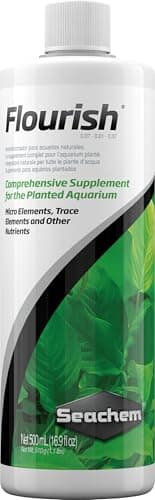 Seachem Flourish Freshwater Plant Supplement A comprehensive trace and micro-element supplement from a company that publishes what is in it and what it is not for. | The one bottle most low-tech tanks need | $10.52 on Amazon #ad How we’re funded · price as of September 25, 2026 |
| 2 | 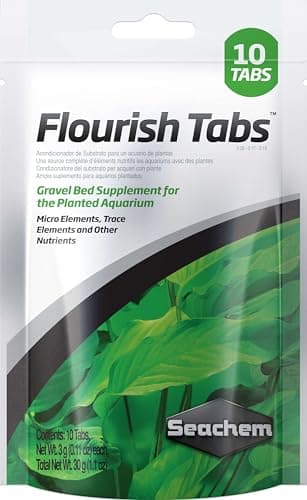 Seachem Flourish Tabs Gravel tablets that put nutrients where a liquid cannot reach: under the plant. | Swords, cryptocorynes and anything else that feeds through its roots | $11.16 on Amazon #ad How we’re funded · price as of September 25, 2026 |
| 3 | 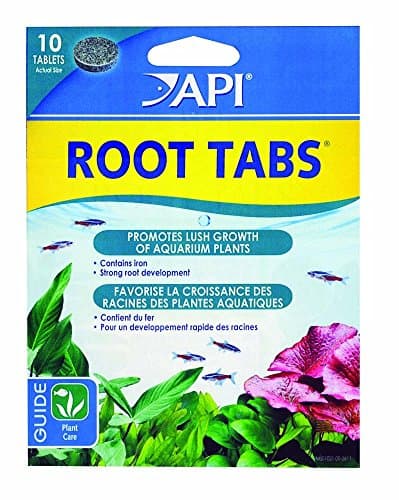 API Root Tabs, 3 Pack Three boxes of ten tablets — the low-cost way to dose a tank end to end rather than one plant at a time. | Feeding a whole tank's root plants cheaply | $24.76 on Amazon #ad How we’re funded · price as of September 25, 2026 |
| 4 | 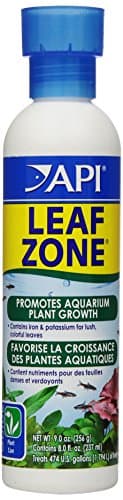 API Leaf Zone Plant Fertilizer A simpler liquid aimed at the two things low-tech tanks most visibly run short of. | Adding iron and potassium without a full macro routine | |
| ! | 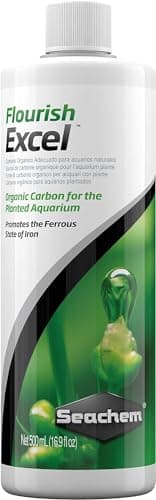 Seachem Flourish Excel A carbon source sold next to the fertilizers, bought by mistake by people whose plants are short of nutrients. Skip this one — see why below | Not a fertilizer | $11.99 on Amazon #ad How we’re funded · price as of September 25, 2026 |
Rows link to the full write-up further down this page. Prices come from the live price layer only; where there is no live figure the button reads “Check price” rather than showing a remembered number.
Dosing without guessing
- Work out your real water volume. A 20 gallon tank with substrate, rocks and a few inches of freeboard holds appreciably less than 20 gallons. Dosing the label number against the box number overdoses the tank.
- Start at the low end. Half the recommended dose, once a week, after the water change. Increase only if plants show a deficiency you can point at.
- Dose after a water change, not before. A change removes some of what you added; dosing afterwards means you know where you stand.
- Change one thing at a time. If you add fertilizer and more light in the same week and get algae, you have learned nothing.
- Push root tabs in deep, away from where the gravel vacuum goes, and replace them every few months rather than monthly.
Reading a deficiency
- Pale, yellowish new growth — usually iron or general trace shortage. This is what a trace supplement is for.
- Pinholes in older leaves — classically potassium.
- Older leaves yellowing and dying back while new growth continues — usually nitrogen, which in a stocked tank is rare and suggests you have more plants than fish.
- A sword or crypt standing still in clean gravel — substrate nutrition. Root tabs.
- Melting crypts after a change — often not a deficiency at all: cryptocorynes melt when conditions shift and regrow from the roots. Leave them alone.
And the deficiency that is not a deficiency: plants that arrive from a shop having been grown emersed will usually drop their old leaves and regrow underwater. That is normal for the first month, and no bottle fixes it faster. The species that tolerate all of this best are on easy live plants for beginners and best low light aquarium plants.
What fertilizer does for the rest of the tank
Healthy plants are not decoration — they consume ammonia and nitrate directly, compete with algae for the same nutrients, and give shy fish cover. A planted tank with a modest fertilizer routine is genuinely more stable than a bare one, which is the practical reason this page exists in the stocking hub rather than in a decorating guide.
What plants do not do is replace water changes. Nitrate uptake by a few low-light plants is real but small next to what a stocked tank produces — the water change routine still does the heavy lifting, and plants make it slightly easier.
Pick 1
Seachem Flourish Freshwater Plant Supplement
The one bottle most low-tech tanks need
The number
Seachem states Flourish is a comprehensive supplement of micro and trace elements — calcium, magnesium, iron among them — and explicitly not a macro (NPK) fertilizer: they state the nitrogen, phosphorus and potassium levels are deliberately low.
In a stocked aquarium, fish waste supplies nitrogen continuously and food supplies phosphate. What the tank does not manufacture is the trace elements plants need in small quantities, and that is precisely the gap this bottle is sold to fill.
Two things Seachem publishes are worth quoting because they answer the questions people actually ask. On shrimp: they state Flourish is safe to use with shrimp, noting that the copper it contains is a trace requirement for plants and animals alike and that tap water usually contains more of it. On algae: they state the recommended dose contributes about 0.0005 mg/L of phosphate — a number small enough to end the argument.
The honest costs. It is a trace supplement, so if your plants are genuinely short of nitrogen or potassium — common in a lightly stocked, heavily planted tank — this is the wrong bottle and you need a macro product as well. Dosing is by water volume, so you need your real volume rather than the number on the tank. And it does nothing for root feeders that a tab would do better.
| What it is | A comprehensive micro and trace element supplement, per Seachem — calcium, magnesium, iron and other trace elements |
|---|---|
| What it is not | Not a macro (NPK) fertilizer; Seachem states the nitrogen, phosphorus and potassium levels are deliberately low |
| Invertebrates | Seachem states Flourish is safe to use with shrimp at the recommended dose |
| Phosphate | Seachem states the recommended dose adds about 0.0005 mg/L of phosphate — negligible |
| What it does not do | A trace supplement does not feed a heavily planted tank on its own; if your plants are short of nitrogen or potassium this is the wrong bottle. Dosing is by volume, so you need to know your real water volume, not the tank's label. |
Specs from Seachem, Flourish product page (comprehensive trace supplement, shrimp safety, phosphate content, macro guidance); Seachem Flourish Freshwater Plant Supplement, Amazon listing. We have not used this unit.
#ad How we’re funded · price as of September 25, 2026
Pick 2
Seachem Flourish Tabs
Swords, cryptocorynes and anything else that feeds through its roots
The number
A 10 tab pack, pushed into the substrate near the root mass. Root feeders take the bulk of their nutrition from the substrate, which is why a liquid dose alone often leaves them yellowing while the stem plants thrive.
The most common planted-tank complaint from a beginner is a sword or crypt that sits still or goes yellow while everything else grows. In an inert gravel or sand substrate, that is a root-feeding plant with nothing to feed on.
A tab under each heavy root feeder solves it directly, and the effect over a few weeks is usually obvious.
The honest costs. Root tabs do nothing at all for stem plants, floating plants and epiphytes like anubias and java fern, which feed from the water column. A disturbed tab clouds the water — push them in deep and away from where you vacuum. And a 10 tab pack does not go far in a fully planted 20 gallon tank.
| Form | Gravel tablets pushed into the substrate |
|---|---|
| Pack | 10 tabs |
| Use | Feeds root-feeding plants such as swords and cryptocorynes where a liquid does least |
| What it does not do | Root tabs do nothing for stem plants and floating plants that feed through their leaves, and a disturbed tab can cloud the water. A 10 tab pack does not go far in a 20 gallon tank planted end to end. |
Specs from Seachem Flourish Tabs, 10 tab pack, Amazon listing. We have not used this unit.
#ad How we’re funded · price as of September 25, 2026
Pick 3
API Root Tabs, 3 Pack
Feeding a whole tank's root plants cheaply
The number
Three boxes of 10 tablets, pushed into gravel or sand. Tabs are typically replaced every few months as they exhaust, so a multi-box pack matches how they are actually used.
If you have more than a couple of root feeders, buying tabs in quantity is the difference between fertilizing the tank and fertilizing one plant. API's own product page positions them as a root-strengthening tablet for gravel-planted aquariums, and at this price you can afford to dose properly.
They also suit the common beginner substrate. Most first planted tanks are gravel or sand rather than an active plant soil, which means the substrate holds nothing until you put it there.
The honest costs. Same structural limits as any root tab — nothing for water-column feeders — plus a recurring cost every few months. Buying three boxes is only a saving if you have the plants to use them before they are wasted.
| Form | Tablets pushed into gravel or sand |
|---|---|
| Pack | 3 boxes of 10 tablets |
| Use | The cheapest way to feed root-feeders across a whole tank rather than one plant |
| What it does not do | Same limits as any root tab: nothing for stem or floating plants, and tabs need replacing every few months, which is a recurring cost. Buying three boxes at once is only a saving if you have the plants to use them. |
Specs from API, Root Tabs product page; API Root Tabs Freshwater Aquarium Plant Fertilizer, 3 pack, Amazon listing. We have not used this unit.
#ad How we’re funded · price as of September 25, 2026
Pick 4
API Leaf Zone Plant Fertilizer
Adding iron and potassium without a full macro routine
There is a middle ground between a trace supplement and a full macro dosing regime, and for most low-tech tanks it is iron and potassium: iron because pale new growth is usually an iron problem, potassium because pinholes in older leaves usually are not anything else.
As a second bottle alongside a trace supplement, it covers the two deficiencies a beginner is most likely to actually see.
The honest costs. It is a partial product by design — it is not comprehensive and is not meant to be. Two bottles is also the point at which a beginner should stop and ask whether the tank needs a dosing routine at all, or just more plants and fewer fish.
| Use | Supplies the trace nutrients a low-tech planted tank runs out of |
|---|---|
| What it does not do | Fertilizer does not fix a light problem, and dosing it into a tank where nothing is growing simply feeds the algae. |
The manufacturer does not publish a full spec sheet for this item, so nothing beyond the figures above is stated. We have not used this unit.
Skip this
Seachem Flourish Excel
Not a fertilizer
The skip entry is the most-bought bottle on this page and the one least likely to solve the problem that sent you shopping.
Excel is a carbon supplement. It supplies no trace elements, no iron and no macro nutrients. If your plants are pale, yellowing or full of holes, carbon is not the missing input and this bottle will not change anything.
It also has a reputation, earned in beginner tanks, for damage when overdosed: vallisneria and some mosses melt, and shrimp can be stressed. Products that are safe at the label dose and harmful at double it deserve to be treated carefully by people who are still learning to measure.
If you have a genuine carbon limitation — a high-light tank with a fertilizer routine already running — carbon is a real lever. That is not the tank most readers of this page have.
| What it is | A carbon source, sold as a bioavailable organic carbon supplement |
|---|---|
| What it is not | Not a fertilizer — it supplies no trace elements and no macro nutrients |
| Size | 500 mL |
| What it does not do | It is on this page to be ruled out, not recommended. Buying it instead of a fertilizer leaves your plants as short of nutrients as they were, and overdosing it is a known way to melt vallisneria and mosses and to stress shrimp. |
Specs from Seachem Flourish Excel 500 mL, Amazon listing. We have not used this unit.
Questions people actually ask
Frequently asked questions
+ Do I need fertilizer for aquarium plants?
+ Is aquarium plant fertilizer safe for fish and shrimp?
+ Will fertilizer cause algae?
+ Liquid fertilizer or root tabs?
+ Is Seachem Flourish Excel a fertilizer?
+ How often should I dose plant fertilizer?
Where the numbers came from
Sources
- Seachem, Flourish product page (comprehensive trace supplement, not a macro fertilizer; shrimp safety and phosphate content answered directly)
- Seachem Flourish Tabs, 10 tab pack, Amazon listing
- API, Root Tabs product page
- API Root Tabs Freshwater Aquarium Plant Fertilizer, 3 pack of 10 tablets, Amazon listing
- Seachem Flourish Excel 500 mL, Amazon listing
Read next
Related on Fin & Filter
Easy live plants for a beginner tank
Java fern, anubias and hornwort — why these three, how to plant them correctly, and what they will not do.
The best low-light aquarium plants
What actually grows under a stock kit LED with no CO2, and the easy-looking plant that needs more light than you have.
The best aquarium substrate
Gravel, sand or planted soil, how much a tank actually takes, and the buffering substrate to avoid by accident.