Worth it?
Is Seachem Purigen worth it?
It does something no other media on the shelf does, it is reusable, and it is the one product in this hobby with a maintenance procedure involving household bleach. Here is when that trade is worth making.
Fin & Filter earns a commission when you buy through the links on this page. It costs you nothing and it does not decide what we rank. How we’re funded.
We have not used any of this gear. Every pick below is chosen from published manufacturer specifications and the arithmetic on how we pick, which you can re-run yourself.
Worth it on a stable, established tank; not the first thing to buy on a struggling one. Seachem states Purigen removes nitrogenous organic waste before bacteria convert it into ammonia, nitrite and nitrate, that 250 mL treats up to 1,000 L for up to six months, and that it regenerates in a 1:1 bleach soak for 24 hours. That makes it genuinely reusable and genuinely different from carbon. It is also a procedure, not a drop-in: the bleach rinse has to be done properly, it must be stored moist, and some amine-based slime coat products can foul it permanently. If your nitrate is high because water changes are being skipped, fix that first — it is free.
This is the third product this site has taken apart on the same question, after is Seachem Prime worth it and the bottled-bacteria roundup, and the answer has the same shape: a good product, sold to people who mostly need a routine rather than a purchase. The difference here is that Purigen does something no cheaper product does, so the case for it is stronger than most — once the routine is in place.
What Seachem actually claims
| Claim | What Seachem states | What it means for you |
|---|---|---|
| Mechanism | Removes organics before they are converted into ammonia, nitrite or nitrate | Nitrate climbs more slowly — it is prevention rather than removal |
| Capacity | 250 mL treats up to 1,000 L (250 US gallons) for up to six months | A small bag covers a beginner tank for a long time |
| Exhaustion | Turns from its normal color to a deep brown | You can see when it is done, which is rare in filter media |
| Regeneration | Soak 24 hours in 1:1 bleach and water, then dechlorinate | Reusable, with a procedure that must be followed exactly |
| Versus carbon | Superior at removing organics, and compatible with carbon | Not a replacement for carbon, a different job |
| Hardness | No impact on calcium or magnesium hardness | It will not soften your water |
| Storage | Must be kept moist; beads shrink if dried out | Do not leave a used bag on a shelf to dry |
| Interaction | Some amine-based slime coat products can foul it, and in some cases make it toxic | Check your dechlorinator and medications before dosing over it |
All rows are Seachem's own published statements from their Purigen product page, cited at the foot of this page. We have not tested the product and make no claims of our own about its performance.
When it is worth it
- Your water is yellow or tea-colored from driftwood tannins or accumulated organics, and you want it clear. This is the visible benefit people actually buy it for.
- Your nitrate climbs faster than water changes hold it down, and the tank is already stocked sensibly and fed lightly.
- You keep a heavily fed tank — growing fish, a lot of frozen food — where organics accumulate faster than usual.
- You want a media that pays for itself over a year or two through regeneration rather than replacement.
- Your filter has spare capacity for a bag, and biological media is already sorted.
When it is not
- The tank is not cycled. Nothing in a media bag substitutes for a bacteria colony — how to cycle a fish tank comes first, always.
- Water changes are being skipped. Purigen slows the nitrate climb; it does not replace the routine, and buying it to avoid a chore is money spent to keep a bad habit.
- The tank is overstocked or overfed. Both are inputs; media is downstream of inputs.
- You will not do the bleach procedure. If regeneration is not going to happen, you are buying a disposable product at a reusable price.
- You are chasing algae. Algae is a light problem far more often than a nutrient one — how to get rid of algae in a fish tank.
Quick picks
Purigen, and the things to try before it
| # | Product | Best for | Price |
|---|---|---|---|
| 1 | 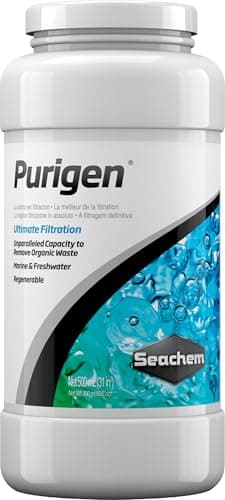 Seachem Purigen Organic Filtration Resin, 500 mL A regenerable resin that takes organic waste out before bacteria convert it — genuinely different from carbon, with a real procedure attached. | A stable, established tank where you want visibly clearer water and a slower nitrate climb | $31.07 on Amazon #ad How we’re funded · price as of November 3, 2026 |
| 2 | 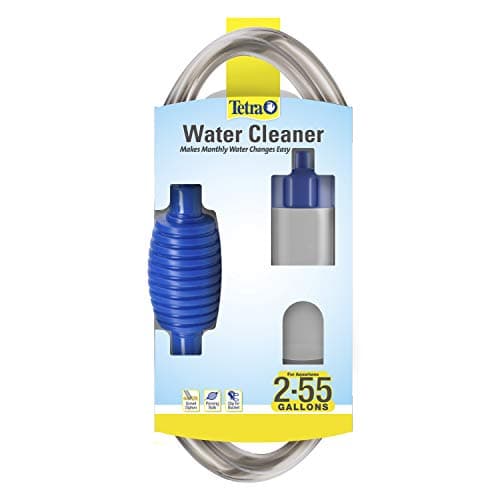 Tetra Water Cleaner Gravel Siphon A weekly water change with the substrate vacuumed removes the organic waste Purigen is being asked to catch. | The thing to do before buying any media | $10.29 on Amazon #ad How we’re funded · price as of November 3, 2026 |
| 3 | 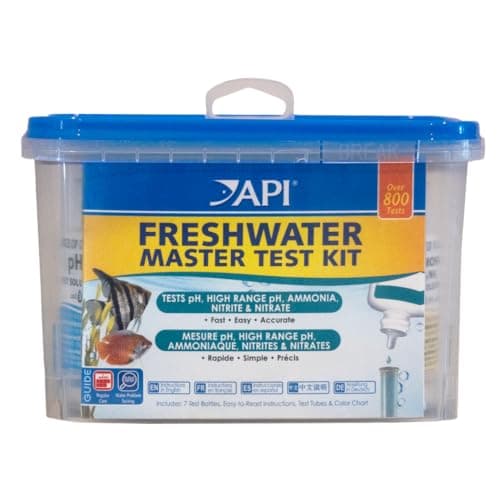 API Freshwater Master Test Kit Buy the nitrate reading before you buy the media that lowers it. | Knowing whether you have the problem you think you have | $35.98 on Amazon #ad How we’re funded · price as of November 3, 2026 |
| 4 | 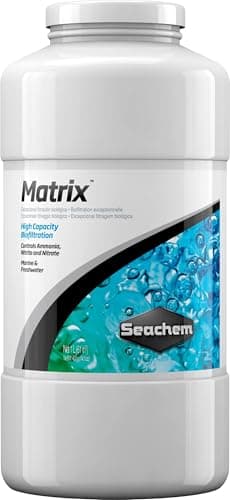 Seachem Matrix Biological Media, 1 L Biological capacity is the media that keeps fish alive; Purigen is the media that makes water look better. | The media most tanks actually need first | $18.72 on Amazon #ad How we’re funded · price as of November 3, 2026 |
Rows link to the full write-up further down this page. Prices come from the live price layer only; where there is no live figure the button reads “Check price” rather than showing a remembered number.
The regeneration, and why it deserves respect
This is the part that makes Purigen unusual among aquarium products: the maintenance instruction involves household bleach, and Seachem's own guidance is specific about the type and the dilution.
- Wait for the color. Seachem states the resin turns a deep brown when exhausted. That is the signal, not a calendar date.
- Follow Seachem's own instructions exactly, including the bleach type they specify — unscented, undyed household bleach — and the stated soak time of 24 hours in a non-metallic container.
- Rinse and dechlorinate thoroughly afterwards. This is the step that matters: resin returned to a tank while still holding chlorine puts chlorine into water with fish in it.
- Keep it moist between uses. Seachem states the beads shrink if they dry out.
- Check your other products first. Seachem states that some amine-based slime coat products can foul the resin, and in some cases render it toxic — so read the label of anything you routinely dose.
The cheaper things to do first
- Test nitrate. If it is under 20 ppm after a week, you do not have the problem Purigen solves.
- Do a fortnight of disciplined water changes — 25% weekly with the substrate vacuumed — and retest. This alone fixes most yellow water.
- Feed less. Uneaten food is the largest organic input in most beginner tanks.
- Rinse the filter's mechanical stage in old tank water. Detritus sitting in a clogged filter is organics decomposing inside your filtration.
- Add plants. They consume nitrate continuously, and a planted tank's nitrate curve is genuinely flatter — how to set up a low-tech planted tank.
Do all five and then decide. If the water is clear, the nitrate is stable and the tank looks how you want it to look, you have saved the money. If the water still looks yellow and the nitrate still climbs, Purigen is a reasonable next purchase and this page is not talking you out of it.
Pick 1
Seachem Purigen Organic Filtration Resin, 500 mL
A stable, established tank where you want visibly clearer water and a slower nitrate climb
The number
Seachem states each 250 mL treats up to 1,000 L (250 US gallons) for up to six months, that it darkens as it exhausts, and that it is renewed by soaking in a 1:1 bleach solution for 24 hours followed by dechlorinator.
Purigen is not carbon and it is not a biological medium. Seachem describes it as removing soluble and insoluble impurities and controlling ammonia, nitrite and nitrate by removing nitrogenous organic waste before it breaks down into them. That is a real mechanism and it is the reason the product exists.
Seachem also states it is superior to carbon at removing organics without carbon's negative impacts, and that the two can be used together — carbon is not a competitor so much as a different job.
The reusability is what makes the price defensible. It darkens visibly as it exhausts, and a bleach soak restores it. Over several regenerations the cost per month drops well below what it looks like on the shelf.
The honest costs. The regeneration is a procedure with a genuine failure mode: Seachem's instructions are specific about the bleach type and about rinsing and dechlorinating thoroughly afterwards, and resin that still holds chlorine goes back into a tank full of fish. It must be stored moist — Seachem states the beads shrink if they dry out. Certain amine-based slime coat products can foul it permanently, and Seachem notes that in some cases that can make it toxic. And it does nothing for hardness: Seachem states no impact on calcium or magnesium.
| What it does | Seachem states it removes soluble and insoluble impurities and controls ammonia, nitrite and nitrate by removing nitrogenous organic waste before it breaks down |
|---|---|
| Capacity | Seachem states each 250 mL treats up to 1,000 L (250 US gallons) for up to six months |
| Regeneration | Seachem states it darkens as it exhausts and is renewed by soaking in a 1:1 bleach solution for 24 hours, then in dechlorinator |
| Clarity | Seachem states it polishes water and raises redox |
| What it does not do | The bleach regeneration is a real procedure with a real failure mode: resin that is not thoroughly dechlorinated afterwards will carry bleach into your tank. If that sounds like a step you would rush, buy fresh resin instead. It is also the most expensive item on this page and the least necessary — it is a polish on a tank that is already working, not a fix for one that is not. |
Specs from Seachem, Purigen product page (what it removes, capacity, regeneration, redox and clarity); Seachem Purigen 500 mL, Amazon listing. We have not used this unit.
#ad How we’re funded · price as of November 3, 2026
Pick 2
Tetra Water Cleaner Gravel Siphon
The thing to do before buying any media
Every problem Purigen addresses starts as waste sitting in the tank: uneaten food, detritus in the substrate, a filter that has not been rinsed in three months. The cheapest intervention is to remove it physically, every week, for nothing.
If your nitrate is high and your water looks yellow, a month of disciplined water changes will change both more than a bag of resin will.
The honest costs. It is a chore, it takes fifteen minutes a week, and nobody has ever enjoyed carrying buckets — which is exactly why people reach for a bottle instead. The full routine is on our water-change page, linked below.
| Type | Manual siphon into a bucket |
|---|---|
| Cost | The cheapest way to do a proper gravel-vac water change |
| What it does not do | You carry the water. On a 10 or 20 gallon tank that is fine. The moment the tank gets big, it is the reason people quietly stop doing water changes. |
The manufacturer does not publish a full spec sheet for this item, so nothing beyond the figures above is stated. We have not used this unit.
#ad How we’re funded · price as of November 3, 2026
Pick 3
API Freshwater Master Test Kit
Knowing whether you have the problem you think you have
Purigen's headline benefit is a slower nitrate climb. If you have never measured your nitrate, you do not know whether it is climbing, and you cannot tell whether the resin is doing anything once it is in.
Test before, test after a month, and you will know whether the purchase was worth repeating. That is the difference between buying media and buying a habit.
The honest costs. It is more expensive than the resin in some sizes, it is a liquid kit read against a color card, and it is the least exciting purchase in this hobby. It is also the one this site would keep if it could keep only one.
| Tests | pH, High Range pH, Ammonia, Nitrite, Nitrate |
|---|---|
| Capacity | Over 800 tests per kit |
| Contents | 7 bottles of test solution, 1 color card, 4 glass tubes with caps, holding tub |
| Type | Liquid reagent |
| What it does not do | Does not test hardness, chlorine or alkalinity. It is slower than strips, the nitrate test needs vigorous shaking of the second bottle and a wait, and the color card is genuinely hard to read between adjacent shades. |
Specs from API Freshwater Master Test Kit, Amazon listing; API Freshwater Aquarium Master Test Kit, PetSmart listing. We have not used this unit.
#ad How we’re funded · price as of November 3, 2026
Pick 4
Seachem Matrix Biological Media, 1 L
The media most tanks actually need first
If a filter is short of anything on a beginner tank, it is usually biological surface area, not organic adsorption. That is the media that converts ammonia and nitrite, and it is what a cycled tank runs on.
Fill the basket with biological media first and see where the tank sits. If it is stable and you still want clearer, yellow-free water, that is the moment Purigen makes sense.
The honest costs. It does nothing visible — no clearer water, no polish, nothing you can photograph. It also takes weeks to colonize, so it is not a fix for anything urgent. Our filter media shortlist covers the full stack.
| Surface area | Seachem states greater than approximately 700 m2 per liter |
|---|---|
| Bacteria supported | Seachem states it supports aerobic and anaerobic species, so it can remove nitrate alongside ammonia and nitrite |
| Dose | Seachem states 250 mL of Matrix for each 200 L (50 US gallons) |
| Service life | Seachem states it is completely inert, will not break down, and need not be replaced |
| What it does not do | The nitrate claim depends on anaerobic zones developing deep inside the pores, which takes time and is not something you can verify at home, so treat it as a bonus rather than a reason to skip water changes. It is not a mechanical stage: without foam in front of it, it clogs with debris and stops doing its job. |
Specs from Seachem, Matrix product page (surface area, bacteria supported, dose, service life); Seachem Matrix Bio Media 1 Liter, Amazon listing. We have not used this unit.
#ad How we’re funded · price as of November 3, 2026
Questions people actually ask
Frequently asked questions
+ What does Seachem Purigen actually do?
+ How long does Purigen last?
+ How do you regenerate Purigen?
+ Is Purigen better than carbon?
+ Will Purigen lower my nitrate?
+ Do I need Purigen in a new tank?
Where the numbers came from
Sources
- Seachem, Purigen product page and FAQ (removes organics before conversion, 250 mL treats up to 1,000 L for up to six months, darkens when exhausted, 1:1 bleach regeneration, storage, amine-based slime coat interaction, no effect on hardness)
- Seachem Purigen Organic Filtration Resin, 500 mL, Amazon listing
- Seachem Matrix biological filtration media, Amazon listing
- API Freshwater Master Test Kit, Amazon listing
Read next
Related on Fin & Filter
The best aquarium filter media
Mechanical, biological and chemical — what each stage does, the order to stack them, and the cartridge habit to break.

Is Seachem Prime worth it?
Concentration, the ammonia-binding claim, and the specific situations where a cheaper dechlorinator is the right buy.
How often to change aquarium water
The 25%-weekly default, how nitrate sets your real schedule, and the water change mistakes to avoid.