Head to head
AquaClear vs Fluval C Series
Both lines are made by Fluval and sit on the same shelf, which is exactly why the choice is confusing. One adds two filtration stages and a wet/dry trickle chamber. The other is cheaper, simpler, and turns its flow down further.
Fin & Filter earns a commission when you buy through the links on this page. It costs you nothing and it does not decide what we rank. How we’re funded.
We have not used any of this gear. Every pick below is chosen from published manufacturer specifications and the arithmetic on how we pick, which you can re-run yourself.
Buy the AquaClear unless you specifically want what the C Series adds. Both lines are made by Fluval, both use a serviceable media basket rather than a throwaway cartridge, and at the sizes a first tank uses the AquaClear is cheaper to buy and cheaper to run. The C Series adds two filtration stages, a wet/dry trickle chamber and a cleaning indicator — real features, at a real premium, and its stated tank ranges are the most optimistic numbers on either box. The exception runs the other way: if you need very gentle flow, the AquaClear 20 turns down to a published 33 GPH, lower than any C Series model.
This comparison exists because the two lines sit next to each other, carry the same maker's name, and are never explained side by side. Fluval owns both. The AquaClear is the older, plainer platform — a box, a basket, three media types. The C Series is the one advertised as the world's first five-stage power filter. What follows is each line's published specification, the site's own turnover arithmetic applied to it, and a clear statement of what the extra money actually buys. We have not used these units and do not claim to have.
Quick picks
AquaClear vs Fluval C Series
| # | Product | Best for | Price |
|---|---|---|---|
| 1 | 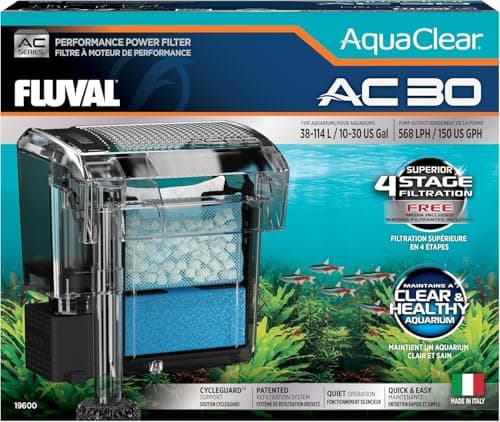 Fluval AquaClear 30 Power Filter 150 GPH, the lowest running cost of anything here, and the model this site recommends most often at this size. | Most 20 gallon first tanks | $49.99 on Amazon #ad How we’re funded · price as of September 25, 2026 |
| 2 | 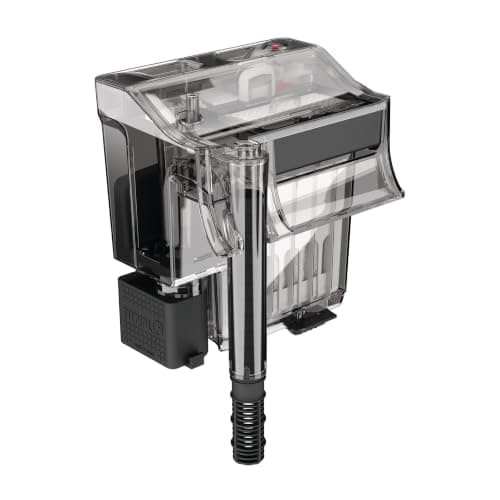 Fluval C2 Power Filter 119 GPH with five stages and a wet/dry trickle chamber — genuinely more filter than an AquaClear 20, at a genuinely higher price. | The buyer who wants the extra stages at 10 to 20 gallon scale | $57.89 on Amazon #ad How we’re funded · price as of September 25, 2026 |
| 3 | 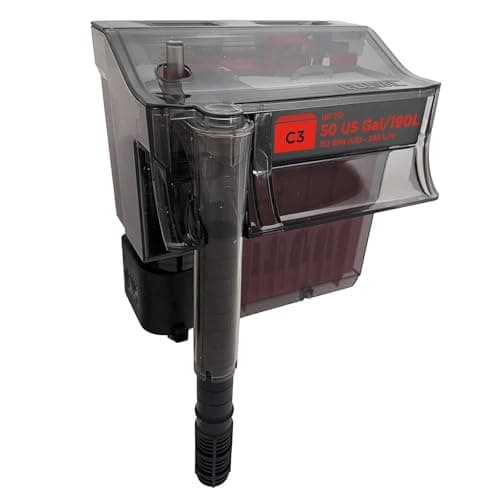 Fluval C3 Power Filter 153 GPH, effectively the same flow as an AquaClear 30, with two more filtration stages and a higher price. | A 20 gallon tank where you want the trickle chamber and a little more flow | $59.99 on Amazon #ad How we’re funded · price as of September 25, 2026 |
| 4 | 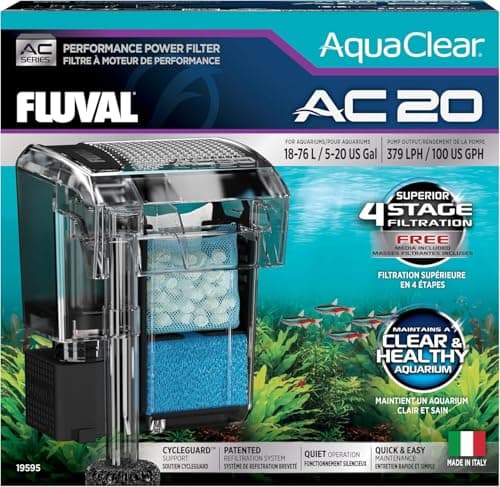 Fluval AquaClear 20 Power Filter 100 GPH at full output and a published 33 GPH with the flow control closed — the gentlest setting either line offers. | A 10 gallon tank, and for anyone who needs the flow turned right down | $41.99 on Amazon #ad How we’re funded · price as of September 25, 2026 |
| ! | 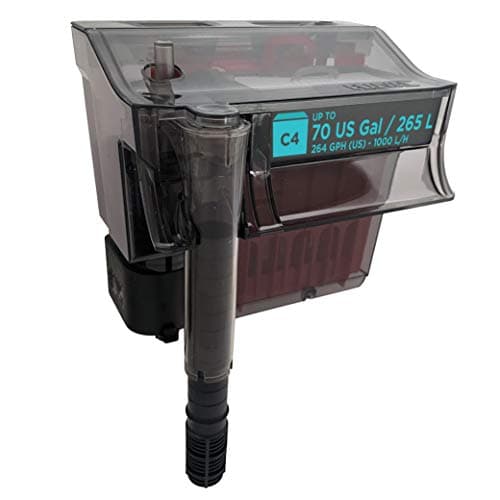 Fluval C4 Power Filter 264 GPH for aquariums up to 70 gallons — the right answer on a 30 gallon tank, and too much filter below that. Skip this one — see why below | Not a first tank | $54.37 on Amazon #ad How we’re funded · price as of September 25, 2026 |
Rows link to the full write-up further down this page. Prices come from the live price layer only; where there is no live figure the button reads “Check price” rather than showing a remembered number.
The published specifications, side by side
| AquaClear 20 | AquaClear 30 | Fluval C2 | Fluval C3 | |
|---|---|---|---|---|
| Rated output | 100 GPH | 150 GPH | 119 GPH | 153 GPH |
| Published minimum | 33 GPH | Not published | 62 GPH | 80 GPH |
| Stated tank range | 5-20 gal | 10-30 gal | Up to 30 gal | Up to 50 gal |
| Filtration stages | Three media types in one basket | Three media types in one basket | Five, incl. trickle chamber | Five, incl. trickle chamber |
| Cleaning indicator | No | No | Yes | Yes |
| Consumables | Foam, carbon, BIOMAX | Foam, carbon, BIOMAX | Foam pad, poly/foam pad, carbon, Bio-Screen | Foam pad, poly/foam pad, carbon, Bio-Screen |
AquaClear figures from Fluval's product pages and the spec sheet reproduced by Aquarium Connection; C Series figures from Fluval's C-series table as reproduced by AquaCave. All cited at the foot of this page.
Read that table and the shape of the decision appears. The C2 costs more than the AquaClear 30 and moves less water than it. The C3 costs more again and moves about the same water as the AquaClear 30. What the extra money buys is not flow — it is two more filtration stages, an indicator, and a trickle chamber.
The stated tank ranges are the loosest numbers on either box
Our method is on how we pick: a stocked community tank wants six turnovers an hour, and rated flow is measured with clean media and no head height, so you divide by 0.7 to get the rating you actually need to buy. Run every model here through it and the stated ranges stop agreeing with the hardware.
| Model | Rated GPH | Stated ceiling | 10 gal (needs 85) | 20 gal (needs 170) | 30 gal (needs 257) |
|---|---|---|---|---|---|
| AquaClear 20 | 100 | 20 gal | Yes, 18% margin | No — 41% short | No |
| Fluval C2 | 119 | 30 gal | Yes, 40% margin | No — 30% short | No — 54% short |
| AquaClear 30 | 150 | 30 gal | Yes | No — 12% short | No |
| Fluval C3 | 153 | 50 gal | Yes | No — 10% short | No |
| AquaClear 50 | 200 | 50 gal | Yes | Yes, 18% margin | No — 22% short |
| Fluval C4 | 264 | 70 gal | Yes | Yes | Yes |
Required figures computed with the site's method. Both lines overstate, and the C Series overstates by more: the C2's stated 30 gallon ceiling is about 46% of the flow that tank needs.
None of this makes the C Series a bad filter. It makes the label a bad way to buy one. The full method, with worked examples, is on how to size an aquarium filter.
What the fifth stage actually is
Fluval describes the C Series as two mechanical stages, one chemical and two biological. Stage one is a porous foam pad for large particles; stage two a denser poly and foam pad for fines; stage three activated carbon; stage four a Bio-Screen; stage five a biological trickle chamber with C-Nodes, which Fluval states creates an oxygen-enriched environment for the bacteria.
That last stage is the one worth understanding, because it is the same idea as the rotating wheel on the Marineland Penguin: media sitting in air rather than under water gets more oxygen, and the bacteria that convert ammonia and nitrite are aerobic. A trickle chamber is a genuine wet/dry stage, not a marketing stage.
The AquaClear's answer is different and also sound: a tall basket of BIOMAX ceramic sitting in the flow, fully submerged, with far more volume than a cartridge filter offers. Fluval's own claim for the platform is a filtration volume up to seven times larger than comparable filters. Submerged media has less oxygen available than a trickle chamber; it also has more surface area in the box. For a stocked community tank of 30 gallons or less, either is more biological capacity than the tank needs.
Turning the flow down
Both lines have adjustable flow, and for once there are published numbers to compare rather than adjectives. Fluval's spec sheet for the AquaClear 20 gives a maximum output of 100 GPH and a full flow control figure of 33 GPH. Fluval's C Series table gives a minimum of 62 GPH for the C2, 80 for the C3 and 159 for the C4.
So the smallest AquaClear turns down to roughly half of what the smallest C Series model can. If you are filtering a betta tank, a shrimp tank, or anything with long fins, that gap is the entire decision and it points away from the C Series — see the best filter for a betta for the shortlist built around it. If you are filtering a stocked community tank, the minimum figure is irrelevant, because you will be running it near maximum anyway.
One caution that applies to both: turning the flow down turns the biological filtration down with it. Less water through the media per hour means less ammonia presented to the bacteria. A filter running at a third of its rating on a fully stocked tank is not a filter for that tank, whatever the box says.
Which one, in one line each
- 10 gallon tank, ordinary community fish — AquaClear 20. It clears the arithmetic, it is the cheapest box here, and nothing about the C2 changes the outcome for that tank.
- 10 gallon tank with a betta or shrimp — AquaClear 20, turned down. The published 33 GPH is lower than any C Series minimum.
- 20 gallon tank, ordinary community fish — AquaClear 30, with a sponge filter if it is fully stocked. The C3 matches it on flow and costs more.
- 20 gallon tank, heavy feeders or a lot of debris — Fluval C3. Two mechanical stages in series is a real advantage on a messy tank.
- You want the filter to tell you when to clean it — either C Series model. The cleaning indicator is the feature beginners most often say they wanted.
- 30 gallon tank — Fluval C4, per the best filter for a 30 gallon tank. It is the only model on this page that clears the figure.
Whichever you buy, both arrive sterile. A new filter contains no bacteria at all and converts no ammonia until you cycle the tank, and the AquaClear platform in isolation is covered in full on the AquaClear Power Filter review.
Questions people actually ask
Frequently asked questions
+ Are AquaClear and Fluval the same brand?
+ Is the Fluval C Series better than an AquaClear?
+ Which is better for a 20 gallon tank, the AquaClear 30 or the Fluval C3?
+ Can a Fluval C2 really filter a 30 gallon tank?
+ Which one is quieter?
+ Do I need the Bio-Screen if I buy a C Series filter?
+ Will an AquaClear work for a betta?
Where the numbers came from
Sources
- Fluval C2 Power Filter, AquaCave listing reproducing Fluval's C-Series specification table and five-stage description (119 max / 62 min GPH, up to 30 US gal)
- Fluval C3 Power Filter, AquaCave listing reproducing Fluval's C-Series specification table (153 max / 80 min GPH, up to 50 US gal, trickle chamber and cleaning indicator)
- Fluval, AquaClear 20 Power Filter — published output, tank range and media
- AquaClear 20 with media, Aquarium Connection listing reproducing Fluval's spec sheet (100 GPH max, 33 GPH full flow control, 6 W, media list, refiltration and CycleGuard claims)
- Fluval, AquaClear 30 Power Filter — published output, tank range and power draw
- AquaClear 50 Power Filter, Fluval USA product page (757 L/h / 200 US GPH, 20-50 US gal, 5 W)
- Fluval C4 Power Filter up to 70 US Gal, Fluval USA product page (264 GPH, 40-70 gal, five-stage)
- Aquifarm, aquarium filter flow rate guidance (turnover multiples)
Read next
Related on Fin & Filter
AquaClear Power Filter review
The media basket, the flow control range Fluval actually publishes, and the buyer who should pick a cartridge filter instead.
The best filter for a 30 gallon tank
The 257 GPH figure a stocked 30 gallon needs, which filters clear it, and the tank-size label that misleads worst.

How to size an aquarium filter
Tank gallons times turnover, divided by 0.7. The formula, worked examples, and the table for every common size.